


Drying Flowers
A Complete Masterclass
The definitive UK guide to growing and drying your own everlasting flowers. Which varieties dry beautifully, the exact moment to cut each one, how to prepare the perfect bunch, where to hang it, and how to know when it's ready. Ten years of Norfolk drying-barn practice, distilled.
Drying flowers is one of the great quiet magic tricks of the cottage garden. A bunch of Statice cut at the right moment, hung in the right place, for the right length of time — becomes, without any further intervention, an arrangement that will last for years rather than days. A handful of Honesty seed pods, patiently harvested and stripped of their outer layers, gives you the silvery translucent "moons" that no fresh flower can rival. A few stems of Quaking Grass, cut and dried in a fortnight, provides architectural movement for wreaths, bouquets and displays that stay beautiful for a decade.
The trick is not difficult. But every step matters — the variety you choose, the day you cut, the way you tie the bunch, the room you hang it in, the number of weeks you leave it — each has an outsized effect on the finished result. Get all of them right and you have flowers indistinguishable from professionally dried commercial stock, at a fraction of the price and with the enormous satisfaction of having grown them yourself. Get any of them wrong and you have mouldy, faded, or shattered flowers in the compost heap. This is our complete UK masterclass, drawn from years of drying our own cutting field at Salle Moor Hall Farm — everything we know about doing it properly.
Drying at a Glance
Cut Time of Day
Morning, after dew
Cut Stage
Buds half-open
Bunch Size
5–10 stems
Fasten With
Elastic band
Hang Position
Upside down
Drying Time
1–4 weeks
The Case for Growing Your Own Dried Flowers
The dried flower market has exploded in the last decade — walk into any homeware shop or florist and you'll now find shelves of dried bunches, wreaths and bouquets, often at eye-watering prices. A hand-tied bouquet of dried flowers can easily run to sixty or seventy pounds. A single stem of dried Bunny Tail Grass, five pounds. A bunch of Statice, twelve. Multiply that across a wreath project, a wedding, a season's home displays, and the cost adds up remarkably quickly.
Yet virtually every flower on those shelves can be grown at home from a packet of seed for a few pounds. Statice, Helichrysum, Honesty, Larkspur, Quaking Grass, Billy Buttons, Nigella, Achillea, Gomphrena, Scabious — the entire everlasting canon is comfortably at the reach of any UK gardener with a sunny patch, a garden shed or attic, and a summer's worth of patience. A single packet of Statice seed produces enough plants to fill a wreath, a mantelpiece display, and a supply of bunches for the whole autumn — for the price of a single bunch bought in.
Alongside the cost saving comes something more meaningful: you can grow varieties commercial dried flower suppliers simply don't stock. Rare heritage Achilleas, the astonishing "jester's hat" seed pods of Spanish Nigella (Nigella hispanica), unusual grasses, unusual colour forms — all available to the home grower, none of them commercially available as dried stems. And every one of them is grown with your own hands, dried in your own barn or attic, and destined for your own home. There is a satisfaction in this that no shop-bought bunch can offer.
The Success Rate is Higher Than People Think
The reputation of drying flowers as "difficult" or "hit-and-miss" is misleading — it comes from people trying to dry the wrong varieties. Choose the right species (the varieties in this guide are all straightforward), cut at the right moment, and hang in the right conditions, and success rates are essentially 100% for the common everlastings. Roses and hydrangeas are trickier; the varieties we recommend below are not.
When to Cut — The Critical Timing Decision
The single most common mistake in drying flowers is cutting too late. Almost every everlasting variety should be cut before it looks fully finished on the plant — because as it dries, it continues to open, and a flower that is already fully open when cut will often become blown out, brown at the edges, or turn inside out entirely. The rule of thumb across every variety in this guide: cut when the flower or seed head has reached about two-thirds of its final size or opening.
The exact moment varies by flower type. Here is the specific timing for the six main categories of dried flower:
Papery Everlastings — Statice, Helichrysum, Acroclinium, Xeranthemum
The classic drying flowers. Cut when buds are half-open — the outer ring of petals starting to unfurl, the centre still tight. They will continue to open through the drying process and finish looking exactly like a mature bloom. Statice is slightly more forgiving than Helichrysum here — Helichrysum flowers that are fully open when cut often turn inside out and lose their perfect ball shape.
Tall Spikes — Larkspur, Delphinium, Salvia, Clary Sage
Cut when two-thirds of the flowers on the spike are open, with the tip still in tight bud. The unopened tip flowers will finish opening as the spike dries, and the fully-open lower flowers hold their shape. Cut too late — when the whole spike is fully open — and the lower flowers often shed as they dry.
Grasses — Quaking Grass, Bunny Tails, Bromus, Panicum
Cut once the seed heads have fully formed, but before they start to shed. For most grasses this is when they've just changed colour from bright green to a slightly softer tone — a matter of days. Late cutting means seeds shatter during drying and you're left with bare stems. Early cutting means grasses that shrink to nothing as they dry.
Seed Heads — Nigella, Poppy, Scabious 'Drumstick', Honesty
The trick with seed pods is to cut once the pods are fully formed and coloured, but before they open to release the seed. Nigella pods should be fat, striped and firm; poppy heads should have hardened and turned tan; Scabious 'Drumstick' should have gone from flower to that unmistakable papery spherical head. Honesty is unique — cut when the outer seed pods have turned brown and papery, then patiently peel back the outer layers by hand to reveal the silvery inner moons.
Golden Orbs — Billy Buttons (Craspedia), Gomphrena
Cut when flowers are fully coloured and firm to the touch. Both Billy Buttons and Gomphrena have a hardness at maturity that tells you they're ready — the flowers feel almost woody rather than soft, and the colour is at its most intense.
Umbels — Ammi, Wild Carrot, Fennel Seed Heads, Bupleurum
Cut when the tiny florets have just finished flowering, before they set into seed. If left too long, umbels shatter dramatically during drying and you're left with a mess of tiny seeds. Cut too early and the umbel is soft and won't hold its architectural shape.
The Right Day, The Right Time
Whatever variety you're cutting: morning is best, after the dew has dried — usually mid-morning in summer. Not too early (still wet, invites mould) and not too hot (flowers wilted and stressed). Choose a dry day rather than a damp one, and never cut after rain — even flowers that look dry on the surface can carry enough moisture to cause mould during drying. If a heatwave is on the way, cut ahead of it rather than during it. Use sharp, clean secateurs, and cut the longest stem you can — you can always shorten later, you cannot lengthen.
How to Prepare Your Bunches
A well-prepared bunch dries evenly, holds its shape, and stays tight around the stems as they shrink through the drying process. A badly prepared bunch develops mould at the centre, drops flowers as it dries, or loosens and slides apart on the drying hook. The whole difference is a few minutes of preparation.
-
Strip the leaves from the lower two-thirds of every stem. Leaves hold onto moisture, dry unevenly, and are the main cause of mould in drying bunches. Strip them off completely — you're keeping the flowers, not the foliage. The exception is a few grey-leaved plants (Achillea, some Salvias) whose foliage does dry attractively; those can stay if you want.
-
Group stems into small bunches of 5 to 10. Small bunches dry faster and more evenly than large ones. A big fat bunch of thirty stems will develop mould at its dense centre while the outer stems are already crispy dry. Keep bunches airy — you should be able to see through the middle of the bunch when you look at it end-on.
-
Match stem lengths within a bunch. All the flower heads should sit at roughly the same level. This is partly aesthetic (matched bunches look better hanging) but also practical — mismatched bunches dry unevenly, with heads at different levels drying at different rates.
-
Bind the base of the bunch with an ELASTIC BAND — not string. This is the single most important technical detail in the whole process. As stems dry they shrink significantly in diameter. An elastic band contracts with them and stays tight; a string tie becomes loose and the bunch falls apart within days. Small rubber bands are perfect. If you must use twine, use it wet and tight — it will shrink as it dries alongside the stems.
-
Hang each bunch from a paperclip, S-hook or bent wire loop. The elastic band goes around the stems; the paperclip hooks around the elastic band and onto a horizontal line, wire, or clothes airer. This lets you space bunches evenly along a line — critical for airflow — and lets you check individual bunches without disturbing the whole batch.
The One-Bunch-Per-Elastic Rule
One bunch, one elastic band, one hook. Don't try to bind multiple bunches together into one bundle — it looks tidy but it kills airflow and causes mould. Space bunches at least 10cm apart on the drying line to let air circulate freely around each one. A dozen small bunches, well-spaced, will dry perfectly. A big compact cluster of the same total stems will disappoint you.
Where to Hang — The Ideal Environment
The room you hang your flowers in is as important as the day you cut them. Four conditions matter — get all four right and your flowers dry beautifully; get any of them wrong and results suffer. These are the four non-negotiables:
Dark
Sunlight bleaches the colour out of drying flowers within days. A dried Larkspur that started deep royal blue can fade to washed-out lilac in a fortnight of direct sun. Curtains drawn, dark room, or better yet, a windowless attic or shed.
Dry
Humidity is the mould-maker. Aim for below 50% relative humidity — a dehumidifier helps in a damp UK autumn. Bathrooms, cellars, kitchens (steam!) and greenhouses (condensation) are all bad choices.
Ventilated
Moving air is the secret weapon. A slight breeze through a room dramatically speeds drying and prevents mould. Not a stuffy airing cupboard — a well-aired room with a window cracked open, or better yet, a small fan gently moving air.
Warm (but not hot)
15–25°C is ideal. Too cold and drying takes forever; too hot (over 30°C) and flowers dry so fast they become brittle and shed petals. A warm dark loft in summer is essentially perfect.
The Best Places (and the Worst)
The single best location in most UK houses is a loft or attic — usually dark, generally dry, often warm in summer, and with enough ventilation from the roof structure to prevent mould. Second best is a spare bedroom or study with curtains drawn. A well-ventilated garden shed or barn works beautifully if you have one, and is what we use here at the farm. An airing cupboard can work if it has ventilation, but many are too enclosed and cause mould.
Places to avoid: the kitchen (steam and cooking humidity), the bathroom (obvious), a cellar or basement (usually too damp and too cold), a greenhouse (too much light, too much condensation) and any room with an open fire or wood burner (both bake and dry unevenly, and produce smoke residues that can discolour flowers).
Hang Upside Down — Almost Always
The overwhelming majority of dried flowers are hung upside down. Hanging inverted keeps stems straight as they dry (rather than drooping into a curve under the weight of the flower head), preserves the shape of the flower head, and keeps colour concentrated in the flower rather than draining down the stem. Only a very small number of grasses and seed heads are dried right-way-up — most notably some large seed head arrangements where inversion would cause seeds to fall out. If in doubt, hang upside down.
A Note on Silica Gel
You may have read about using silica gel or borax to dry flowers — burying them in the desiccant for a few days. This is a real technique but it's for a completely different job: preserving a specific fresh flower (an intact rose, an orchid, a delicate wedding bloom) in three-dimensional form. It's fiddly, expensive and only worth doing for a specific memento. For everyday everlastings and dried bunches, air-drying is genuinely superior, cheaper, and used by every professional dried-flower grower we know.
How Long They Take — and Knowing When They're Ready
Drying times vary substantially by variety, stem thickness and conditions. In a warm, dry, well-ventilated attic in July, most everlastings take between one and three weeks; in a cooler autumn spare bedroom, expect two to four weeks. Rather than watching the clock, learn to read the flowers themselves.
Typical Drying Times
As a rough guide: Statice and thin-stemmed grasses like Quaking Grass — 1 to 2 weeks. Helichrysum, Larkspur, Billy Buttons, Achillea — 2 to 3 weeks. Honesty seed pods — 3 to 4 weeks (plus the time to peel the outer layers). Roses, Hydrangeas and thick-stemmed umbellifers — 3 to 4 weeks. In colder or damper conditions, add another week to each.
The Four Signs They're Ready
-
Stems snap crisply rather than bending. Take one stem from a bunch and try to bend it gently — a fully dry stem breaks with an audible snap; a stem that still contains moisture will bend rather than snap. This is the single most reliable test.
-
Flower heads feel papery, not soft or fleshy. Rub a petal gently between finger and thumb. A dry petal feels papery, slightly rustling, sometimes brittle. A petal that still contains moisture feels soft, silky, or leathery.
-
The base of the flower head is fully coloured, with no green or soft patch. Look at where the petals meet the stem — this is the last place to dry because it's the thickest, most moisture-holding point. If it's still green or feels squishy, the flower needs another few days.
-
The colour has slightly deepened or aged. Most dried flowers develop a slightly deeper, more antique version of their fresh colour as they dry — reds become more burgundy, blues become more muted, pinks become more dusky. This is normal and part of the charm.
Store Once Dry
Once fully dry, take bunches down and store somewhere dark, dry, and dust-free — a lidded storage box, an old suitcase, a paper-lined drawer. Don't leave hanging in a bright room long-term because sunlight continues to bleach the colour out even after drying. For arrangements on display in the home, keep them out of direct sunlight and away from humid rooms; dust gently with a hairdryer on cool setting every couple of months. Well-stored dried flowers last for years — a decade is not unusual.
The Six Best Varieties to Start With
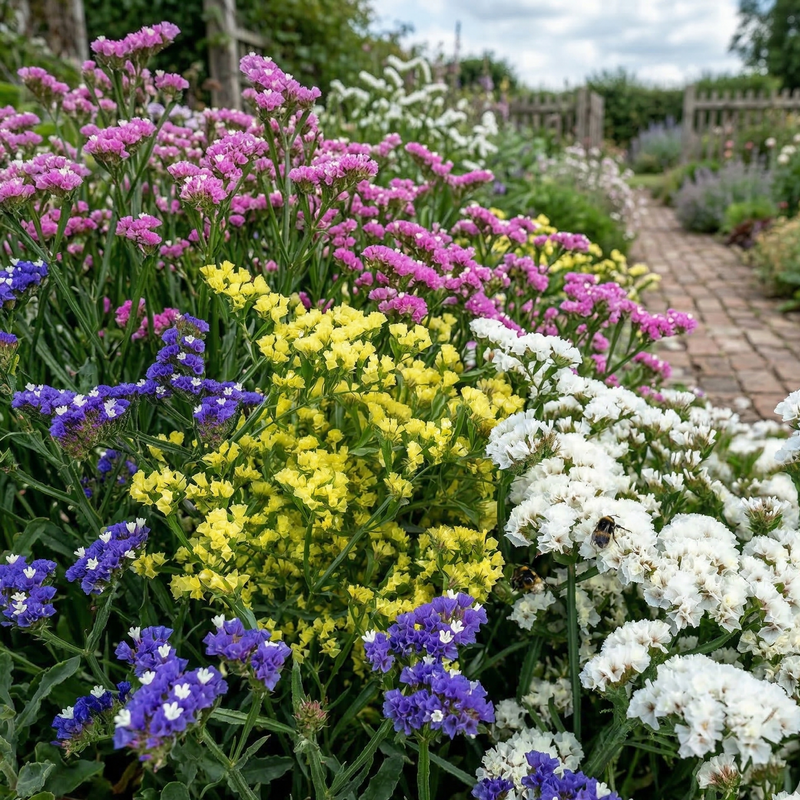
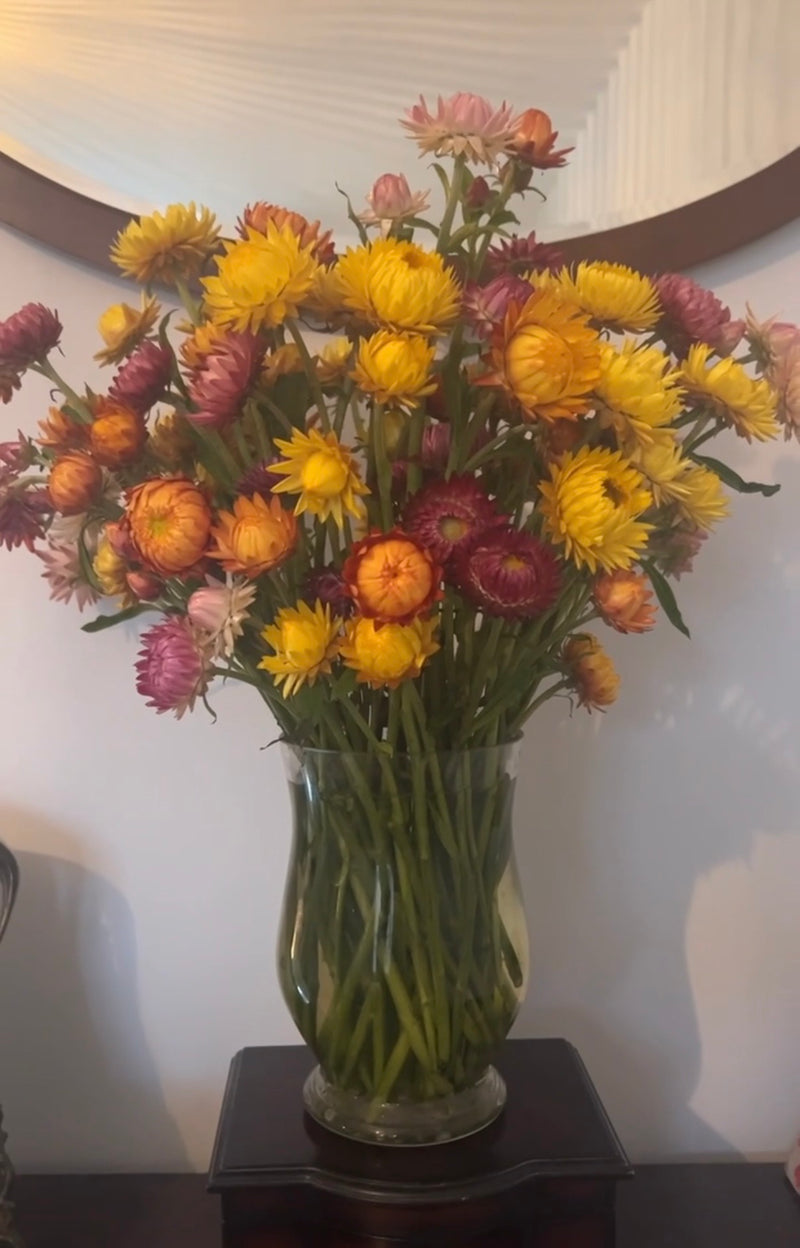
If you're growing your own dried flowers for the first time, these are the six we would put in front of you before anything else. Each one is beginner-friendly, dries almost effortlessly, and gives you a fundamentally different kind of dried material — meaning that these six alone give you enough variety of colour, form and texture to build any wreath, bouquet or arrangement you want. Each has its own dedicated growing guide on our site, linked from each card, and all six are included in our Flowers Perfect for Drying seed box (featured in the next section). And if you'd rather buy them ready-dried while your first crop establishes, our farm-grown dried range is featured further down.


Every Variety Has Its Own Growing Guide
Every one of the six varieties above has a full dedicated growing guide on the blog — Statice, Helichrysum, Larkspur, Honesty, Quaking Grass and Billy Buttons. And beyond these six, our full drying range also has growing guides for Echinops, Scabious 'Drumstick', Gomphrena, Achillea and the Spanish Nigella (hispanica). Every one is a candidate for the drying barn.
The Complete Kit — Flowers Perfect for Drying
Rather than buying ten separate seed packets, our Flowers Perfect for Drying seed box puts the complete drying-flower cottage garden into a single beautifully packaged collection — the same ten varieties professional dried-flower growers use, chosen to work together across the season, and priced substantially below the sum of the individual packets.
The Ten Varieties, One Box
Flowers Perfect for Drying
Ten full-size seed packets of the most reliable, most beautiful everlasting flowers — Statice, Helichrysum, Honesty, Billy Buttons, Quaking Grass, Achillea, Gomphrena, Echinops, Scabious 'Paper Moon' and the Spanish Nigella. Each variety chosen for reliable performance, complementary flowering times, and superb drying quality. Sow across spring, cut across summer, dry through autumn — an everlasting cottage garden in a single box.
£23.50 Ten Full-Size Packets · Compostable Packaging
Shop the Seed Box →What's Inside
- Statice
- Helichrysum (Strawflower)
- Honesty (Lunaria)
- Billy Buttons (Craspedia)
- Quaking Grass (Briza)
- Achillea
- Gomphrena
- Echinops Ritro
- Scabious 'Drumstick'
- Nigella hispanica
For gardeners already committed to a serious drying-flower project, we also offer an Extra Large box (eighteen packets), which adds Bunny Tails, additional grasses, umbellifers and specialist textural varieties for wreath-makers and florists building substantial harvests. Both boxes come in the same eco-friendly compostable packaging as our standard seed packets, and both include a folded printed guide with sowing calendars and drying notes for each variety.
Why the Seed Box is the Best Value Route In
Ten individual seed packets bought separately from our range would cost noticeably more than the boxed price, and involve ten separate decisions and orders. The box removes all of that — one purchase, a complete curated everlasting cottage garden's worth of seed, and an instant flying start on the drying-flower year. For a first-time drying gardener, we would recommend this route ahead of individual packets almost every time.
Or Buy Ready-Dried
We don't just write about drying flowers — we grow, cut and dry an extensive range of everlastings at Salle Moor Hall Farm each year, and sell them as finished stems throughout the autumn and winter. If you're not ready to commit to a full growing season this year, or you want to build up an arrangement while your seeds are still establishing, or you simply want to try a variety before deciding whether to grow it yourself — our dried flower shop has you covered. Every stem cut, dried and packed by hand here on the Norfolk cutting field. Never bleached, never dyed, never imported.
A snapshot of what's currently listed and shipping — with plenty more arriving through the coming weeks as this year's harvest finishes drying in the barn.


More Coming From the Drying Barn
Alongside the six listed above, more varieties are being added over the coming weeks as this year's harvest finishes drying and is packed by hand — including Statice bunches, Larkspur bunches, Umbellifers, poppy seed heads and more of the everlastings featured in this guide. Follow the Dried Flowers collection or reply to any of our emails to be notified when fresh stock lands. Our Hand-Tied Dried Bouquets — hand-tied arrangements of the season's best, curated by us — are also back in stock.
Quick Drying Reference
For when you just need the bullet points — every variety in this guide, when to cut it, how long it takes to dry, and the single most important tip for each.
| Variety | Cut When | Drying Time | Key Tip |
|---|---|---|---|
| Statice | Buds half-open, colour showing | 1–2 weeks | Strip all leaves before hanging |
| Helichrysum | Buds half-open, before fully open | 2–3 weeks | Fully-open blooms turn inside out |
| Larkspur | Two-thirds of spike open | 2–3 weeks | Cut in the morning, dry in the dark |
| Honesty (Lunaria) | Outer pods turned brown | 3–4 weeks | Peel back outer layers by hand |
| Quaking Grass (Briza) | Seed heads fully formed, still green | 1–2 weeks | Cut early — late-cut heads shatter |
| Billy Buttons (Craspedia) | Golden orbs fully coloured, firm | 2–3 weeks | Colour intensifies as it dries |
| Achillea | Flat plates fully open, colour deep | 2 weeks | Group in small bunches for airflow |
| Echinops | Balls fully formed, still blue | 2–3 weeks | Cut before spikes go over to seed |
| Gomphrena | Fully coloured, firm to touch | 2 weeks | Cut long stems for arrangement work |
| Scabious 'Drumstick' | Papery spheres fully formed | 1–2 weeks | Handle gently — spheres are fragile |
| Nigella hispanica | Seed pods fat, striped and firm | 1–2 weeks | Cut before pods split and shed seed |
| Bunny Tails | Heads formed but still soft | 1–2 weeks | Cut early for perfect fluffy shape |
| Poppy heads | Pods hard, turned tan | 3–4 weeks | Empty the seeds first or leave rattling |
| Umbellifers | Florets just finished flowering | 2 weeks | Cut early to prevent shattering |
The Bottom Line
If you take only three things from this masterclass, take these: cut in the morning when flowers are half-open, tie bunches of 5-10 stems with an elastic band, and hang upside down in a dark, dry, well-ventilated place for two to three weeks. Do those three things correctly across the varieties in this guide and you will produce dried flowers indistinguishable from professionally-grown commercial stock, at a fraction of the price, and with the enormous satisfaction of having grown them yourself.
Further Reading — Books We've Learned From
Everything in this guide has come from a decade of growing and drying at Salle Moor Hall Farm — but no gardener grows in isolation, and a great deal of what we know we've learned from the excellent published UK writing on dried flowers. These four books are the ones we return to most often. Every one is worth its place on a serious dried-flower gardener's shelf, and every one has shaped how we think about our own harvest.
Everlastings
Hardie Grant · 2020
The single most influential modern UK book on drying flowers, and the reference point for the current wave of British dried-flower gardening. Bex Partridge's Devon flower farm at Botanical Tales inspired a generation of growers, and this book is genuinely where a lot of us started. Approachable, beautifully photographed, packed with practical technique.
Flowers Forever
Hardie Grant · 2022
Bex Partridge's follow-up to Everlastings, focused on pressing and preserving flowers for a wide range of creative projects — from botanical art to home décor to gift-making. Same beautiful design values and clear instruction as the first book, expanding the toolkit for anyone serious about preserving their garden.
Wreaths
Frances Lincoln · 2018
Full title Wreaths: Fresh, Foraged & Dried Floral Arrangements. Written by the founders of Worm London, this is the definitive UK wreath-making book — heavy on dried and foraged material, packed with technical detail that transfers straight into home practice. Essential for anyone using their dried harvest for wreaths and seasonal displays.
Vintage Flowers
Kyle Books · 2011
Written by the florist behind Scarlet & Violet in London, this is the classic UK book on romantic, vintage-style flower arrangement — with substantial coverage of dried and preserved flowers, jam-jar posies and the softly-aged natural aesthetic that suits our cottage-garden approach beautifully. Still in print, still exquisite, still endlessly inspiring for anyone using their dried harvest to arrange for the home.
A Note on Where to Buy Books
Every one of the books above is widely available. Where you buy them matters — we'd recommend independent bookshops via Bookshop.org UK (which supports independent booksellers), your local high-street bookshop, or direct from each publisher. All four titles are also stocked by the usual online retailers if you prefer.
The most satisfying gardening technique there is — grow flowers once, enjoy them for years.
Whether you're starting with a single packet of Statice or committing to a serious dried-flower cutting patch, our Norfolk-grown everlasting seed range and dedicated Flowers Perfect for Drying seed boxes have you covered. Every variety chosen by growers who dry their own harvests here at Salle Moor Hall Farm — proven in real UK conditions, backed by full growing guides, and delivered in compostable packaging.
Shop the Drying Seed Box →
0 comments