


Floriography
The Language of Flowers
The forgotten Victorian art of saying without speaking — a complete introduction to the language of flowers. Where it came from, why it flourished, how it worked, and how you can grow a garden that speaks its beautiful, silent, romantic vocabulary today.
In the 1830s, a young Englishwoman receiving a small hand-tied bouquet from an admirer did not simply see flowers. She saw a message. A red rose meant love. A yellow rose meant jealousy. A sprig of rosemary was for remembrance. A pansy was a "thought" — the word coming from the French pensée, meaning both the flower and the act of thinking. A lily of the valley meant "the return of happiness." A hyacinth, "constancy of love." And when the flowers had been read — and their meanings understood — she knew exactly what her admirer meant to say, without a single spoken word.
This was Floriography, the Victorian language of flowers — a codified system of romantic and emotional communication that flourished throughout the nineteenth century, particularly in Britain, France and America, and which allowed lovers, friends, mourners and admirers to send elaborate messages through the medium of small carefully-chosen bouquets. It was serious, it was fashionable, it was published in dozens of dictionaries, and it played a genuine role in the courtships, apologies, farewells and consolations of an entire generation. Today it survives in fragments — a rose still means love, forget-me-nots still mean what their name suggests — but the full vocabulary is largely forgotten. This little guide restores it.
Floriography at a Glance
Also Known As
The Language of Flowers
Peak Era
Victorian Britain, 1830–1900
Origin
Ottoman Constantinople
Main Vehicle
The tussie-mussie bouquet
Classic Reference
Kate Greenaway, 1884
Best Known Today
Rose · Forget-me-not · Rosemary
What is Floriography?
Floriography is the practice of communicating specific emotions, sentiments and messages through the giving of specific flowers — a symbolic language where every bloom has a codified meaning, and where a carefully chosen bouquet becomes, in effect, a small silent letter. The word itself is a nineteenth-century coinage from the Latin flos (flower) and the Greek -graphia (writing) — literally "flower-writing," and an appropriately elegant name for what was in every meaningful sense a written language expressed in petals rather than ink.
At its height in mid-Victorian Britain, floriography was a serious and widely-known cultural practice. Flower dictionaries were bestsellers. Newly engaged couples exchanged bouquets that spelled out the terms of their affection. Fathers included specific flowers at their daughters' weddings. Widows in mourning sent flowers of remembrance to friends. Ladies at balls carried tussie-mussies that broadcast their availability, their engagement, or their carefully-coded disinterest to the young men circling the room. To the modern reader it sounds like a game, or a piece of literary whimsy — but for the Victorian recipient it was an entirely real communication system, and the mistake of misreading it could be socially serious.
The system was extensive. The Vocabulaire Symbolique de Fleurs, one of the earliest published flower dictionaries, listed several hundred flowers with meanings. Kate Greenaway's 1884 Language of Flowers — still the most famous English source, still in print — codified around three hundred and eighty flowers, with meanings ranging from the tender ("Snowdrop: Hope") to the melancholy ("Cypress: Mourning") to the strikingly rude ("Yellow Carnation: Disdain"). Meaning also varied by colour, by quantity, and by presentation. A single flower said one thing; a bouquet said another; a bouquet held upside-down inverted the meaning entirely.
A Language, Not Just a Symbolism
What distinguished floriography from simple flower symbolism (which appears in every culture across all of history) was its codification and communicative intent. It was a system with grammar rules, dictionaries, response protocols, and cultural conventions. People genuinely used it to communicate. And that separated floriography from the wider tradition of flower symbolism the way a written alphabet is separated from a cave painting: same medium, quite different function.
Where It Came From
The origin story of floriography is delightful, entirely historically documented, and takes us not to Victorian London — where it flourished — but to Ottoman Constantinople a full century earlier, and to a remarkable English aristocrat called Lady Mary Wortley Montagu.
The Ottoman Roots — the "Selam"
In 1717, Lady Mary Wortley Montagu — the wife of the British Ambassador to the Ottoman Empire — was living in Constantinople and writing detailed letters home to her friends in England. Fascinated by everything about Ottoman court culture, she described a practice among the women of the sultan's harem called the selam: a kind of poetic game in which small objects were sent to lovers, each object rhyming (in Turkish) with a line of well-known verse, and thereby communicating an entire message through what appeared to be a small parcel of trinkets. A pearl might be sent because "pearl" rhymed with a phrase meaning "your beauty pierces me." A pear because it rhymed with "give me hope." Flowers were part of this vocabulary, alongside objects and stones.
Lady Montagu's letters describing this practice were widely circulated in London and Paris, and later published — and the idea of communicating in flowers captured the European imagination almost instantly. The Ottoman selam was, technically, quite different from what floriography would become: it was based on Turkish rhymes rather than symbolic meanings, and it used many objects besides flowers. But the idea — that a bouquet could be a letter — was the seed from which the whole nineteenth-century tradition grew.
The French Codification — Charlotte de Latour, 1819
The first proper floriography dictionary was Le Langage des Fleurs by "Charlotte de Latour" (a pseudonym, probably for Louise Cortambert, the wife of a French geographer), published in Paris in 1819. It codified the meanings of around three hundred flowers into a dictionary format, added rules of grammar (how to combine flowers, how to indicate response), and turned floriography from a fashionable idea into a workable communication system. It sold prodigiously, was translated into English within a year, and was the direct ancestor of every English-language floriography book that followed.
The English Explosion — Kate Greenaway, 1884
Between 1820 and 1900, dozens of English floriography dictionaries were published — Flora's Interpreter (1832), The Language of Flowers by Frederic Shoberl (1834), Flora Symbolica by John Ingram (1869), and many more — each slightly different, each authoritative to its readers, and collectively driving the practice to its peak popularity. But the book that survived beyond its era, the one that still sits on cottage-garden bookshelves today, was Kate Greenaway's exquisitely-illustrated 1884 Language of Flowers. Greenaway was already famous as a children's illustrator, and her small pocket-sized book — with its charming watercolour vignettes and its beautifully clear dictionary of meanings — is the classic English source. It has never been out of print since.
A Historical Note on the Meanings
An important honest caveat: the meanings assigned to specific flowers varied significantly between dictionaries. Charlotte de Latour and Kate Greenaway sometimes disagreed. British and French sources disagreed. Between 1820 and 1900 the "correct" meaning of many flowers drifted — and the modern gardener wanting to consult "the" meaning will find that there is no single universally-agreed answer for some varieties. In this little guide we use the mainstream Victorian British meanings drawn primarily from Kate Greenaway, cross-referenced with the wider English-language sources. Where different traditions offer meaningfully different meanings, we note it.
Why the Victorians Used It
Victorian society was — famously — deeply codified, socially restrictive, and highly conscious of manners, propriety, and the boundaries of what could and could not be said aloud. Romantic feelings could not be declared openly by an unmarried woman. Attraction between unmarried people had to be expressed only within the strictest social rules of introduction, chaperonage and family approval. Grief had to be observed with elaborate periods of mourning and appropriately-coded dress. And a young lady could not, in most social contexts, say to a young man, "I like you very much and I hope you will call again."
Floriography offered a way around all of this. A young lady could send a small hand-tied bouquet — a "tussie-mussie" — to a gentleman, and the bouquet, being a proper polite gift, was socially unimpeachable. But if the bouquet happened to contain a red rose and a sprig of forget-me-not, and the young man happened to know his floriography, then a great deal had been said without a single word crossing anyone's lips. The medium was flowers; the message was courtship; and the plausibly-deniable coding gave everyone involved a way to communicate without violating the elaborate social conventions that surrounded them.
Who Used Floriography
Young unmarried women in courtship were the largest users — floriography gave them a rare tool for expressing preference and interest in an age that otherwise denied them the ability to. Suitors and admirers used it in response, sending increasingly specific bouquets as courtships progressed. Mourners used it to send flowers of remembrance, sympathy and comfort to the bereaved. Rejected lovers used it to send messages of dignified farewell (or, occasionally, cutting responses of contempt — the yellow carnation for disdain, the marigold for grief and cruelty). Family members used it to acknowledge weddings, births, milestones and sorrows in a language considered more delicate than direct speech.
Why It Worked
Three practical factors made floriography workable as a genuine communication system. First, flowers were widely available — even a small suburban garden or a shop in a market town could supply a bouquet. Second, the vocabulary was widely published and knowable — a young lady with access to a Kate Greenaway dictionary could compose a bouquet, and any young man with access to the same source could read it. And third, flowers carried plausible deniability — a bouquet was always, at surface level, simply a polite gift, meaning that even if the message failed to land, no social boundary had been visibly crossed. This last point was crucial, and the reason the practice thrived: floriography offered communication with a safety net.
A Word on the Wider Culture
Floriography was not the only such coded language of the Victorian era. There was also the "language of fans" (in which the position and movement of a hand-fan communicated readiness to dance, interest, rejection or engagement). There was the language of stamps on envelopes (the tilt and position of a postage stamp carried private codes). And there was a whole underground vocabulary of glances, gloves, handkerchiefs and calling-cards. Victorians simply lived, to a degree we can barely imagine today, in a world where a great deal of communication was necessarily indirect — and floriography was one of its most poetic and enduring expressions.
How It Worked
Floriography was more elaborate than simply picking a rose to mean "love." A full bouquet — a tussie-mussie — was composed with attention to the meanings of every flower, the combinations, the order of arrangement, the number of blooms, the colour of each variety, and the way it was presented. These were the rules a serious Victorian floriographer would follow.
-
Each flower had a specific meaning drawn from the dictionary. Rose (love), Rosemary (remembrance), Forget-me-not (true love, memory), Zinnia (thoughts of absent friends), Sweet Pea (delicate pleasures / farewell). A bouquet composed of a rose, a rosemary sprig and a forget-me-not might say: "My love; remember me; do not forget."
-
Colour modified meaning. A red rose meant love; a yellow rose meant jealousy or infidelity; a white rose meant "I am worthy of you"; a pink rose meant grace and gentleness. Choosing the wrong colour could reverse the whole message. A carnation was similarly split: red for admiration, white for pure and ardent love, yellow for disdain, striped for refusal.
-
Numbers mattered. A single flower expressed the meaning at its simplest. A bunch amplified it. A large bouquet composed of a single variety was a strong single-word declaration; a mixed bouquet was a sentence.
-
Presentation could invert meaning. A bouquet presented right-way-up carried its normal meaning. A bouquet presented upside-down inverted every meaning — "no love" instead of "love," "disinterest" instead of "engagement." This was one of the more elegant rules of the system, and it allowed a gentle way of communicating rejection or refusal without needing to explicitly convey a hurtful message.
-
Response was signalled through the same medium. The response protocols were codified as well. Touching the flowers to the lips signalled acceptance. Touching the flowers to the heart signalled love in return. Returning the bouquet, or accepting it with the left hand, indicated rejection. Even the manner of holding the tussie-mussie mattered.
The Tussie-Mussie
The physical vehicle of the message was the tussie-mussie — also called a "nosegay" or a "posy" — a small circular hand-tied bouquet, usually only a few centimetres across, arranged with the primary "message" flower at the centre, then a ring of complementary meanings around it, and often finished with a collar of herb foliage. Rosemary, mint or lavender were traditional collar foliage, both for their fragrance and for their own symbolic meanings (rosemary for remembrance, lavender for devotion, mint for warmth of feeling). The whole was tied with a ribbon or lace collar, sometimes with a message card, and presented in a small silver posy-holder — an item so widely-owned in Victorian households that antique posy-holders can still easily be found in antique shops today.
The Modern Revival — a Practical Suggestion
Floriography is beautifully suited to modern occasions — birthdays, anniversaries, apologies, sympathy notes, wedding centrepieces, memorial gifts. A small hand-tied posy composed with intent — the meanings written on a small accompanying card — turns an ordinary bouquet into something considered, personal, and remembered. It is a genuine way of giving a bouquet that says something specific to a specific person, rather than an anonymous mixed bunch.
Six Essential Meanings — Growing the Vocabulary
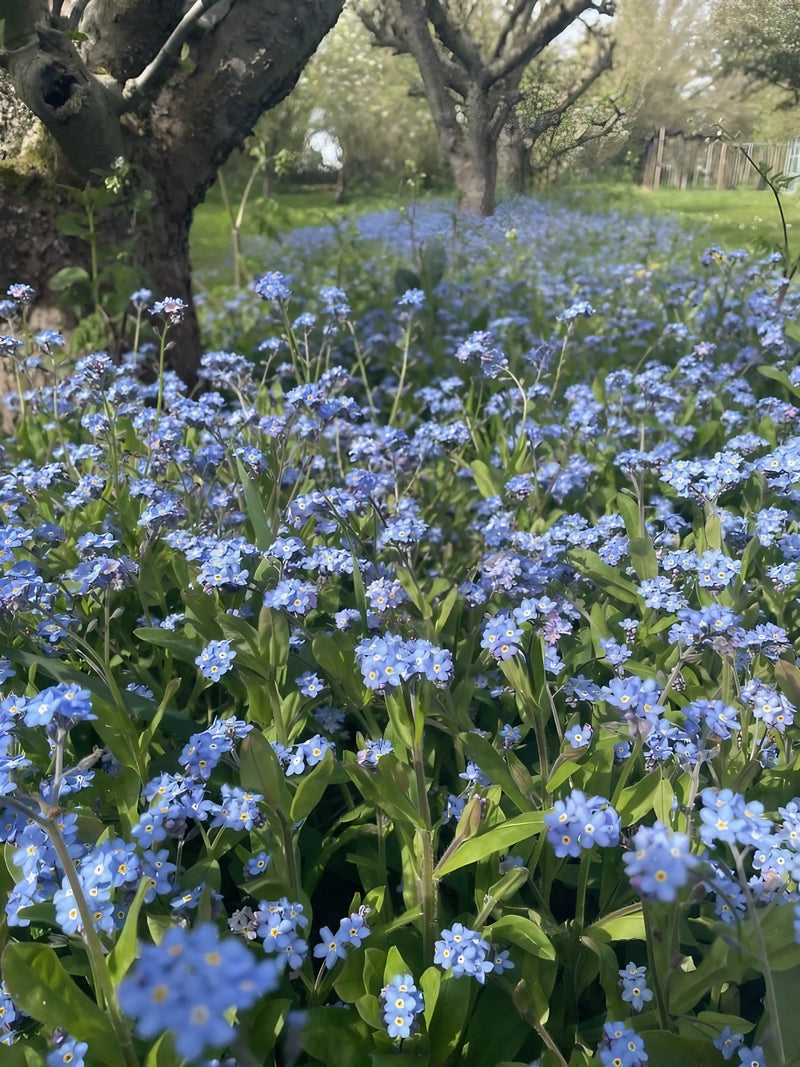
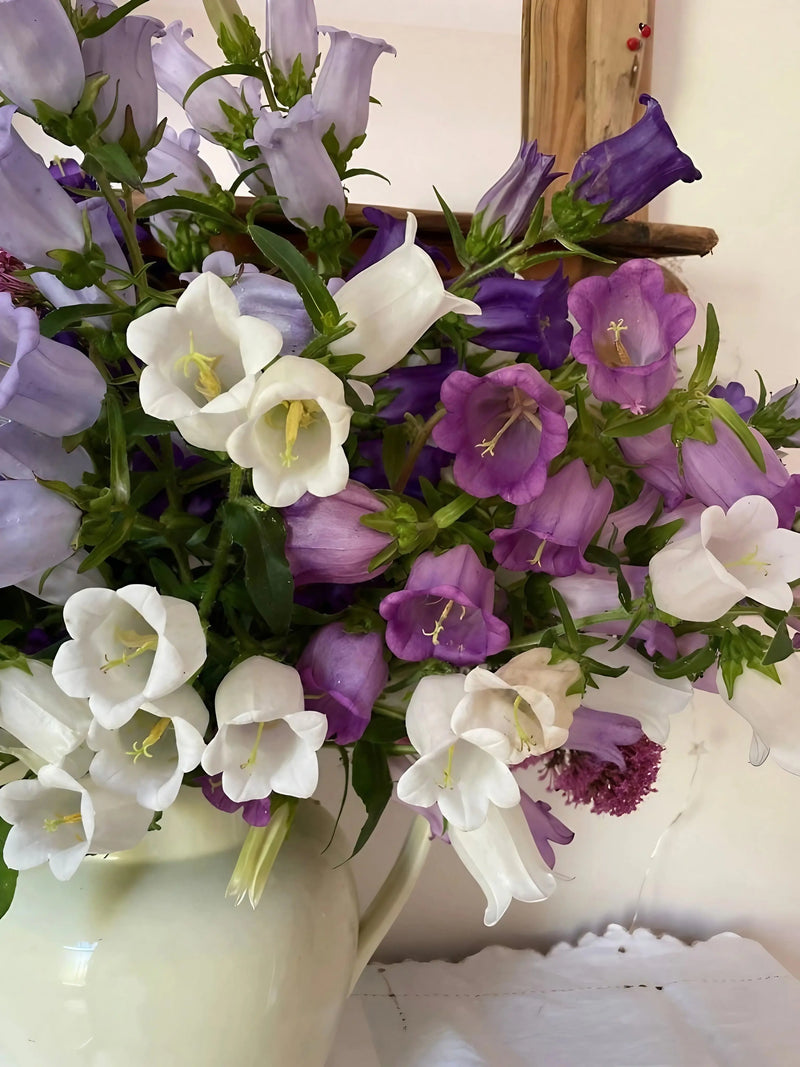
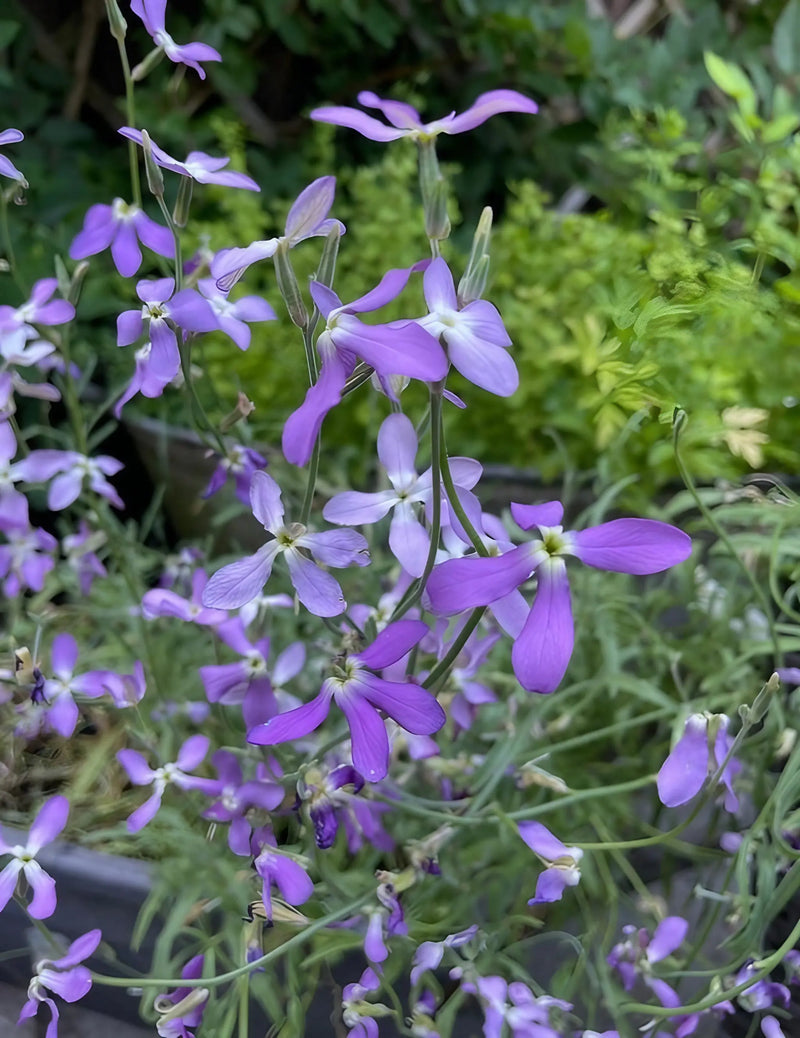
The full Kate Greenaway dictionary contains hundreds of flowers. But six emotional categories cover most of the messages a modern floriographer would ever want to send: love, devotion, gratitude, admiration, sincerity, and good wishes. Below are six varieties — each with its traditional meaning, each producing beautiful cut flowers, and each available to grow yourself from a packet of our seed. Together they form a working floriography vocabulary in a single cutting patch. Five of the six sit inside our dedicated Floriography seed box (featured in the next section) — with the sixth, Forget-me-not, available separately from our biennials range.



A Working Vocabulary in a Single Cutting Patch
These six flowers — sown across spring and summer, flowering through the season, and cut for the vase or the small hand-tied posy — give you the ability to send meaningful floriographic gifts across the whole spectrum of emotional occasion. A single Bells of Ireland stem tucked into a "good luck" bouquet for someone starting a new venture. A tussie-mussie of Gypsophila and Forget-me-not for a wedding-and-devotion sentiment. Canterbury Bells for the thank-you that needs to say more than words. Stocks for the anniversary card. Larkspur for the sincere first declaration. This is what the Victorians meant when they said flowers could speak — and it is genuinely within the reach of any UK gardener with a sunny patch and a summer's worth of patience.
The Complete Kit — Floriography: The Little Box of Love
Growing a floriographic garden from twelve individual seed packets is possible — and rewarding — but there is a simpler and considerably more beautiful way, particularly if you're thinking of a gift. Our Floriography: The Little Box of Love assembles twelve full-sized seed packets of the most meaningful Victorian floriography varieties into a single beautifully-packaged box, with a lid chart showing every flower and its meaning, and eco-friendly compostable packaging throughout.
Say It With Seeds
Floriography: The Little Box of Love

Twelve full-sized seed packets of the most meaningful flowers in the Victorian language — each chosen not only for its beauty and its garden performance, but for the sentiment it carried in the great flower dictionaries of the nineteenth century. Sow across spring, flower across summer, and cut small tussie-mussies through the season that say what a card cannot. A living, growing gift that doesn't wilt in a week like a fresh bouquet — but flowers instead for a whole summer of meaningful cutting.
Beautifully packaged with a lid chart showing every flower and its meaning, this is our most-gifted seed collection. It works equally well for yourself — as the fastest way to build a floriographic cutting garden — or as a gift for a wedding, an anniversary, a milestone birthday, or the person whose garden means something to them.
£24.00 Twelve Full-Size Packets · Lid Chart · Compostable Packaging
Shop the Little Box of Love →The Twelve Meanings Inside
- Sweet Pea Mix — Friendship & Loyalty
- Gypsophila 'Covent Garden' — Eternal Love
- Zinnia 'Lilliput Mix' — Thoughts of Absent Friends
- Scabious 'Imperial Mix' — Pure Love
- Forget-me-not Blue — True Love & Respect
- Aster 'Duchess Mixed' — Patience & Elegance
- Larkspur 'Giant Imperial' — An Open Heart
- Canterbury Bells — Gratitude
- Ammi majus — Sanctuary & Warmth
- Stocks Night Scented — You Are Always Beautiful to Me
- Bells of Ireland — Good Luck
- Chrysanthemum Painted Daisies — You Are a Wonderful Friend
The Perfect Gift for the Gardener Who Has Everything
Because the Floriography box is fundamentally about meaning rather than plant novelty, it works as a gift even for experienced gardeners who might otherwise be difficult to buy for. Almost every gardener has grown a Zinnia or a Sweet Pea — but few have knowingly grown a Zinnia for "thoughts of absent friends" or a Sweet Pea for "the delicate pleasure of your company." The box transforms familiar flowers into thoughtful, meaningful ones, which is a rare kind of gift to give a keen gardener.
A Small Floriography Dictionary
For reference — a working table of eighteen classic Victorian floriography meanings, drawn primarily from Kate Greenaway's 1884 Language of Flowers and cross-referenced with the wider English-language sources. Not comprehensive (the full Greenaway dictionary runs to nearly four hundred flowers) but a solid working vocabulary covering most of the situations a modern floriographer would ever want to send.
| Flower | Meaning | When to Give |
|---|---|---|
| Rose, Red | Love, romantic desire | Declarations of love, Valentine's, anniversaries |
| Rose, White | I am worthy of you; purity | Weddings, engagements, first meetings |
| Rose, Yellow | Jealousy, infidelity (careful!) | Almost never — read the dictionary before sending |
| Rosemary | Remembrance | Funerals, wedding boutonnières, memorial gifts |
| Forget-me-not | True love and respect | Long-distance love, faithful admiration, quiet devotion |
| Sweet Pea | Friendship and loyalty | Faithful friends, long companionships, "you can count on me" |
| Zinnia | Thoughts of absent friends | Friends abroad, moving away, long-lost contacts |
| Pansy | Thoughts (from French pensée) | Any thoughtful, contemplative sentiment |
| Gypsophila | Eternal love | Weddings, deep commitments, lasting bonds |
| Chamomile | Patience and energy in adversity | Difficult times, illness, "keep going" gifts |
| Scabious | Pure love | Sincere unspoken love, quiet romantic gifts |
| Aster | Patience, elegance | Reflective gifts, apologies, "I have been thinking" messages |
| Larkspur | An open heart | New love, sincere admiration, candid feelings |
| Canterbury Bells | Gratitude | Thank-you gifts, appreciation, quiet thanks |
| Ammi majus | Sanctuary and warmth | Home-warming, shelter, welcome, comfort |
| Stocks, Night-Scented | You are always beautiful to me | Anniversaries, long marriages, enduring compliments |
| Bells of Ireland | Good luck | New ventures, weddings, exams, journeys |
| Chrysanthemum, Red | You are a wonderful friend | Friendship gifts, appreciation, autumn thank-yous |
The Bottom Line
If you take only one thing from this little guide, take this: the next time you give someone flowers, choose them for what they mean rather than only how they look. Add a small card noting the meanings. The gift becomes considered, personal, and genuinely remembered — and you have participated in one of the loveliest quiet traditions of British cottage-garden history.
Further Reading — Books We've Learned From
Floriography rewards deeper reading — every book on the subject adds another layer of meaning, another set of variations, another beautifully-illustrated set of vignettes. These four are the books we return to most often, and each earns its place on the shelf of anyone serious about the language of flowers.
Language of Flowers
Frederick Warne · 1884 · Still in print
The definitive Victorian source, and one of the loveliest small books ever published. Kate Greenaway's exquisite watercolour illustrations wrap around a beautifully-clear dictionary of around 380 flowers and their meanings. Pocket-sized, endlessly rereadable, and the reference every modern floriographer eventually acquires. Continuously in print for over 140 years — for good reason.
Find the Book →A Victorian Flower Dictionary
Ballantine · 2011
The best modern reference on Victorian floriography — comprehensive, beautifully illustrated, historically rigorous, and organised in a way that makes cross-referencing meanings straightforward. Published as a companion to Vanessa Diffenbaugh's novel The Language of Flowers, but stands entirely on its own as the modern reference book of choice.
Find the Book →The Language of Flowers
Pan Macmillan · 2011 (novel)
The novel that single-handedly drove the modern revival of floriography. A beautiful, moving story of a young woman who uses the Victorian language of flowers to communicate when spoken words fail her. Not a reference book but a genuinely wonderful read, and the first place many modern floriographers were introduced to the tradition. Hugely bestselling; still recommended everywhere.
Find the Book →The Meaning of Flowers
Chronicle Books · 1998
A beautifully-illustrated modern coffee-table reference on the wider tradition of flower meanings — covering not only Victorian floriography but earlier and international traditions of flower symbolism. Less pocket-sized than Greenaway, more visually rich than Kirkby, and a lovely gift book in its own right for anyone captivated by the tradition.
Find the Book →A Note on Where to Buy Books
Every one of the books above is widely available. Where you buy them matters — we'd recommend independent bookshops via Bookshop.org UK (which supports independent booksellers), your local high-street bookshop, or direct from each publisher. All four titles are also stocked by the usual online retailers if you prefer.
Twelve meanings. One beautifully-packaged little box. A whole summer of flowers that say what a card cannot.
Whether for yourself as the fastest way to grow a floriographic cutting garden, or as a considered, memorable gift for the gardener in your life — our Floriography: The Little Box of Love assembles the whole vocabulary in a single Norfolk-grown, compostably-packaged, beautifully-illustrated seed collection. Sow this spring; cut small posies that carry meaning all summer; participate in one of the loveliest quiet traditions of the British cottage garden.
Shop the Little Box of Love →
1 comment
That was so interesting. Thank you.