

Delphinium Pacific Giant Summer Skies
Delphinium elatum Pacific Giant 'Summer Skies' — clear sky-blue with white bee
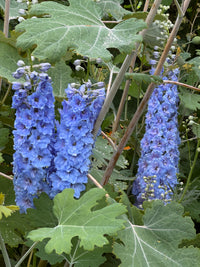
Towering 1.8m spikes of clear azure sky-blue flowers with white centres — the legendary Pacific Giant delphinium that defines the back of every English cottage border.
About this variety
Delphinium elatum 'Pacific Giant Summer Skies' Tall Delphinium 'Summer Skies'
Towering 1.8m architectural spikes of clear azure-sky-blue flowers, each individual bloom marked with a soft white centre (the "bee") — 'Summer Skies' is the majestic Pacific Giant Delphinium that defines the back of any classic English cottage border, and the variety against which all other tall blue delphiniums are measured.
This is the quintessential English cottage border perennial. The Pacific Giant series was developed in California in the 1930s specifically to produce taller, larger-flowered, more spectacular delphiniums than the older European varieties — and 'Summer Skies' is the legendary sky-blue selection from that breeding programme. Tall, architectural flower spikes can reach 1.8m (six feet) in good conditions, completely covered with large semi-double flowers in clear azure with a contrasting white centre that gives each bloom a "bee-eye" quality. Hardy perennial flowering June and July, often with a second flush in late summer if cut back hard after first flowering. RHS Plants for Pollinators recognised — bumblebees particularly love delphinium spikes.
A note on growing
Delphinium seeds need patience and the right conditions. Sow from January to April — surface-sow onto moist compost (delphinium seeds need light to germinate). Cover lightly with vermiculite to maintain humidity. Important: delphinium seeds germinate best at slightly cool temperatures (15–18°C) — high heat actually inhibits germination. A few weeks of cold treatment (refrigerator) before sowing can improve germination rates significantly. Germination takes 14–28 days.
Plant out into a sheltered, sunny or lightly-shaded position in deep, fertile, moisture-retentive but well-drained soil. Delphiniums are hungry plants — dig in plenty of compost or well-rotted manure before planting. The first year sees establishment; expect modest flowering. From year two onwards, the plants come into their full glory. Critical growing tip: at 1.8m tall, 'Summer Skies' absolutely needs staking. Insert sturdy canes or grow-through plant supports early in the season — by the time the spikes are tall enough to need support, the plant is too fragile to stake without damage. After flowering, cut back hard to encourage a second flush. Slugs and snails are the main pest — protect young growth in spring.
⚠️ Safety note: All parts of Delphinium are toxic if ingested. Wear gloves when handling and keep away from grazing animals.
Where it shines
At the back of classic English cottage borders, where the towering blue spires define the quintessential cottage planting and provide vertical structure that few other plants can match. In wildlife gardens, where the deep nectar tubes are specifically valued by long-tongued bumblebees. As cut flowers for tall dramatic arrangements (handle with care — flower spikes are fragile after cutting). In any heritage planting scheme that wants traditional English country-garden character.
Plant alongside
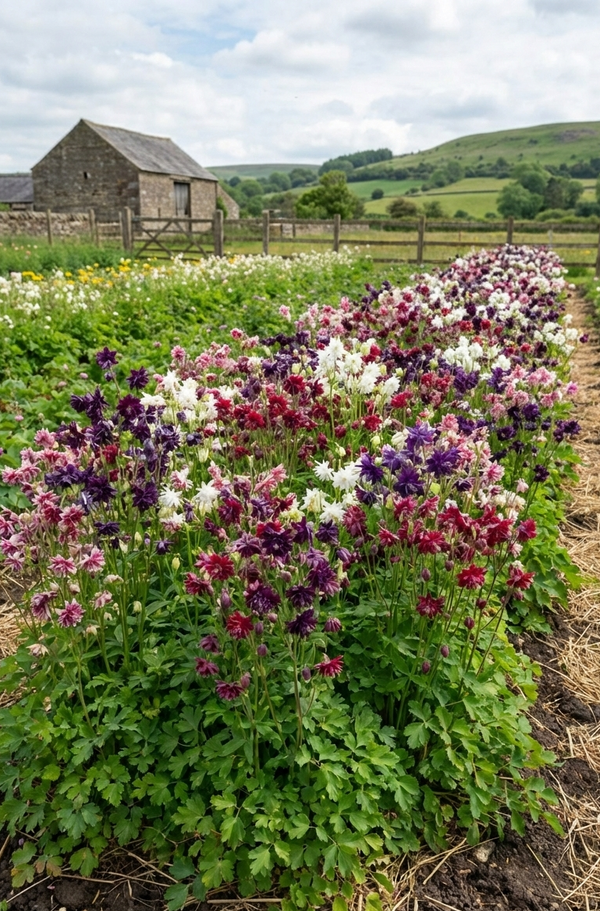
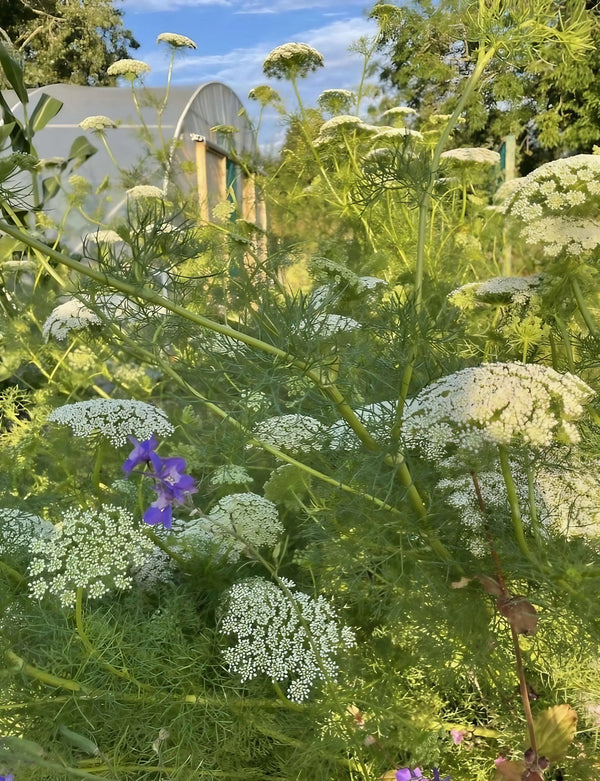
The classic English cottage border combination: pair 'Summer Skies' with David Austin-style roses (if you grow them), Foxglove 'Excelsior Mixed' for matching vertical structure, and Aquilegia 'Barlow Mixed' for lower-level interest. For colour-coordinated cutting, combine with the lime-green spires of Bells of Ireland and the airy white of Ammi majus.
Plant alongside
Delphinium Pacific Giant Summer Skies pairs beautifully with these cottage garden classics

RHS Plants for Pollinators
This plant has been assessed by the Royal Horticultural Society and recommended as especially beneficial to bees, butterflies and other pollinators. Growing plants like this directly supports UK pollinator populations — something close to our hearts at Salle Moor Hall Farm, where we see the difference a cottage garden full of the right plants can make.
Learn more at RHS.org.uk →