Skip to product information
1 of 2

Aquilegia 'Barlow Mixed' Seeds

If you want the romance and nostalgic charm of a classic English cottage garden, you need 'Granny's Bonnets'—and the Barlow Series represents the absolute pinnacle of this beloved perennial! Unlike traditional aquilegias with their delicate spurred flowers, the Barlow Series was specifically bred for one remarkable feature: fully double, spurless, pom-pom-like blooms that resemble miniature dahlias. This mixed-colour collection brings you the entire spectacular Barlow palette in a single packet: deep blues and violets, soft pinks and raspberry tones, rich carmine, and pure white—plus wonderful bicolours with contrasting tips and edges. Each flower is a frilly masterpiece of layered petals that nod gracefully on wiry stems above lacy, fern-like foliage.

What makes the Barlow Series genuinely special is its heritage: it was originally bred for cut flower production, which means these varieties have strong, upright stems (70-90cm tall!), exceptional vase life, and flowers that are substantially larger and more dramatic than wild aquilegias. The fully double blooms create instant "wow-factor" in both garden borders and floral arrangements—they're the sort of flowers that make visitors stop and ask "what IS that?!" Beyond their ornamental beauty, 'Barlow Mixed' is brilliantly practical: it's a hardy perennial (H7) that returns year after year, thrives in partial shade where many flowers struggle, attracts clouds of early bees and butterflies, and self-seeds politely to create gentle colonies without becoming invasive. Plant them under trees, along shady borders, in woodland gardens, or anywhere you want late spring colour with that unmistakable cottage garden magic!


Read More

🌿 Understanding the Plant

Aquilegia 'Barlow Mixed' is a Hardy Perennial (H7 - survives temperatures down to -20°C).

The Revolutionary Barlow Series:
The Barlow Series represents a genuine breakthrough in aquilegia breeding and remains unique even decades after its introduction. Here's what makes it special:

1. THE FIRST FULLY DOUBLE, SPURLESS AQUILEGIA SERIES: Traditional aquilegias have distinctive backward-pointing spurs (the tubular projections behind the petals). The Barlow Series was the FIRST to eliminate spurs entirely, creating completely double, pom-pom-shaped blooms that look more like miniature dahlias or pompon chrysanthemums than typical columbines. This was revolutionary!

2. BRED FOR CUT FLOWER PRODUCTION: Unlike ornamental garden varieties, Barlow aquilegias were specifically developed for the cut flower industry. This breeding focus resulted in several crucial improvements:
- Stronger, taller stems (70-90cm vs. 40-60cm in many garden varieties) that stand upright without staking
- Larger flowers (4-5cm diameter vs. 2.5-3cm in wild types)
- Exceptional vase life (7-10 days as cut flowers)
- Uniform height and bloom time for consistent displays

3. THE MIXED COLOUR MAGIC: 'Barlow Mixed' includes the full spectrum of Barlow varieties in a single packet, creating a cottage garden painter's palette:
- Deep Blues & Violets: 'Blue Barlow' shades ranging from soft lavender to rich purple-blue
- Raspberry & Carmine: 'Nora Barlow' tones in raspberry-pink with white and green tips
- Soft Pinks: 'Rose Barlow' in delicate blush to deeper rose
- Pure White: 'White Barlow' with crisp white petals, often with subtle green centres
- Deep Purple-Black: 'Black Barlow' in dramatically dark, nearly black tones
- Bordeaux: 'Bordeaux Barlow' in wine-red to burgundy shades
- Bicolours: Many flowers feature contrasting petal tips, edges, or centres in white, green, or complementary colours

4. SHORT-LIVED BUT SELF-SEEDING: Like most aquilegias, Barlow varieties are technically short-lived perennials (typically peak performance in years 2-4, then decline). HOWEVER, they self-seed prolifically! Once established, they create gentle, ever-renewing colonies that naturalize beautifully in borders and woodland edges.

The Botanical Background:
Aquilegia 'Barlow Mixed' derives from Aquilegia vulgaris var. stellata plena - the European Columbine. Wild A. vulgaris is native to Britain and grows naturally in woodland edges, meadows, and damp hedgerows. The Barlow cultivars maintain this woodland heritage, thriving in conditions where many sun-loving perennials fail:
- Partial shade tolerance: Evolved for dappled woodland light
- Moisture preference: Likes consistently moist (not waterlogged) soil
- Cool-season flowering: Blooms May-June before summer heat
- Deciduous: Dies back completely in winter, re-emerging in early spring

The Common Names:
Aquilegias have the most charming common names in horticulture!
- "Granny's Bonnet": The nodding flowers resemble old-fashioned ladies' bonnets
- "Columbine": From Latin columba (dove) - traditional spurred flowers resemble a circle of doves drinking
- "Barlow" Name: 'Nora Barlow' (the most famous of the series) was named after Charles Darwin's granddaughter, and subsequent varieties adopted the "Barlow" surname

Why 'Barlow Mixed' vs. Individual Named Varieties:
You might wonder whether to grow the mixed collection or individual named Barlow varieties. Here's the advantage of the MIX:
CHOOSE BARLOW MIXED IF:
- You want a naturalistic cottage garden with delightful colour surprises each spring
- You appreciate the romance of not knowing exactly which colours will emerge
- You want to create large drifts of aquilegias economically (one packet provides multiple colours)
- You enjoy the self-seeding process where offspring create new colour combinations
- You want maximum visual interest from varied hues in a single border

CHOOSE INDIVIDUAL NAMED VARIETIES IF:
- You're creating a specific colour scheme (e.g., all-white woodland garden)
- You want to prevent cross-pollination and maintain pure colour strains
- You're growing for formal cut flower production requiring colour consistency

The Famous Self-Seeding Habit:
Aquilegias are delightfully "promiscuous" in the horticultural sense! Here's what happens:
- After flowering, seed pods develop containing numerous small black seeds
- If allowed to ripen and drop (or if you don't deadhead), seeds germinate readily
- The twist: Aquilegia species and cultivars cross-pollinate VERY easily!
- Self-sown seedlings from 'Barlow Mixed' often display new colour combinations
- Over years, you develop a unique aquilegia population specific to YOUR garden
- This is considered charming rather than problematic—part of the cottage garden magic!
- Control method: Deadhead immediately after flowering if you want to prevent seeding

The Foliage:
Even when not flowering, aquilegias provide beautiful structural foliage:
- Basal rosettes of delicate, lacy, fern-like leaves
- Grey-green to blue-green colouring (glaucous)
- Ternately divided (each leaf divides into three, then three again)
- Fresh, clean appearance in spring and early summer
- Mid-summer decline: Foliage often becomes tatty by July-August (common and natural)
- Solution: Cut foliage back to ground level in August for fresh autumn regrowth that persists until frost

Pollinator Value:
Despite lacking the long spurs that attract hummingbirds (in North America), double-flowered Barlow aquilegias still provide significant pollinator value:
- Early bees: Emerge May-June when bees are building colonies and need abundant nectar
- Bumblebees: Particularly attracted to the layered petals
- Butterflies: Orange Tip butterflies especially love aquilegias
- RHS Plants for Pollinators: Aquilegia vulgaris (the parent species) holds this designation

🌱 Growing Guide

Aquilegias have a reputation for "erratic" germination, but the truth is they just need specific conditions—once you understand their requirements, they're actually quite reliable!

The CRITICAL Germination Secret - Cold Stratification:
Aquilegia seeds evolved in temperate climates with cold winters. They have built-in dormancy that REQUIRES a period of cold to "wake up." This is called stratification. Here's how to do it:

METHOD 1 - Refrigerator Stratification (Most Reliable):
1. Place seeds in a small sealed plastic bag or container with slightly damp (not wet) vermiculite or kitchen paper
2. Put in refrigerator (NOT freezer) at 2-5°C
3. Leave for 3-4 weeks
4. Then sow as normal—germination will be much faster and more consistent!

METHOD 2 - Winter Sowing Outdoors (Nature's Method):
1. Sow seeds in pots or trays in January-March
2. Place outside in a cold frame, unheated greenhouse, or sheltered spot
3. Let winter cold naturally stratify the seeds
4. Seeds germinate in spring when temperatures rise
5. This method is more hands-off but germination timing is less predictable

METHOD 3 - Direct Sowing (Easiest but Slowest):
1. Sow directly where you want plants to grow in April-July
2. Seeds may germinate within weeks OR may wait until following spring after winter cold
3. Mark the area so you don't accidentally weed out seedlings!

When to Sow:
Aquilegias are flexible—multiple sowing windows work!
January-March (Indoor Sowing with Stratification): Sow in pots/trays, stratify in fridge 3-4 weeks, then bring into warmth. Plants will be ready to plant out in autumn for flowers the following May-June.
April-July (Direct Sowing Outdoors): Sow where they're to flower. May germinate within 14-28 days, or wait until following spring. Flowers year 2.
July-September (Sowing for Next Year): Sow in trays, grow seedlings in pots, plant out in autumn. This gives plants maximum establishment time before flowering the following May-June.

How to Sow:
Seeds need LIGHT to germinate! This is crucial.

1. Fill pots/trays with good quality seed compost
2. Water thoroughly and let drain
3. Scatter seeds thinly on the surface
4. DO NOT COVER WITH COMPOST! Seeds need light!
5. You can sprinkle the finest dusting of vermiculite (1mm maximum) to help keep seeds in contact with moist compost, but they should still be visible
6. Place in sealed plastic bag or cover with clear lid to maintain humidity
7. Temperature: 15-20°C for germination (cooler is fine, actually helps!)
8. Germination time: 14-35 days (highly variable—be patient!)
9. Once seedlings emerge, remove from bag/cover and provide bright light
10. When large enough to handle (2-3 true leaves), transplant into individual 7-9cm pots

Where to Plant:
The great advantage of aquilegias is their shade tolerance—they thrive where many perennials struggle!
Light Requirements:
- IDEAL: Partial shade (dappled light under deciduous trees, north-facing borders, or areas that get morning sun + afternoon shade)
- TOLERATED: Full sun IF soil stays consistently moist (in dry sunny spots, foliage declines faster)
- TOLERATED: Quite deep shade (they'll survive but flower less prolifically)
Soil Requirements:
- ESSENTIAL: Moist but well-drained (this is critical—aquilegias SERIOUSLY DISLIKE waterlogged soil!)
- IDEAL: Rich in organic matter (woodland-type soil with leaf mould or compost)
- pH: Tolerant of most pH levels (slightly acid to slightly alkaline, 6.0-7.5)
- Texture: Tolerates heavy clay IF drainage is adequate
Spacing: 30-40cm (12-16 inches) apart for individual plants. For naturalistic drifts, plant in groups of 5-7 with 25cm spacing.

Planting Out Timing:
AUTUMN PLANTING (Recommended):
- Plant young aquilegias in September-October
- This gives roots time to establish before winter
- Plants will be much stronger and flower more abundantly in their first spring
- Water well after planting and mulch lightly
SPRING PLANTING (Acceptable):
- Plant March-April
- Plants may flower lightly in first year
- Provide consistent watering through first summer

Care & Maintenance:
Aquilegias are genuinely low-maintenance once established!

Watering:
- Keep consistently moist during active growth (April-July)
- Allow top inch of soil to dry slightly between waterings
- CRITICAL: Never let soil become waterlogged—root rot is a real risk
- In established plantings under trees, natural rainfall is usually sufficient in UK
- Container plants need regular watering

Feeding:
- Apply balanced slow-release fertilizer or well-rotted compost in early spring (March)
- Alternatively, liquid feed every 2-3 weeks during active growth
- Aquilegias aren't heavy feeders but appreciate organic matter

Deadheading (Your Choice!):
You have two viable strategies:
DEADHEAD IF: You want to prolong flowering slightly (removing spent blooms may encourage a few more), or you want to prevent self-seeding and maintain a tidy border
DON'T DEADHEAD IF: You want seed pods for visual interest (they're attractive!), or you want self-sown seedlings for naturalizing, or you're saving seed

The Mid-Summer Cutback:
- By July-August, aquilegia foliage often looks tired, yellowed, or develops powdery mildew
- Solution: Cut all foliage back to ground level
- Within 2-3 weeks, fresh new growth emerges
- This fresh foliage remains attractive through autumn and into winter
- It's perfectly natural and healthy—not a sign of plant failure!

Division vs. Seeding:
Aquilegias famously "dislike disturbance" and can take a LONG time to recover from division. Here's the reality:
DIVISION:
- Only divide if absolutely necessary (e.g., congested clumps after 4-5 years)
- Divide in very early spring (March) just as growth starts
- Use a sharp spade to cut sections with good root systems
- Plants will sulk and may not flower well for 1-2 years
- Aquilegias have deep taproots that resent disturbance
BETTER OPTION - Save and Sow Seeds:
- Collect seed pods when they turn brown and papery (July-August)
- Dry pods, then break open to release small black seeds
- Store in paper envelopes in cool, dry location
- Sow following spring after stratification
- This gives you fresh, vigorous young plants without disturbing established clumps!

Pests & Diseases:
Aquilegias are generally trouble-free but can face a few issues:
Common Pests:
- Aphids: Can cluster on flower buds and young shoots. Blast off with water or tolerate (they attract beneficial insects)
- Leaf miners: Create serpentine tunnels in leaves. Purely cosmetic—doesn't harm plant. Remove affected leaves if unsightly
- Sawfly caterpillars: Can defoliate plants rapidly. Hand-pick or use organic controls
Common Diseases:
- Powdery mildew: White powdery coating on leaves, especially in dry conditions or late summer. Prevent with good air circulation; treat by cutting back affected foliage
- Aquilegia downy mildew: More serious—yellowing and distorted leaves. Remove and destroy affected plants
CAUTION - Mildly Toxic:
All parts of aquilegia plants are mildly toxic if ingested and can cause skin/eye irritation in sensitive individuals. Wear gloves when handling if you have sensitive skin. Keep away from pets and children who might eat plants.

📏 Plant Specifications
Common Name: Granny's Bonnet, Columbine, Barlow Mixed Columbine
Botanical Name: Aquilegia vulgaris var. stellata plena 'Barlow Mixed'
Plant Type: Hardy Perennial (short-lived but self-seeding)
Height: 70-90cm (28-36 inches)
Spread: 40-45cm (16-18 inches)
Flower Type: Fully double, spurless, pom-pom-like (4-5cm diameter)
Flower Colours: Mixed blues, violets, pinks, raspberry, carmine, white, and bicolours
Flowering Time: May-June (late spring to early summer)
Foliage: Lacy, fern-like, grey-green, ternately divided
Sunlight: Partial shade preferred; tolerates full sun to quite deep shade
Soil: Moist but well-drained, rich in organic matter; seriously dislikes waterlogged conditions
Soil pH: 6.0-7.5 (slightly acid to slightly alkaline)
Hardiness: H7 (Very Hardy - survives -20°C)
RHS Hardiness Zones: 3-8
Germination Time: 14-35 days (erratic without cold stratification; more consistent with 3-4 weeks refrigeration)
Germination Temperature: 15-20°C
Light Requirement for Germination: LIGHT NEEDED - do not cover seeds deeply!
Time to First Flower: Year 2 from sowing (occasional light flowering Year 1)
Lifespan: Short-lived perennial (3-4 years peak, but self-seeds readily)
Spacing: 30-40cm (12-16 inches) apart
Growth Habit: Upright, bushy clump-forming
Native Range: Europe (including Britain)
Attracts: Bees, butterflies (especially Orange Tip)
Deer/Rabbit Resistant: Yes (mildly toxic - avoided by wildlife)
RHS Award: Parent species (Aquilegia vulgaris) holds RHS Plants for Pollinators designation
Best Uses: Cottage gardens, woodland borders, shade gardens, cut flowers, naturalistic plantings
Toxicity: Mildly toxic if ingested; can cause skin/eye irritation
Seeds per Packet: Approximately 100 seeds
🎨 Perfect Garden Companions

Aquilegia 'Barlow Mixed' thrives in partial shade and loves the same woodland-edge conditions as many classic cottage garden biennials and perennials. Create magical late spring/early summer combinations!

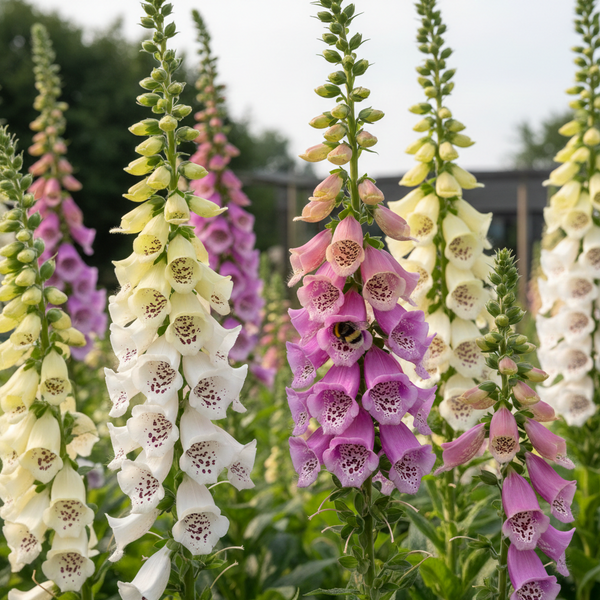
  • 💜 Foxglove 'Bishy Barnabee Mix' - The Woodland Towers
    This is THE classic cottage garden pairing! Foxgloves and aquilegias are natural companions—both evolved for woodland edges, both thrive in partial shade, both flower May-June, and both attract early bees. The combination creates perfect vertical layering: aquilegias provide mid-height colour (70-90cm) with their nodding double blooms, while foxgloves tower behind them (120-180cm) with dramatic spire-like flower spikes. The 'Bishy Barnabee Mix' brings pinks, whites, creams, and apricots that complement the blues, violets, and pinks in 'Barlow Mixed' beautifully! Culturally, they're identical: both are sown in summer, both grow as leafy rosettes through winter, both flower spectacularly the following May-June, and both self-seed politely to create gentle colonies. Plant foxgloves 50-60cm apart at the back of borders, with aquilegias 30-40cm apart in front. The combination creates instant cottage garden magic with that romantic, slightly wild aesthetic. Both are RHS Plants for Pollinators, so bees adore this pairing! Aftercare tip: deadhead foxgloves after main flowering to encourage side-shoot blooms; allow aquilegias to set seed for naturalizing.
  • 🌙 Honesty (Lunaria) Mixed - The Early-Late Show
    Honesty flowers slightly earlier than aquilegias (April-May) in rich purples, magentas, and whites, then develops its famous translucent "silver dollar" seed pods just as aquilegias reach peak bloom in May-June. The two plants create perfect seasonal succession: Honesty provides the opening act, aquilegias take over as Honesty transitions to seed, and both share the same woodland aesthetic and soil preferences. The purple Honesty flowers create a rich, dramatic backdrop for the mixed pastels of 'Barlow' aquilegias—it's a sophisticated colour combination! Both are biennials/short-lived perennials that self-seed prolifically, creating ever-changing naturalistic drifts. They love the same conditions: partial shade, moist but well-drained soil, rich in organic matter. Plant Honesty 40-50cm apart, aquilegias 30-40cm apart, in overlapping groups. The visual interest continues even after flowering—Honesty's papery seed pods provide structure through summer while aquilegia foliage fills in below. Both attract Orange Tip butterflies and early bees. Leave seed heads on both plants for naturalization and for harvesting Honesty's decorative pods for dried arrangements!
  • 💚 Bronze Fennel - The Feathery Contrast
    Bronze Fennel provides the perfect textural and colour contrast for aquilegias! While aquilegias have lacy, grey-green foliage and frilly double flowers, Bronze Fennel offers towering (180cm+) clouds of thread-fine, bronze-purple foliage with airy yellow umbels of flowers. The feathery fennel creates a see-through vertical element that allows aquilegias to shine in front without being hidden. The bronze-purple fennel foliage amplifies the purple and violet tones in 'Barlow Mixed' while complementing the pinks and whites. Both plants appreciate similar conditions: fennel tolerates partial shade (though prefers sun), both like well-drained soil, and both self-seed (though fennel more aggressively—deadhead if needed). Plant fennel as individual specimens (60-90cm apart) towards the back of borders, with aquilegias grouped in front (30-40cm spacing). The combination creates height, movement, and textural interest. Bonus: Bronze Fennel is exceptional for beneficial insects—it attracts hoverflies whose larvae eat aphids, plus countless other pollinators. Both plants provide valuable early-season nectar when bees are building colonies. The flowering times overlap (May-June), creating a frothy, romantic display with the best of cottage and herb garden aesthetics!
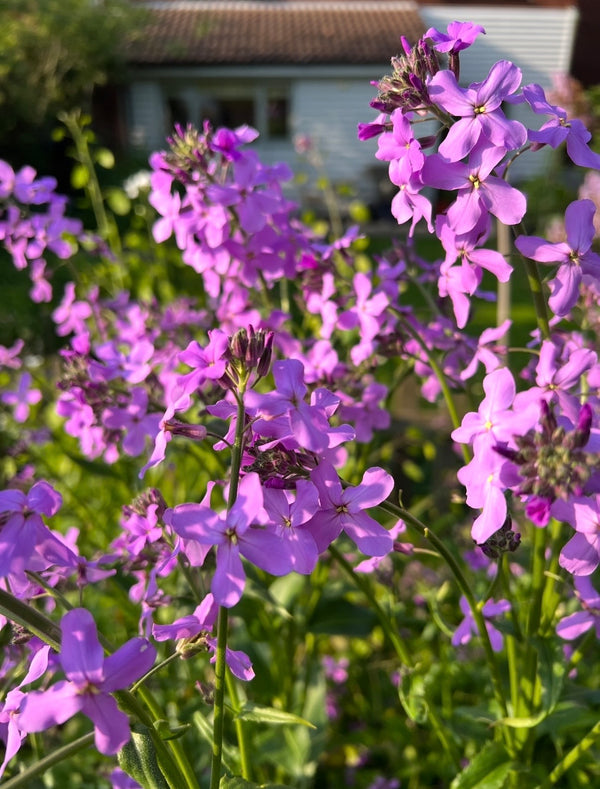
  • 🌸 Sweet Rocket 'Purple' (Hesperis) - The Fragrant Woodland Pair
    Sweet Rocket and aquilegias are PERFECT companions—both are woodland-edge natives, both flower May-June, both thrive in partial shade, and both create that romantic, slightly wild cottage garden look! Sweet Rocket produces tall (60-90cm), branching stems of vibrant violet-purple four-petaled flowers that release an incredible sweet fragrance at dusk (designed to attract night-flying moths). The rich purple of Hesperis creates a stunning backdrop for the mixed pastels and blues of 'Barlow' aquilegias, while the contrasting flower forms (simple four-petaled Sweet Rocket vs. complex double aquilegias) create visual interest. Both plants appreciate the same conditions: partial shade, moist but well-drained soil rich in organic matter, protection from hot afternoon sun. Both are short-lived perennials/biennials that self-seed readily, creating gentle, wandering colonies. Plant Sweet Rocket 30-40cm apart in groups, interspersed with aquilegias at similar spacing—they'll naturally mingle and self-seed together over years. The combination provides layered colour, fragrance, and continuous pollinator value. Evening bonus: sit near this pairing at dusk to enjoy Sweet Rocket's incredible scent while watching moths and late-day bees visit both plants!
  • 💙 Forget-me-not 'Victoria Mixed' - The Carpet of Blue
    For a truly enchanting late spring display, underplant 'Barlow Mixed' aquilegias with Forget-me-nots! Forget-me-nots create a low (20-30cm) carpet of soft blue flowers that bloom simultaneously with aquilegias (May-June), providing a magical blue-and-mixed-pastel colour scheme. The tiny Forget-me-not flowers create a hazy blue groundcover that allows the larger, more dramatic aquilegia blooms to float above like jewels. Both are cottage garden classics that self-seed prolifically, creating naturalistic, ever-changing displays. Cultural compatibility: both prefer partial shade to full sun, both appreciate moist (but not waterlogged) soil, and both are undemanding once established. Forget-me-nots are technically biennials but behave as self-seeding annuals, while aquilegias are short-lived perennials—together they create permanent, self-renewing colonies. Plant aquilegias 30-40cm apart as feature plants, then broadcast Forget-me-not seeds around and between them in autumn. The Forget-me-nots will germinate, overwinter as tiny rosettes, then burst into bloom just as aquilegias emerge in spring. The blue carpet highlights the mixed colours in 'Barlow' aquilegias—particularly effective with the pink and white shades! Both attract early bees and create that quintessential English cottage garden aesthetic.

💡 Woodland Garden Scheme: Create a complete woodland-edge border by combining 'Barlow Mixed' aquilegias with Foxglove 'Primrose Yellow' at the back (150cm), Sweet Rocket 'Purple' in the mid-ground (70-90cm), aquilegias as the main feature (70-90cm), and Forget-me-nots carpeting the ground (20cm). Add Bronze Fennel as vertical accents. This combination provides May-June colour, fragrance, varied heights, and exceptional pollinator value—all thriving in the partial shade where many perennials fail! All species self-seed, creating gentle, ever-evolving colonies that improve with age.

📅 Sowing & Harvesting Calendar
Activity Jan Feb Mar Apr May Jun Jul Aug Sep Oct Nov Dec
Sow Indoors (stratified)
Sow Outdoors (direct)
Plant Out
Flowering 🌸 🌸

Note: Flowers appear in Year 2. Sow in Year 1, plant out in autumn, enjoy blooms the following May-June!

⚠️ Cold Stratification Improves Germination!
Aquilegia seeds germinate much more reliably after experiencing cold. For best results, place seeds in a sealed bag with damp vermiculite and refrigerate for 3-4 weeks before sowing. This mimics winter conditions and "wakes up" the seeds, giving you faster, more consistent germination (14-21 days instead of erratic 30+ days). Alternatively, sow in pots in January-March and leave outside over winter—nature will stratify them for you! Without cold treatment, germination can be slow and unpredictable.

🌸 RHS Plants for Pollinators

The parent species Aquilegia vulgaris holds the prestigious RHS Plants for Pollinators designation, recognising its exceptional value for bees and butterflies. 'Barlow Mixed' maintains this pollinator-friendly heritage! Early bumblebees and the beautiful Orange Tip butterfly particularly love aquilegias. These late spring flowers provide crucial nectar when bee colonies are expanding and butterflies are emerging. Despite the double flowers (which have less accessible nectar than single forms), Barlow aquilegias still attract abundant pollinators and contribute significantly to biodiversity in woodland and cottage gardens!

📖 Want more detailed growing advice?
View our Complete Growing Guides →

Regular price
£2.10
Regular price
Sale price
£2.10
Tax included. Shipping calculated at checkout.
    Aquilegia Barlow Mixed
    Aquilegia Barlow Mixed