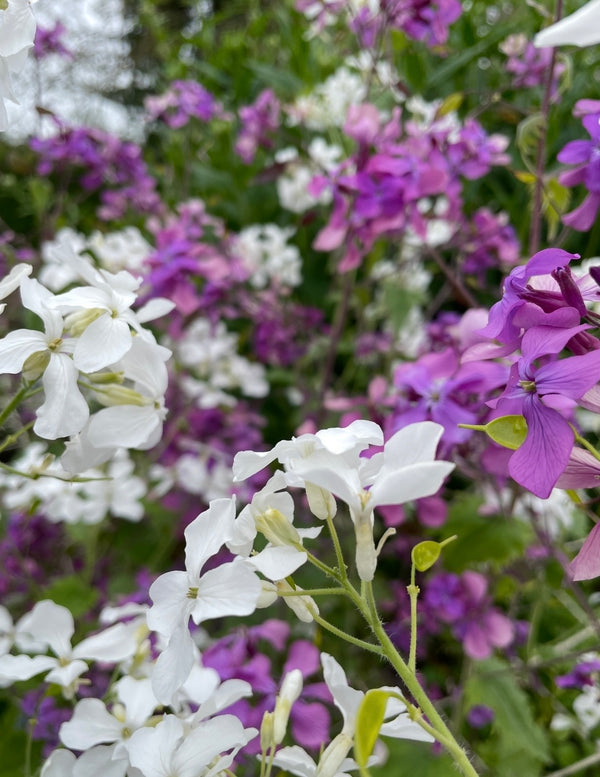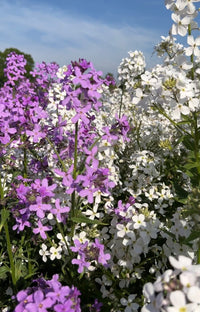
Hesperis Mixed (Hesperis matronalis) – field in flower under blue sky with trees

Hesperis Mixed

£2.20
Skip to product information
Hesperis Mixed (Hesperis matronalis) – field in flower under blue sky with trees
RHS Plants for Pollinators

Hesperis Mixed

Hesperis matronalis — Sweet Rocket, Dame's Violet; Brassicaceae

Tall stems of dusk-scented violet-purple and white four-petalled flowers — the great evening flower of the cottage garden in a mixed-colour packet. Orange Tip butterfly host.

£2.20

Free UK delivery on seed orders over £30

Dispatched from our Norfolk farm — Royal Mail, usually within one working day.

Your growing year

Sow, plant out and flowering months for this variety

Jan
Feb
Mar
Apr
May
Jun
Jul
Aug
Sep
Oct
Nov
Dec
Sow
Plant out
In flower
SowPlant outIn flower

At a glance

Height
70–90cm
Spread
30-50cm
Spacing
30-45cm
Position
Semi-shade to partial sun
Colour
Mixed
Seeds per packet
500
Soil
Moist, humus-rich soil; under trees
Grow guide How to grow Hesperis Mixed Read the full guide →

About this variety

By day it is a pleasant enough plant and no more: branching stems at 75 to 90cm carrying loose clusters of four-petalled flowers that look like a slightly rough phlox, here in a blend of violet-purple and white. Then the sun goes down.

The scent is the whole reason to grow it. As the temperature drops the flowers release a heavy sweet fragrance of violets and cloves that carries right across a garden, timed that way to bring in night-flying moths. Plant it by a bench, a path you use in the evening, or an open kitchen window.

It is a biennial: rosette the first year, flowers in May and June the second, then it dies. It self-seeds prolifically, which is how a colony keeps going and also how it turns up in places you did not intend, so pull what you do not want while it is small. Two other things worth knowing. It is the preferred larval food plant of the orange tip butterfly, so leave some seed pods rather than cutting everything back, and the foliage mildews badly in a dry late summer.
RHS Plants for Pollinators

This plant has been assessed by the Royal Horticultural Society and recommended as especially beneficial to bees, butterflies and other pollinators. Growing plants like this directly supports UK pollinator populations — something close to our hearts at Salle Moor Hall Farm, where we see the difference a cottage garden full of the right plants can make.

Learn more at RHS.org.uk →