


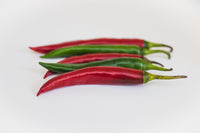
About this variety
Standard cayenne with the specific problems of a British summer bred out of it. Heritage cayennes were selected in the American south, central Italy and India, where the season runs long and hot, and dropped into a Norfolk garden they will sit stubbornly green into October. Ring of Fire ripens around 80 days from transplant rather than the 90-plus of the older lines, which means usable red pods from August in most years.
It is also a smaller plant, a compact 45cm that fits a 25cm pot and needs no staking, and it still crops heavily. The pods are the classic cayenne shape, pencil-thin, 10 to 12cm long, slightly twisted, thin-walled and hanging in quantity. Those thin walls are the reason to grow it, because they dry fast and cleanly for home-ground cayenne, chilli flakes or a kitchen ristra.
One honest note on heat. American sources rate it in the same 30,000 to 50,000 Scoville band as its parent, while UK growers under glass regularly report 50,000 to 85,000. The fair reading is that it runs hotter than standard cayenne in most conditions here, comfortably in very hot territory and still nowhere near a habanero.