

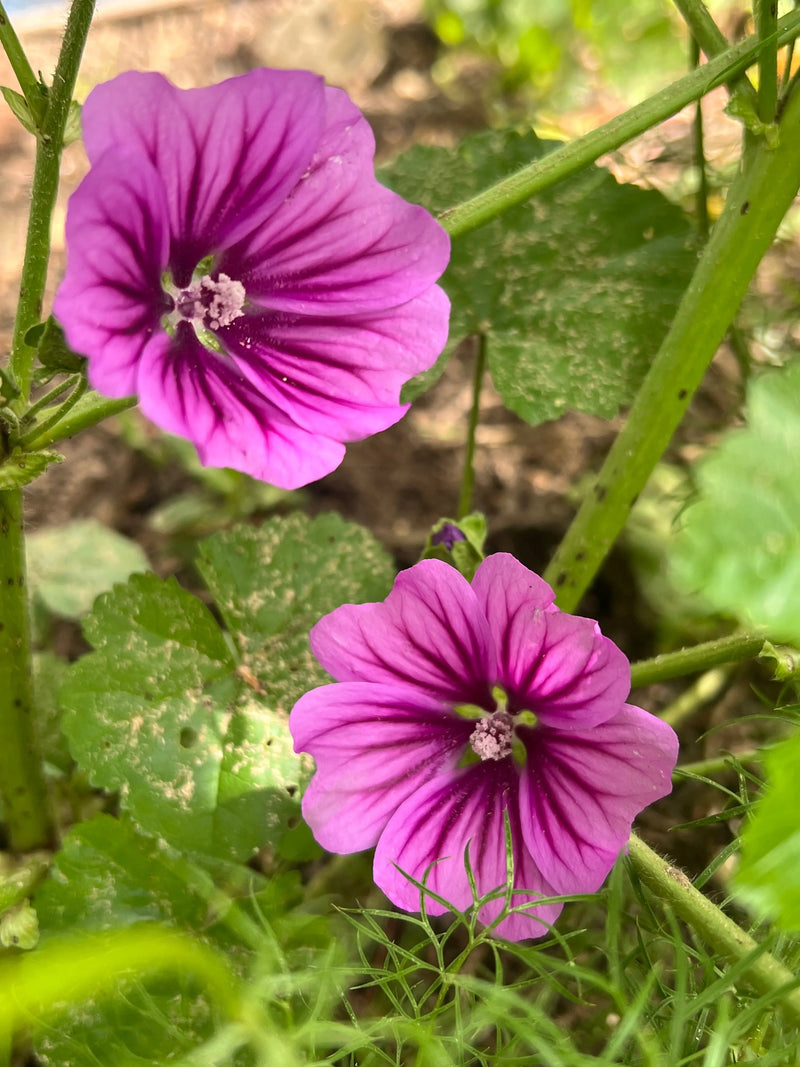
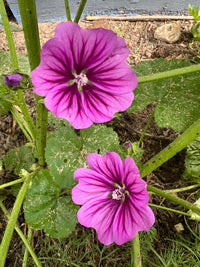
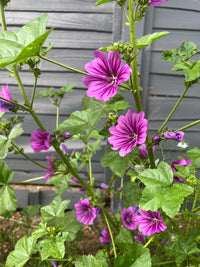
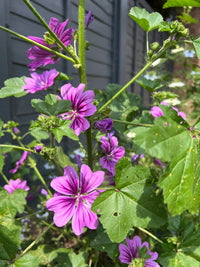
Malva Mystic Merlin
Malva sylvestris var. mauritiana 'Mystic Merlin' -- French Mallow
Tall sturdy spikes of deep violet-purple silky flowers with darker maroon veining — the Hollyhock alternative without rust problems. Hardy perennial, edible flowers.
About this variety
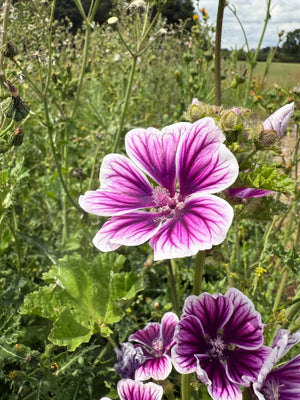
Tall sturdy spikes at 1.2 to 1.5m, loaded with silky saucers in deep violet-purple veined with darker maroon. The colour shifts about depending on temperature and soil, running between indigo-purple and richer magenta, so the plant looks slightly different from week to week.
It is the sensible alternative to a hollyhock. You get the same height, the same architectural spike against a wall, and none of the rust that makes hollyhocks a two-year battle. It is a short-lived perennial, three or four years, gaining size each season.
The dark colour needs company. On its own at the back of a border it reads as a shadow; put it against gold or orange, rudbeckia or a warm calendula, and the complementary contrast is about as strong as cottage planting gets. Flowers and young leaves are edible. The midsummer chop applies here too: cut it back by half when the first flush tires, or the plant goes woody and unproductive for the rest of the season. It self-seeds prolifically, and the seedlings will not all come back this dark.
Plant alongside
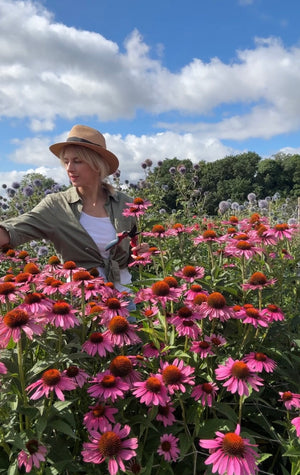
Malva Mystic Merlin pairs beautifully with these cottage garden classics

RHS Plants for Pollinators
This plant has been assessed by the Royal Horticultural Society and recommended as especially beneficial to bees, butterflies and other pollinators. Growing plants like this directly supports UK pollinator populations — something close to our hearts at Salle Moor Hall Farm, where we see the difference a cottage garden full of the right plants can make.
Learn more at RHS.org.uk →