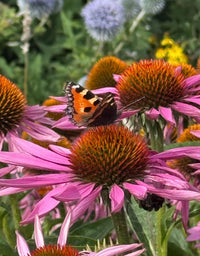
Echinacea Purple Coneflower Seeds
Few plants define the summer garden quite like the Purple Coneflower. Echinacea purpurea is a tough, reliable perennial that produces large, daisy-like flowers with drooping magenta-pink petals surrounding a prominent, coppery-orange central cone. It is iconic, architectural, and completely loved by wildlife.
Native to the North American prairies, this plant is built for resilience. It stands tall on sturdy stems that rarely need staking, blooming tirelessly from mid-summer right through to the first frosts. It is the perfect choice for a low-maintenance border, a wildflower meadow, or a dedicated "pollinator station" in your garden.
Read More
🌿 Understanding the Plant
Echinacea purpurea is a robust Hardy Herbaceous Perennial (H5). It is perfectly suited to the UK climate, dying back to its crown in winter and re-emerging with increased vigour each spring. As the plant matures over 2-3 years, the clumps become larger and more floriferous.
The "Cone" Architecture: The central coppery cone is not just for show; it is composed of hundreds of tiny fertile florets. This structure provides an ideal "landing pad" for butterflies and bees, allowing them to forage efficiently. In autumn, these cones harden and turn black, providing architectural winter interest and a vital seed source for goldfinches.
resilient Root System: Echinacea develops a deep taproot, which makes it exceptionally drought-tolerant once established. It is an essential component of the "New Perennial" or "Prairie Style" movement, valued for its ability to provide structure and colour during the hottest months of the year.
🌱 Growing Guide
Echinacea is straightforward to grow from seed but requires a sunny start and well-drained conditions to thrive.
How to Sow:
Sow indoors from February to April. Surface sow the seeds onto moist seed compost and cover with only a very fine dusting of vermiculite; the seeds require light to germinate. Keep at a constant 20°C. If germination is slow after 3 weeks, move the tray to a refrigerator (approx. 4°C) for 2 weeks to simulate winter (stratification) before returning to the warmth.
Where to Plant:
They demand full sun and thrive in soil that is moderately fertile and well-drained. While they are tolerant of poor soil, drainage is critical; they will struggle in heavy, waterlogged clay over winter. If your soil is dense, we recommend adding grit to the planting hole or growing in raised beds.
Ongoing Care:
While plants may flower lightly in their first year, they are true stars from their second season onwards. Deadheading spent blooms will encourage the production of fresh flower stems through to October. However, leave the final flush of "cones" standing over winter to provide striking silhouettes and a food source for garden birds.
📋 Plant Specifications
| Botanical Name | Echinacea purpurea |
| Common Name | Purple Coneflower |
| Plant Type | Hardy Perennial |
| Hardiness | H5 (Hardy through most UK winters) |
| Light Requirements | Full Sun ☀️ |
| Height | 90cm - 120cm |
| Spread | 45cm - 60cm |
| Spacing | Plant 45cm apart |
| Flowering Period | July to October |
| Perfect For | 🦋 Butterfly & Bee Magnet 🌾 Prairie & Meadow Planting ✂️ Long-Lasting Cut Flowers 🏰 Architectural Structure |
| Seeds per Packet | Approximately 50 seeds |
🤝 Beautiful Garden Combinations
Echinacea is the queen of the "Prairie Style" border. Pair it with these available partners from our collection:
- 🍂 Rudbeckia 'Autumn Forest': The Warm Contrast. The rich, mahogany-gold petals of this Rudbeckia create a stunning autumnal glow against the cool magenta-pink of the Echinacea. Both are stamina-rich, sun-loving partners that keep the garden alive with colour into October.
- 💙 Salvia 'Victoria Blue': The Texture Pair. The upright, vertical indigo spikes of the Salvia provide a brilliant structural counterpoint to the broad, flat daisy heads of the Echinacea. Together, they create a high-contrast, bee-heavy display that looks spectacular in the late summer sun.
📅 Sowing & Flowering Calendar
Sow indoors in spring to establish architectural clumps that will bloom reliably from mid-summer until the first frosts.
| Month | J | F | M | A | M | J | J | J | A | S | O | N | D |
|---|---|---|---|---|---|---|---|---|---|---|---|---|---|
| Sow Indoors | ✓ | ✓ | ✓ | ||||||||||
| Flowering | ✓ | ✓ | ✓ | ✓ |
🦋 Butterfly Landing Pad
If you want to see Red Admirals and Peacocks in your garden, plant Echinacea. The wide, flat landing pad of the central cone is perfectly designed for butterflies to rest while they feed on the high-quality nectar.
🏆 Robust Garden Stamina
Known for its stamina and ability to thrive in baking-hot conditions, Echinacea purpurea is an essential choice for those wanting to create a naturalistic, low-maintenance garden that supports a huge range of British pollinators.
📖 Want more detailed growing advice?
View our Complete Growing Guide for Perennials →
- Regular price
-
£2.50 - Regular price
-
- Sale price
-
£2.50
Couldn't load pickup availability
5.0 / 5.0
(1) 1 total reviews


Echinacea Purple Coneflower
- Regular price
-
£2.50 - Regular price
-
- Sale price
-
£2.50
Beautifully packed and although I haven’t sown these yet, I have other seeds coming up, so more than happy with the quality.