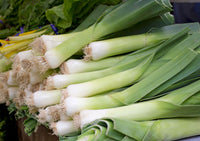
Leek Musselburgh
Scottish heritage maincrop leek - RHS AGM, in cultivation since 1834
The Scottish heritage workhorse with the RHS Award of Garden Merit - thick substantial shanks, sweet mild flavour, in continuous cultivation since 1834 because nothing has yet beaten it.

About this variety
Allium porrum 'Musselburgh' Scottish heritage maincrop leek, RHS AGM
The Scottish heritage leek that has been the British gardener's first choice for over 175 years. Musselburgh was developed in the town of the same name on the Firth of Forth in 1834, and has been in continuous cultivation ever since — longer than most modern countries have existed. The RHS holds it in particular regard, awarding it the Award of Garden Merit for its outstanding reliability, hardiness, and eating quality. If a British gardener has grown only one leek, the chances are it was Musselburgh.
The shanks are exceptionally thick and substantial — up to 5cm in diameter and 25–30cm in length when well grown, with broad green flag leaves above. The flavour is the classic British leek profile: sweet, mild, fully-flavoured without being harsh, and tender even in larger sizes. Unlike some leek varieties that become coarse or fibrous if left too long in the ground, Musselburgh retains its quality through extended cropping — you can harvest as needed from October through to April without worrying about the later plants having become tough.
The hardiness is genuinely outstanding. Musselburgh survives sustained sub-zero winter temperatures without protection, standing in the ground through Scottish winters that would defeat softer varieties. In the south of England the plants are if anything happier than they need to be. Combined with the broad green leaves (which contrast handsomely with the blue-grey of varieties like Bleu de Solaise), Musselburgh is also genuinely attractive in the winter garden.
Musselburgh is open-pollinated heritage, in continuous cultivation since 1834. Seed saved from second-year flowering plants will grow true the following year.
A note on growing
Sow indoors from February to April in trays or modules at 1cm depth in seed compost. Germination takes 10–21 days at 15–20°C. Alternatively, direct sow outdoors from March to May in a seedbed. Seedlings should be grown on to pencil-thickness (around 20cm tall) before transplanting — usually June to July.
Transplant using the traditional British leek-planting technique: make a 15cm-deep hole with a dibber, drop one seedling per hole, and fill the hole with water rather than soil. The hole stays open as the leek grows; surrounding soil gradually falls in to blanch the developing shank white and produce the long pale stem prized in the kitchen. Space plants 15cm apart in rows 30cm apart.
Water consistently through the growing season. Feed monthly with balanced liquid fertiliser through summer for strong shank development. In late autumn, earth up around the plants to additional blanch the stems and provide extra cold protection — though Musselburgh genuinely doesn't need it.
Harvest from October onwards by lifting plants individually with a fork. The crop stays usable in the ground through winter and into early spring. Many British gardeners simply lift leeks as required, leaving the rest in place.
Where it shines
In the kitchen, Musselburgh is the leek of every classic British leek dish — cock-a-leekie soup, leek and potato soup, leek and stilton flan, leek and ham bake, leeks braised in cream as a Sunday side. The substantial size of the shanks makes Musselburgh particularly useful for stuffing (split lengthways, fill with mince or cheese, bake in stock). The mild sweetness pairs naturally with cream, butter, mature cheese, smoked meats, and stock-based soups.
In the garden, Musselburgh is the no-fuss workhorse leek variety. A row of 30–40 plants in the brassica or alliums section of the rotation provides leeks through six months of the British calendar. Pair with Bleu de Solaise for visual variety (broad green Musselburgh foliage alongside blue Bleu de Solaise) and slightly different flavour profiles.
Plant alongside
Leeks are themselves valuable companions for carrots — their strong scent confuses carrot fly, one of the most damaging pests in the UK garden. Plant alongside carrots, celery (mutual protection from each other's main pests), and brassicas. Calendula 'Neon' attracts beneficial insects. Avoid planting near beans or peas, which compete for similar soil nutrients.
Plant alongside
Leek Musselburgh pairs beautifully with these kitchen garden companions