

About this product
Green lacewing larvae earn the nickname aphid lion. A single larva gets through 300 to 400 aphids during its two to three weeks of feeding, and more than 600 where prey is abundant. A third-instar larva at full tilt can manage 120 in a day.
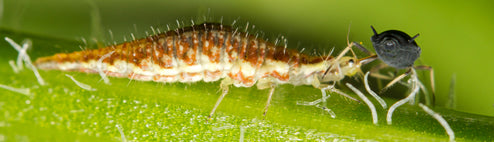
The larvae do the work, not the adults. Adult lacewings feed only on pollen, nectar and honeydew, so they are useful pollinators and no use at all as predators. What you receive is the larval stage specifically, which is the part of the lifecycle that hunts. They look like tiny alligators, about 8mm long, beige-brown with dark markings and curved sickle jaws. They locate prey by movement and chemical cues, grasp it, inject a fluid that digests the contents and drink it out. They will take prey larger than themselves.
They are generalists. Aphids of all species and stages are the primary target, but they also take mealybug, thrips larvae and eggs, whitefly eggs and pupae, spider mite, moth eggs, small caterpillars and scale crawlers.
The limits are equally clear. They cannot reach flying adults, they will not touch hard-bodied insects like beetles or adult weevils, and they are foliage predators, so soil pests need Hypoaspis mites or nematodes instead. Some pest eggs laid on stalks evade them. And the predation window is only the two to three week larval stage; once they pupate, the work stops.
Apply as soon as they arrive, or hold at 10 to 15°C for a day or two at most. Sprinkle them directly onto aphid-affected foliage, or place them on card or paper among the leaves. Put them where the aphids actually are rather than scattering them about. Apply at dusk or in cool conditions, out of direct sun, and not during heavy rain, which washes them off before they settle.
Rates run about 5 larvae per plant or square metre preventatively, 10 for a light infestation, and more for a heavy one. For a substantial infestation, two or three releases at 7 to 10 day intervals work considerably better than one large drop. Equally effective indoors and out.
Live product, cannot be returned.