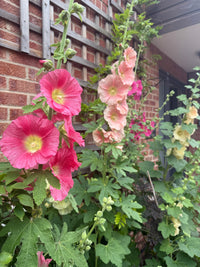
Hollyhock Bishy Barnabee Mix (Alcea rosea) – pink, red and yellow spires against a brick wall

Hollyhock Bishy Barnabee Mix

£2.10
Skip to product information
Hollyhock Bishy Barnabee Mix (Alcea rosea) – pink, red and yellow spires against a brick wall
RHS Plants for Pollinators

Hollyhock Bishy Barnabee Mix

Alcea rosea

1 reviews

Our exclusive house blend of single and double Hollyhocks in every shade from lemon to chocolate-maroon — rising 1.8–2.2m against warm walls. Hand-picked at Salle Moor Hall Farm.

£2.10

Free UK delivery on seed orders over £40

Dispatched from our Norfolk farm by Royal Mail, usually within one working day.

Your growing year

Sow, plant out and flowering months for this variety

Jan
Feb
Mar
Apr
May
Jun
Jul
Aug
Sep
Oct
Nov
Dec
Sow
Plant out
In flower
SowPlant outIn flower

At a glance

Height
Up to 2.2m
Spread
60cm
Spacing
60cm
Position
Full sun
Colour
Mixed
Seeds per packet
50
Soil
Rich, moist, well-drained soil, preferring sandy to clay loam
Grow guide How to grow Hollyhock Bishy Barnabee Mix Read the full guide →

About this variety

Our own blend, picked from the hollyhocks we grow and trial here at Salle Moor Hall Farm. It deliberately mixes the heavy ruffled Chater's doubles with open single saucers, in soft lemon, crimson, apple-blossom pink, white and near-black chocolate-maroon, on spires of 1.8 to 2.2m.

Including both flower forms is not an accident. The doubles are the showpieces and the singles are the ones bumblebees can actually get into, so a mixed row gives you the display and does something useful at the same time.

Now the thing every hollyhock grower has to deal with. Rust is more or less inevitable, and it will cover the lower leaves in orange pustules by midsummer. It disfigures rather than kills. Water at the base rather than over the leaves, give the plants air, and strip the worst leaves off as they go. Treat them as a two-year crop and start fresh plants each year rather than nursing old ones along.

The stems and leaves are bristly and irritate sensitive skin, so wear gloves.
RHS Plants for Pollinators

This plant has been assessed by the Royal Horticultural Society and recommended as especially beneficial to bees, butterflies and other pollinators. Growing plants like this directly supports UK pollinator populations — something close to our hearts at Salle Moor Hall Farm, where we see the difference a cottage garden full of the right plants can make.

Learn more at RHS.org.uk →
  • 5 stars: 1 (100%)
  • 4 stars: 0 (0%)
  • 3 stars: 0 (0%)
  • 2 stars: 0 (0%)
  • 1 star: 0 (0%)
C
Cheryl Ridgewell

Hollyhock Bishy Barnabee Mix