A mezzaluna knife rests on a wooden board with chopped herbs—great for pickling—and fresh dill sprigs, perfect for planting Dill Bouquet seeds from Bishy Barnabees Cottage Garden, beside a beige cloth.

Dill Bouquet

£2.15
Skip to product information
A mezzaluna knife rests on a wooden board with chopped herbs—great for pickling—and fresh dill sprigs, perfect for planting Dill Bouquet seeds from Bishy Barnabees Cottage Garden, beside a beige cloth.
RHS Plants for PollinatorsBeginner friendly

Dill Bouquet

Anethum graveolens 'Bouquet'

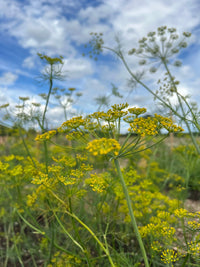
Tall stems topped with flat lime-green umbels that lift every colour around them. Good in the kitchen, good in a vase, and a magnet for hoverflies.

£2.15

Free UK delivery on seed orders over £30

Dispatched from our Norfolk farm — Royal Mail, usually within one working day.

Your growing year

Sow, plant out and harvest months for this variety

Jan
Feb
Mar
Apr
May
Jun
Jul
Aug
Sep
Oct
Nov
Dec
Sow
Plant out
Harvest
SowPlant outHarvest

At a glance

Height
90cm
Spread
30cm
Spacing
20cm
Position
Full sun. Well-drained moisture-retentive soil. Stake in windy gardens. Direct sow only (resents transplanting).
Seeds per packet
300
Soil
Well-drained, moisture-retentive. Not over-fed (rich soil produces leaf rather than flower).
Grow guide How to grow Dill Bouquet Read the full guide →

About this variety

The dill the cutting garden grows. Where ordinary dill is raised for the kitchen alone, 'Bouquet' was selected for the flower bench — ninety centimetre stems topped with large flat umbels of vivid acid-green florets that make every colour around them look better.

Set it against deep purple cosmos, rusty rudbeckia or a near-black dahlia and the lime lifts the whole arrangement. It lasts a week to ten days in water, which is more than most fillers manage.

You still get everything dill normally gives you. Feathery aromatic leaves for the kitchen, edible florets to scatter over fish or new potatoes, and seed heads to dry for pickling. It is also slower to bolt than most dills, so the leaf harvest lasts longer before the plant turns its attention to flowering.
RHS Plants for Pollinators

This plant has been assessed by the Royal Horticultural Society and recommended as especially beneficial to bees, butterflies and other pollinators. Growing plants like this directly supports UK pollinator populations — something close to our hearts at Salle Moor Hall Farm, where we see the difference a cottage garden full of the right plants can make.

Learn more at RHS.org.uk →