


Verbena bonariensis
Verbena bonariensis — RHS AGM; RHS Pollinators
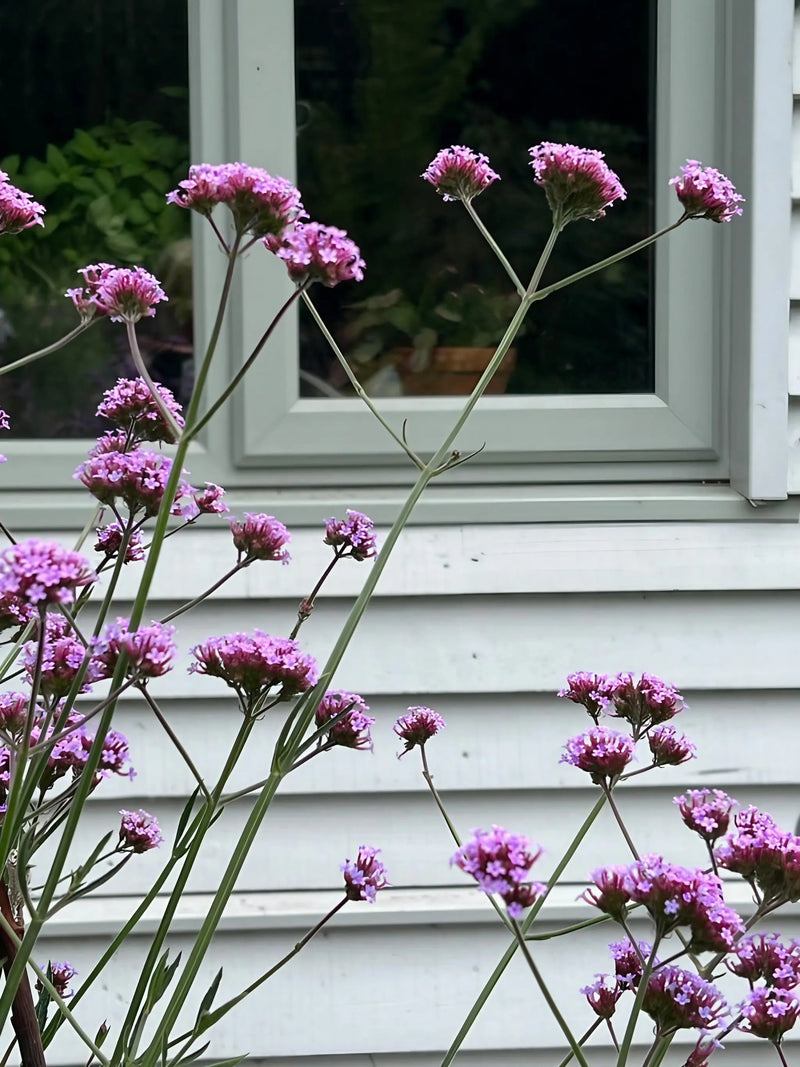
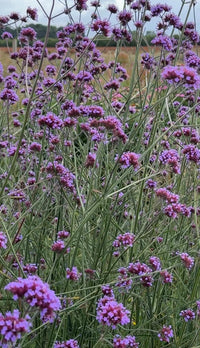
Tall wiry "see-through" stems topped with electric-purple flower clusters — the designer-quality structural perennial and one of the best UK plants for attracting butterflies.
About this variety
Verbena bonariensis Argentinian Verbena / Purpletop Verbena
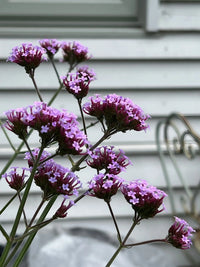
The ultimate "see-through" plant — tall wiry almost-invisible stems topped with tight clusters of electric-purple flowers that add height, movement, and an airy violet haze without creating a heavy block of foliage. Verbena bonariensis is widely regarded as one of the best UK plants for attracting butterflies, and one of the most useful designer-quality structural perennials in the cottage garden.
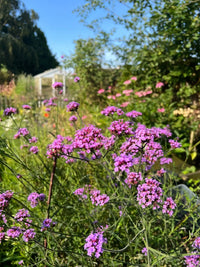
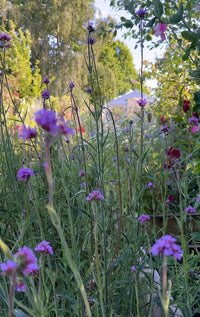
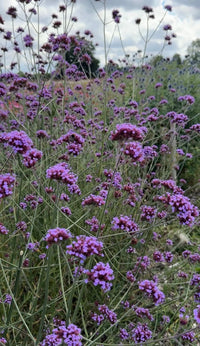
This is the plant garden designers reach for when they want vertical interest that weaves through other plants with grace. Verbena bonariensis produces tall wiry stems (1.2–1.5m) that are so thin and sparse they can be planted at the front of a border without obscuring the plants behind it — the rare "see-through" quality that adds height and movement without creating a visual block. The flowers are tight rounded clusters of small electric-purple florets, held airily at the tops of the stems where they catch sunlight beautifully and make perfect butterfly landing platforms. The plant blooms from midsummer until the first frosts — an exceptionally long flowering season — and is genuinely loved by butterflies who can sometimes be seen feeding on Verbena even when the plant looks bare of other visitors. Short-lived perennial (H4) — may be killed by particularly harsh UK winters, but is a prolific self-seeder. Dozens of seedlings often appear in spring to naturally replace parent plants, ensuring a permanent presence in the garden. Officially listed on RHS Plants for Pollinators and widely regarded as one of the single most important sources of nectar for butterflies in the late-summer garden.
A note on growing
Surface-sow indoors February–April at 18–22°C. Light required for germination — do not cover. Germination 14–28 days, sometimes erratic. Pot on once large enough to handle. Plant out after frost risk in full sun in well-drained soil. Like most perennials from seed, Year 1 establishes the plant; Year 2 onwards delivers the full architectural display — and from Year 2 onwards, self-seeded offspring begin to appear, building the colony.
Important winter survival guidance: in colder gardens, Verbena bonariensis may behave as a short-lived perennial that can be lost to harsh winters. Two protections improve survival: don't cut back the dead stems in autumn (they provide crown insulation through winter); and mulch the crown with bark or straw in particularly cold areas. Trust the self-seeding mechanism — even if parent plants are lost, seedlings from previous years will appear and replace them.
Drought-tolerant once established. Avoid heavy waterlogged soil.
Where it shines
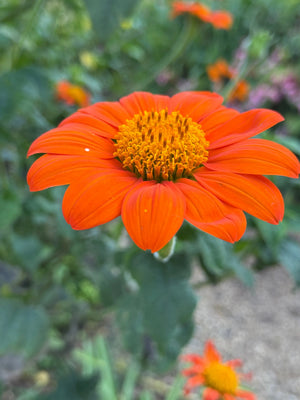
In cottage borders as the designer-quality vertical structural element — Verbena bonariensis is genuinely the plant garden designers reach for when they want height without bulk. At the front of borders specifically, where the see-through quality matters most. As the purple companion for any warm-toned planting — purple and orange are complementary colours, and Verbena bonariensis with Tithonia, Rudbeckia or Helenium creates one of the most powerful complementary cottage colour combinations available. In wildlife gardens specifically for late-summer butterfly support. As an architectural autumn-into-winter plant — the dried stems and seed heads provide structure long after flowering finishes.
Plant alongside
For the textbook butterfly border, combine Verbena bonariensis with Tithonia 'Goldfinger' (matching late-summer butterfly value with complementary orange-and-purple) and Echinacea 'Bravado' (matching prairie-style perennial reliability). With Dahlia 'Bishop's Children Mix' for matching open-flower butterfly support with contrasting form. With Rudbeckia 'Marmalade' for the classic purple-and-gold complementary scheme.
Plant alongside
Verbena bonariensis pairs beautifully with these cottage garden classics


RHS Plants for Pollinators
This plant has been assessed by the Royal Horticultural Society and recommended as especially beneficial to bees, butterflies and other pollinators. Growing plants like this directly supports UK pollinator populations — something close to our hearts at Salle Moor Hall Farm, where we see the difference a cottage garden full of the right plants can make.
Learn more at RHS.org.uk →
RHS Award of Garden Merit
The RHS Award of Garden Merit is given to plants of outstanding excellence for ordinary garden use. To earn this award a plant must be of good constitution, available to the gardening public, and perform reliably across a range of UK growing conditions. It is one of the most trusted plant recommendations in British gardening and a genuine mark of quality.
Learn more at RHS.org.uk →