

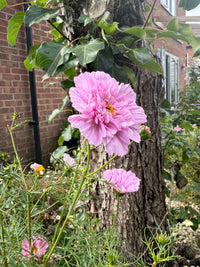
Cosmos Double Click Rose Bon Bon
Cosmos bipinnatus 'Double Click Rose Bon Bon' — Double Click series
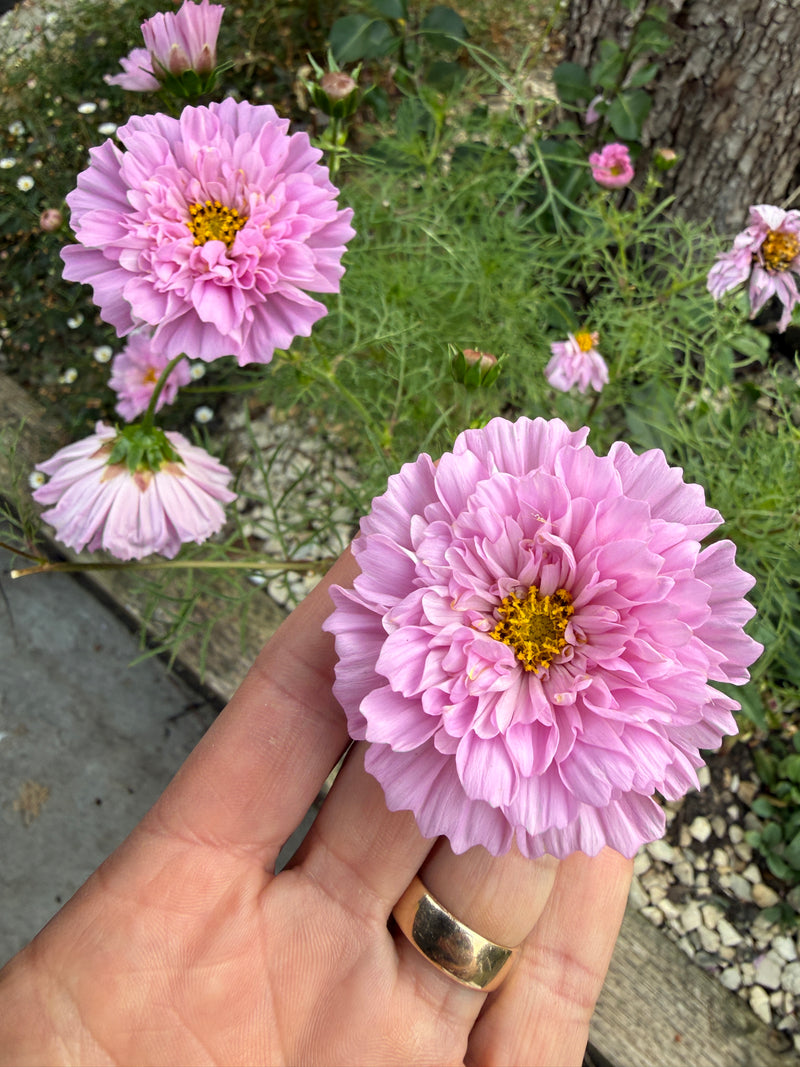
Fully double, peony-like pompom flowers in vintage rose-pink — the Cosmos that gives you peony volume and luxury from a single packet of seed.
About this variety
Cosmos bipinnatus 'Double Click Rose Bon Bon' Double Cosmos 'Rose Bon Bon'
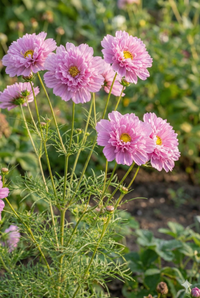
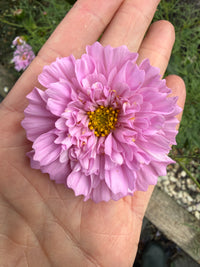
Fully double, peony-like pompom flowers in vintage rose-pink — dense, voluminous, packed with ruffled petals into rounded heads up to 8cm across — held on tall airy stems above characteristically fine, feathery foliage. 'Double Click Rose Bon Bon' is the Cosmos that gives you the volume and luxury of a peony from a single packet of seed.
Standard Cosmos flowers are flat, open, simple daisies — eight broad petals around a central golden disc. 'Double Click Rose Bon Bon' is the opposite of this in almost every structural respect. The flowers are fully double — no visible central disc, no open space — just layer upon layer of ruffled petals packed tightly into a rounded pompom. The effect is unmistakably peony-like: a dense, richly textured flower head that the word "Cosmos" does not in any way prepare you for when you first see it in the garden. If you removed the fine feathery Cosmos foliage and substituted bolder leaves, the flower head alone would pass as a small garden rose or miniature dahlia. This is the Cosmos for gardeners who want peony volume without the years of establishment that peonies require — sow in March, pinch in April, plant out in June, and by July the double pompoms are arriving. Half-hardy annual flowering July through November. Tall stems (90–120cm).
A note on growing
The Cosmos "starvation rule" applies and is especially important for double-flowered varieties: do not feed. Do not plant in freshly manured ground. In rich soil or with any nitrogen fertiliser, 'Double Click Rose Bon Bon' produces magnificent ferny foliage and almost no flowers. In poor, lean, dry, unfed ground in full sun, it flowers prolifically. This is non-negotiable for double Cosmos varieties.
Sow indoors February to April at 18–22°C. Surface-sow or barely cover — Cosmos seeds need light to germinate. Germination 7–14 days. Pot on and harden off carefully. Plant out only after all risk of frost (late May/June) in full sun and lean, well-drained soil. Pinch out the growing tip at 15–20cm to encourage bushy multi-stemmed growth — without pinching, a single main stem produces limited flowers; with pinching, a bushy plant produces continuously. Cutting note: unlike single Cosmos (which are cut at tight bud stage), double Cosmos should be cut when the flower is half to fully open — the dense pompom form does not open well once cut in early bud.
Where it shines
In the cutting garden as the focal flower — the substantial peony-like volume that draws the eye and anchors a mixed arrangement. A hand-tied bouquet of three double pompom stems surrounded by single Cosmos 'Purity', Ammi majus and Nigella creates a professionally styled arrangement with minimal effort. In wedding work, where it provides the peony substance for cottage-garden weddings without the cost or short season of actual peonies — 'Double Click Rose Bon Bon' is reliably available from July through November. Important: double-flowered Cosmos are less accessible to pollinators than single varieties (the dense petals reduce access to nectar). If pollinator support matters, plant alongside single Cosmos like 'Purity' or 'Daydream' to provide accessible flowers for bees and butterflies.
Plant alongside
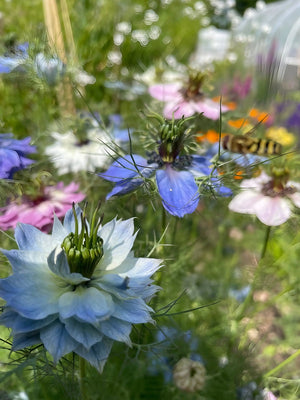
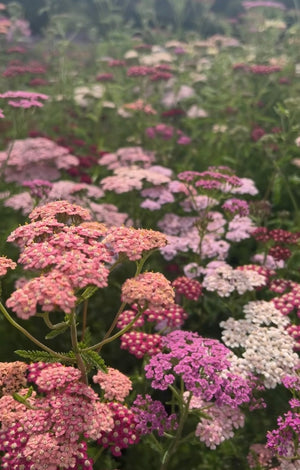
For wedding-quality cutting, combine 'Double Click Rose Bon Bon' with Cosmos 'Purity' (open white daisies), Ammi majus (lacy white), and Nigella for the complete romantic palette. For a vintage rose-pink scheme, pair with Cornflower 'Mauve Boy' and Achillea 'Pastel Mixed' for a properly cottage-romantic border. The dense pompom form contrasts beautifully with the airy quaking-grass plumes of Briza Maxima.
Plant alongside
Cosmos Double Click Rose Bon Bon pairs beautifully with these cottage garden classics

RHS Plants for Pollinators
This plant has been assessed by the Royal Horticultural Society and recommended as especially beneficial to bees, butterflies and other pollinators. Growing plants like this directly supports UK pollinator populations — something close to our hearts at Salle Moor Hall Farm, where we see the difference a cottage garden full of the right plants can make.
Learn more at RHS.org.uk →