


About this variety
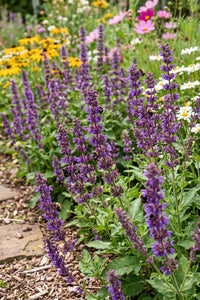
Whorled clary, and the whorls are the point. Most border salvias carry a single dense column of flower; this one packs its violet-purple into tight rings spaced up the stem, so a spire reads as a series of tiers with air between them. At 50 to 60cm it sits at the front or the middle of a border and stands upright without staking.
It flowers in its first summer from a February or March sowing, which is unusual in a perennial and the main practical reason to raise it from seed rather than buy a plant in a pot. Flowering runs from June into September, and it keeps going only if you take the spent spikes off. Leave them on and it sets seed and stops.
Bees work it from the first whorl to the last. The foliage is aromatic and hairy, which rabbits and deer dislike, and once the roots are down it shrugs off drought without complaint.
The seed wants two or three weeks in the fridge before you sow it. Sown straight from the packet, germination is slow and uneven. After that it asks for very little, with one condition: winter wet is what kills it, not cold, so it wants drainage far more than it wants feeding.