

Salvia Victoria Blue
Salvia farinacea 'Victoria Blue' -- Mealy Sage
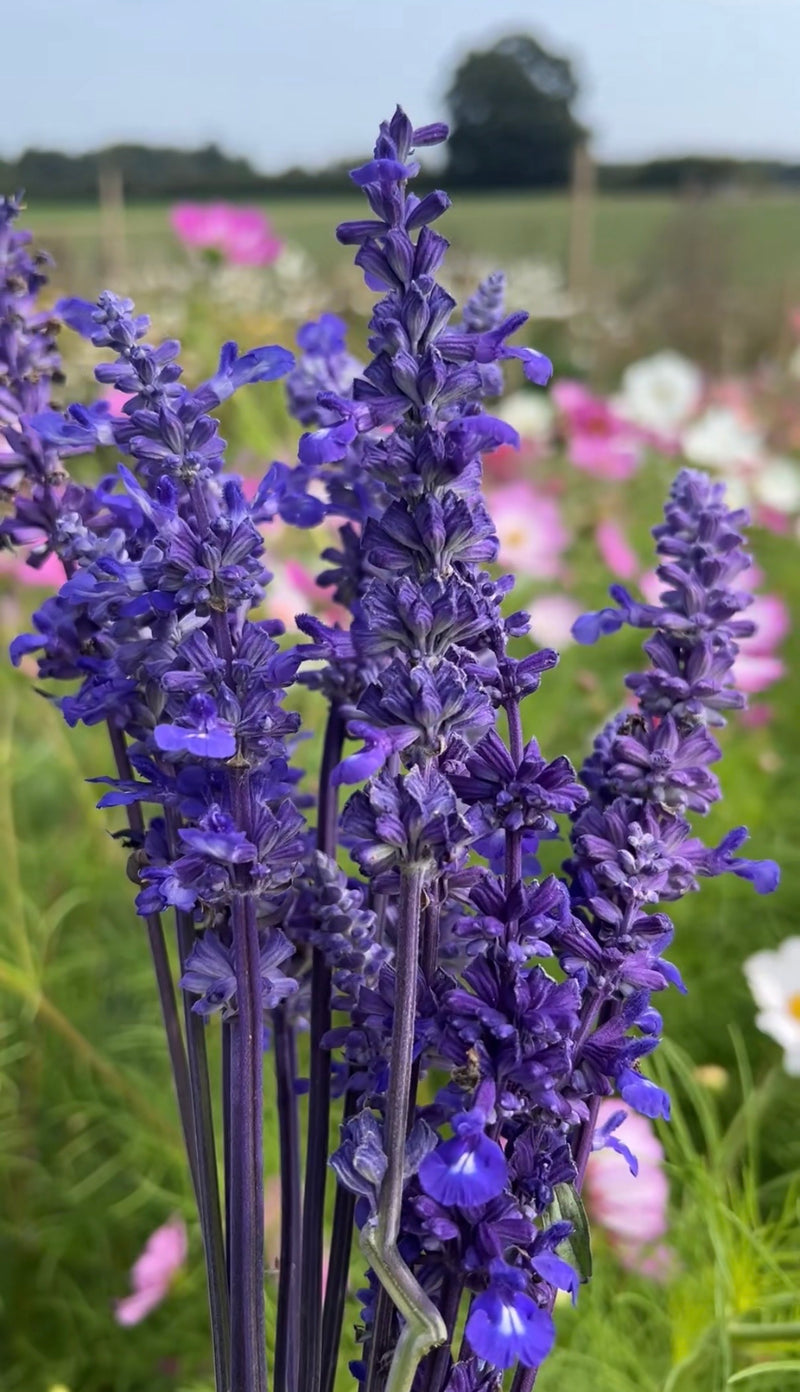
Poker-straight stems with dense velvet indigo-violet spikes — the architectural bolder alternative to Lavender. Clean, unscented, one of the finest blue dried flowers.
About this variety
Salvia farinacea 'Victoria Blue' Mealy Cup Sage 'Victoria Blue'
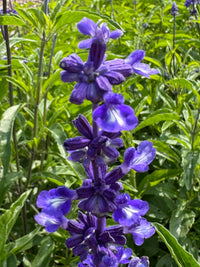
Poker-straight stems topped with dense spikes of velvet-textured flowers in a deep, electrifying shade of indigo-violet — Salvia farinacea 'Victoria Blue' is the architectural cottage Salvia often mistaken for Lavender, but bolder, more structural, and significantly more reliable. Clean, unscented, and one of the most useful structural blue plants in any cottage cutting garden.
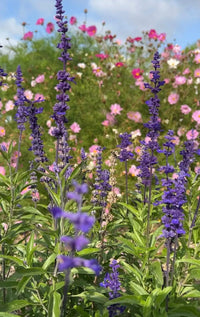
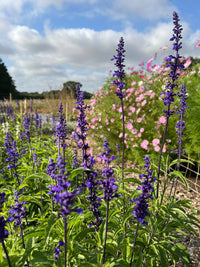
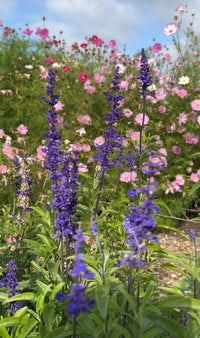
This is the bold structural cousin to Lavender. While Lavender provides soft mounded form and powerful fragrance, Salvia farinacea 'Victoria Blue' provides genuine vertical architecture — poker-straight stems rising to 45–60cm topped with dense compact spikes of small velvet-textured flowers in a deep electrifying indigo-violet that's noticeably more saturated than the soft greyed lavender-blue of true Lavender. The stems themselves carry the characteristic silver-white "mealy" dusting that gives the species its common name "Mealy Cup Sage" and makes the blue flowers appear to glow against the pale stems. Clean, architectural, and unscented — making it the perfect choice for dining table arrangements and indoor display where you want the visual impact of blue without a heavy perfume overpowering food or close company. Half-hardy annual or short-lived perennial in mild UK gardens. Flowers June through October. Outstanding as a dried flower — Salvia farinacea holds its rich colour and structure perfectly when dried, far better than Lavender (which fades to grey and sheds prolifically).
A note on growing
Sow indoors February–April at 18–22°C. Surface-press onto moist seed compost — Salvia seeds need light to germinate; do not bury. Germination 10–21 days. Pot on into individual modules as seedlings develop. Harden off thoroughly before planting out only after all risk of frost has passed (late May or June).
Plant out in full sun in well-drained soil. Salvia farinacea is genuinely drought-tolerant once established and resents heavy waterlogged ground. In heavy clay gardens, add grit to the planting position. Space 30cm apart. Deadhead spent flower spikes by cutting back to the next strong lateral bud — the plant immediately produces new spikes, extending the flowering season significantly.
For drying: harvest stems at peak summer colour saturation when the lower flowers on each spike are open and the upper buds still tight. Air-dry in small bunches hanging upside down in a warm dark place. The dried colour holds beautifully for years if kept away from direct sunlight (all blue dried flowers bleach in UV light).
Where it shines
In cottage borders as architectural vertical blue — the poker-straight stems contrast properly against rounded or airy companions. In container plantings where the upright form provides structural contrast to mounded annuals. As cut flowers for unscented arrangements where Lavender's fragrance would overpower (dining tables, sickroom displays). As one of the most reliable blue dried flowers any cottage gardener can grow — we cut Salvia farinacea specifically for our dried flower range here at Salle Moor Hall Farm. In wildlife gardens for the high bee value.
Plant alongside
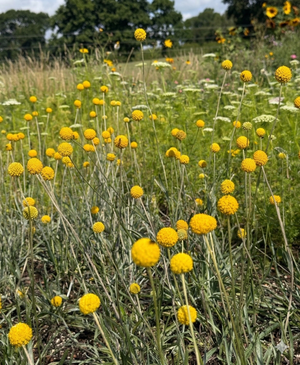
The classic blue-and-yellow combination: pair 'Victoria Blue' with Craspedia (Billy Buttons) — the round yellow Craspedia globes sit beautifully against the vertical blue spikes for a designer cottage cutting and drying combination. For warm-tone contrast in late-summer borders, combine with Rudbeckia 'Marmalade' (matching late-summer reliability, contrasting warm gold). With Salvia 'Violet Queen' for a tonal blue-to-purple Salvia border at slightly different heights.
Plant alongside
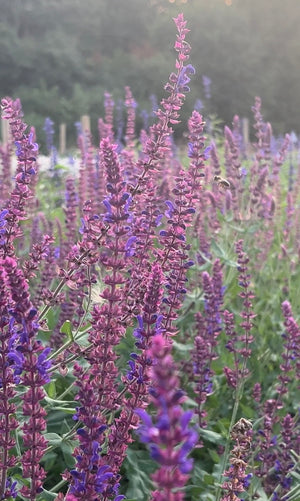
Salvia Victoria Blue pairs beautifully with these cottage garden classics

RHS Plants for Pollinators
This plant has been assessed by the Royal Horticultural Society and recommended as especially beneficial to bees, butterflies and other pollinators. Growing plants like this directly supports UK pollinator populations — something close to our hearts at Salle Moor Hall Farm, where we see the difference a cottage garden full of the right plants can make.
Learn more at RHS.org.uk →
RHS Award of Garden Merit
The RHS Award of Garden Merit is given to plants of outstanding excellence for ordinary garden use. To earn this award a plant must be of good constitution, available to the gardening public, and perform reliably across a range of UK growing conditions. It is one of the most trusted plant recommendations in British gardening and a genuine mark of quality.
Learn more at RHS.org.uk →