

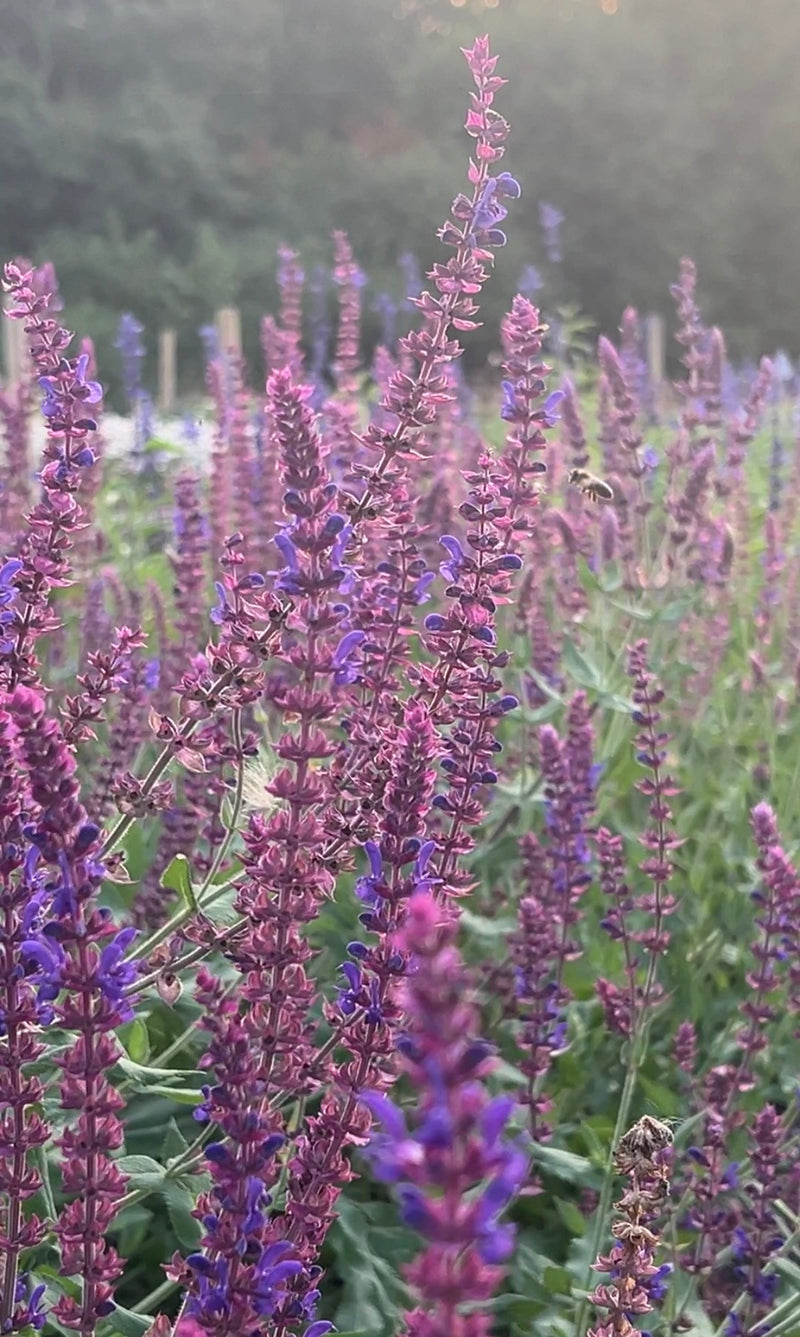
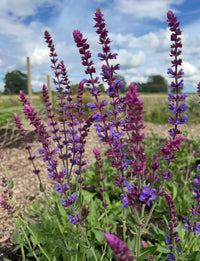
Salvia Violet Queen
Salvia nemorosa 'Violet Queen' -- Woodland Sage
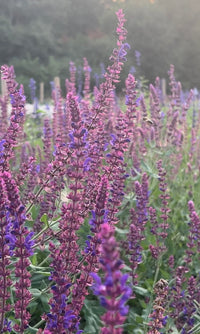
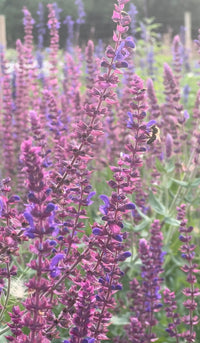
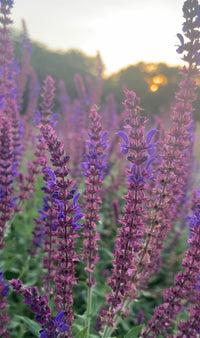
Dense erect violet-purple spikes on sturdy stems — the permanent perennial vertical for the cottage border. Hardy perennial (to -20°C) that flowers in its first year.
About this variety
Salvia × superba 'Violet Queen' Violet Salvia 'Violet Queen'
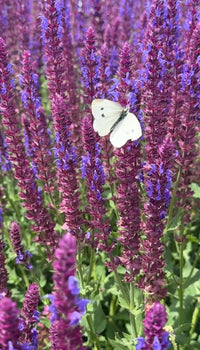
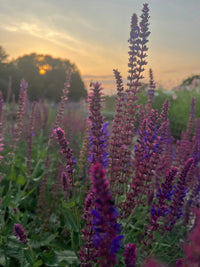
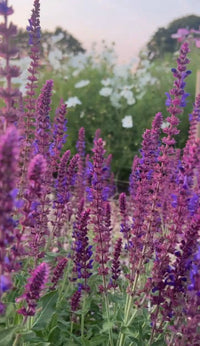
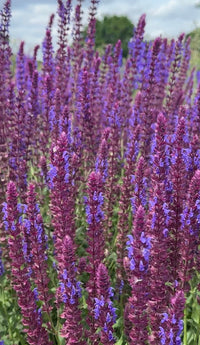
The permanent violet-purple perennial vertical for any cottage border — dense erect spikes of intense violet-purple flowers on sturdy stems, providing essential vertical structure from June onwards, and unusually for a perennial, flowering in its first year from early sowing. Hardy perennial (H7, to -20°C) that expands its crown year after year, providing reliable architectural drama for over a decade once established.
This is the architectural perennial Salvia that every cottage border benefits from. 'Violet Queen' produces dense erect spikes of intense violet-purple flowers on sturdy strong stems reaching 45–60cm, providing the essential vertical structural element that defines a properly composed cottage border. Unlike most perennials grown from seed, 'Violet Queen' flowers in its first year from an early sowing — a real practical advantage that means you don't have to wait until Year 2 for the display. Hardy perennial (H7, surviving below -20°C). RHS Plants for Pollinators recognised. The expanding crown gradually builds into a substantial multi-stemmed clump over years, delivering more spikes and stronger structure with each season.
A note on growing
Surface-press onto moist seed compost. Light required for germination. Sow indoors February–April at 20°C. Germination 14–21 days. Pot on and grow on in bright cool conditions before hardening off.
Plant out in full sun in free-draining soil — this is essential. Salvia 'Violet Queen' is exceptionally tolerant of cold winters but hates winter wet: waterlogged conditions are the single most common cause of plant loss. In heavy clay gardens, add generous grit to the planting hole, plant on a slight slope, or in raised beds. Once established, drought-tolerance is excellent. Space 40cm apart.
Optional Chelsea Chop: in late May, cut the developing stems back by one-third for sturdier, more compact, slightly later-flowering spikes. This is particularly worth doing in exposed gardens where the full-height spikes might flop.
The two-flush trick: shear the entire plant back to the ground after the first flush of flowering finishes (usually August). The plant rapidly regrows and produces a spectacular second flush of flowering spikes in September–October when much of the rest of the garden is winding down. This single intervention dramatically extends 'Violet Queen's' season of usefulness.
Where it shines
At the back of cottage borders as architectural vertical structure — the spikes are some of the strongest natural verticals available from any perennial. In prairie-style and naturalistic plantings. In containers for sustained structural drama. As cut flowers for dramatic vertical arrangements (excellent vase life). In wildlife gardens for the very high bee value — long-tongued bumblebees especially love the deep nectar tubes. As the permanent purple anchor in any planting scheme that benefits from year-on-year reliability.
Plant alongside
The classic purple-and-gold complementary scheme — pair 'Violet Queen' with Rudbeckia 'Autumn Forest' or Rudbeckia 'Marmalade' for one of the most visually satisfying colour combinations in garden design. With Echinacea 'Bravado' (matching prairie-style reliability, complementary pink daisy form) and Echinops ritro 'Veitch's Blue' (matching architectural blue tone). With Salvia 'Victoria Blue' for a tonal blue-to-purple Salvia border.
Plant alongside
Salvia Violet Queen pairs beautifully with these cottage garden classics
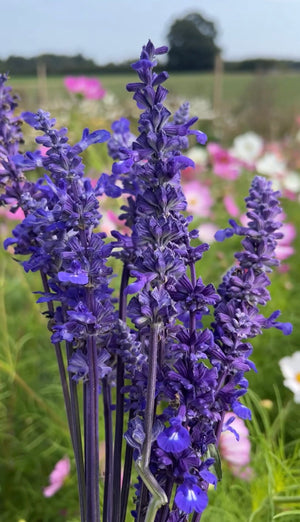
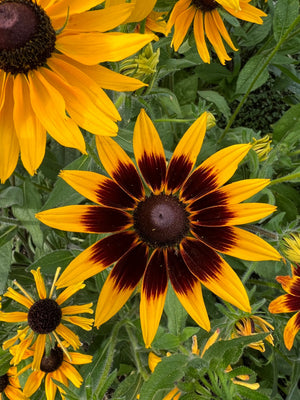


RHS Plants for Pollinators
This plant has been assessed by the Royal Horticultural Society and recommended as especially beneficial to bees, butterflies and other pollinators. Growing plants like this directly supports UK pollinator populations — something close to our hearts at Salle Moor Hall Farm, where we see the difference a cottage garden full of the right plants can make.
Learn more at RHS.org.uk →