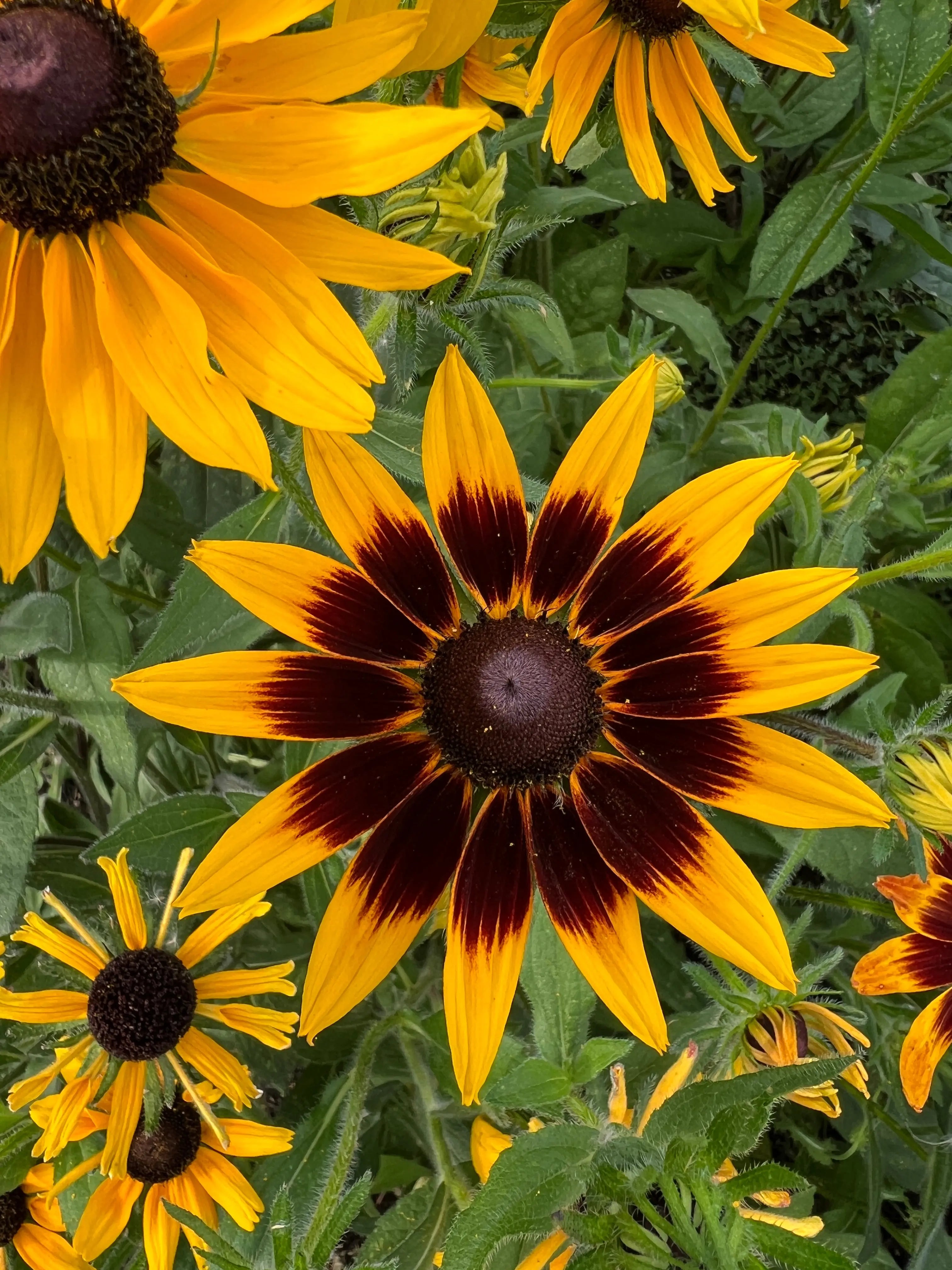


Rudbeckia Autumn Forest
Rudbeckia hirta 'Autumn Forest'
Daisy-form flowers in autumnal mahogany, russet, chestnut and bronze with dark cone centres — the RHS AGM retro-autumnal Black-Eyed Susan for warm late-summer borders.
About this variety
Rudbeckia hirta 'Autumn Forest' Black-Eyed Susan 'Autumn Forest'
Large daisy-form flowers in the warm autumnal palette — rich mahogany, deep russet, warm chestnut, bronze-brown and various bi-colour combinations — all anchored by the characteristic dark brown-to-black central cone. Rudbeckia 'Autumn Forest' is the RHS Award of Garden Merit retro-autumnal Black-Eyed Susan that brings the warm earthy tones of a British woodland (and the harvest-festival aesthetic of 1970s curtains) to the late-summer-into-autumn border with exceptional generosity.
This is not the typical bright golden-yellow Black-Eyed Susan. 'Autumn Forest' provides retro autumnal colours — a palette that evokes the warm earthy tones of 1970s harvest-festival aesthetics as much as it does the actual colours of a British autumn woodland. The flowers range through rich mahogany, deep russet, warm chestnut, bronze-brown, and various bi-colour combinations where warm-toned petals are edged or suffused with darker shading. The dark brown-to-black cone centre gives the Black-Eyed Susan its name and provides each flower with proper depth and definition. Double RHS recognition: both the Award of Garden Merit AND Plants for Pollinators designation — independently verified for outstanding garden performance, bee value, and reliability. Half-hardy annual or short-lived perennial. Height 60–90cm. Flowers July through October.
The defining quality: 'Autumn Forest' is genuinely the most autumnal colour available from a commonly-grown UK annual in the July–October period. The warm orangey-browns are vivid and saturated — they read as deliberate autumn warmth rather than fading. This is the variety to grow when the cottage border is reaching for warmth and depth in late summer.
A note on growing
Rudbeckia hirta seeds need light to germinate. Sow indoors February–April. Surface-sow onto moist compost and press gently — cover with only the finest dusting of vermiculite if covering at all. Do not bury — any significant depth reduces germination rates. Maintain 18–22°C. Germination 10–21 days.
Grow on in bright cool conditions before hardening off. Plant out in June only after all risk of frost has passed, in rich moisture-retentive soil — Rudbeckia is one of the few late-summer plants that genuinely prefers rich fed soil rather than lean conditions (opposite of Cosmos, opposite of Nasturtiums). Add compost to the planting position. Protect young seedlings from slugs for the first 2–3 weeks after planting out — once the leaves develop their characteristic hairy rough texture, slug interest declines significantly.
Deadhead consistently throughout the season for continuous flowering through to November.
Where it shines
In late-summer-into-autumn cottage borders, where the warm autumnal palette reads as proper seasonal colour rather than late-summer fading. In prairie-style and naturalistic plantings. As cut flowers for autumn arrangements — the warm mahogany, russet and bronze tones create a distinctive autumn look (very different from the primary yellow of Marmalade or sunflowers) with vase life of 7–10 days. Combined with dried seed heads, dark foliage and copper-toned stems for unambiguously seasonal autumn arrangements. In wildlife gardens for the high bee value.
Plant alongside
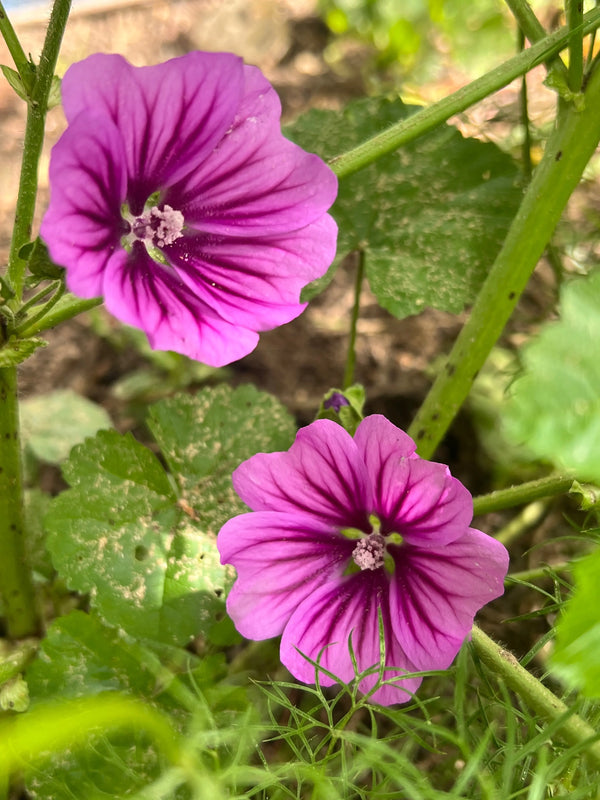
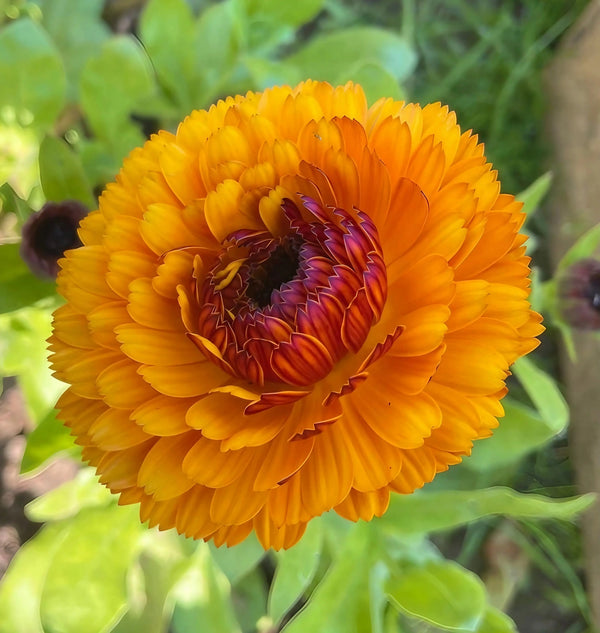
The classical purple-and-gold complementary scheme has been recognised since the 19th century as one of the most visually satisfying combinations — combine 'Autumn Forest' with Malva 'Mystic Merlin' for the perfect cottage example. With purple Salvia (if stocked) for the same complementary effect. For an all-warm autumn cottage scheme, plant alongside Calendula 'Touch of Red' (matching autumnal mahogany tones), Cosmos 'Apricotta' (matching warm pastels) and Bronze Fennel (matching smoky foliage backdrop).
Plant alongside
Rudbeckia Autumn Forest pairs beautifully with these cottage garden classics

RHS Plants for Pollinators
This plant has been assessed by the Royal Horticultural Society and recommended as especially beneficial to bees, butterflies and other pollinators. Growing plants like this directly supports UK pollinator populations — something close to our hearts at Salle Moor Hall Farm, where we see the difference a cottage garden full of the right plants can make.
Learn more at RHS.org.uk →
RHS Award of Garden Merit
The RHS Award of Garden Merit is given to plants of outstanding excellence for ordinary garden use. To earn this award a plant must be of good constitution, available to the gardening public, and perform reliably across a range of UK growing conditions. It is one of the most trusted plant recommendations in British gardening and a genuine mark of quality.
Learn more at RHS.org.uk →