
About this product
Full description
If you've ever planted out a tray of seedlings using a hand trowel, you know the rhythm: dig a hole, lift the soil, place the plant, push the soil back, firm in. Repeat fifty times. By the time you've finished, your back hurts, the soil along the row is a little chaotic, and a few plants have suffered from the disturbance. A dibber changes the rhythm entirely. Push, drop, firm. Push, drop, firm. The same job done in half the time, with half the soil disturbance.
The Burgon & Ball Stainless Steel Dibber is exactly the right version of this small specialised tool. Polished stainless steel body, FSC-certified hardwood handle, RHS-endorsed, backed by a lifetime guarantee. From Burgon & Ball, the Sheffield toolmaker who've been making garden tools since 1730. Supplied to us through our partners at AllotMate, who curate proper, well-made tools for gardeners and allotmenteers who'd rather buy once.
What a dibber actually does
For anyone unfamiliar with the tool — or making do with a trowel for jobs a dibber is genuinely better at — here's the case for owning one:
- Sharp tapered tip — pushes cleanly into prepared soil, creating a properly sized planting hole in a single motion. No digging, lifting or replacing soil
- Smooth polished surface — glides past stones, roots and small underground obstacles rather than catching on them. The tool finds its way through soil that a trowel would have to work around
- Consistent depth — markings or by-feel guidance let you set seedlings, bulbs and seeds at the right depth every time, which matters more than most gardeners realise
- Minimal soil disturbance — surrounding roots and structure stay where they are, which is particularly important when planting amongst established planting
- Speed — for a tray of forty seedlings, a dibber roughly halves the planting time compared to working with a trowel
The honest truth: a dibber is a single-purpose tool. If you only ever plant the occasional thing, a trowel will manage. But if your spring routine includes potting on, planting out modules, or setting bulbs in any quantity, a proper dibber moves it from a tedious back-aching job to a satisfyingly efficient one.
When you'll reach for it
The dibber comes into its own at the busy planting moments of the gardening calendar:
- Planting out seedlings — modules of cosmos, zinnia, salads, brassicas, bedding plants, anything raised under cover and transplanted
- Setting bulbs — particularly snowdrops, crocuses, alliums, and the smaller spring bulbs where consistent depth and spacing matter
- Sowing seeds at depth — large seeds like beans, peas, sweetcorn, sunflowers, where each seed needs its own hole at a precise depth
- Pricking out — moving small seedlings between trays, where the tapered tip lifts roots gently from the compost
- Working in established planting — where you want to add bulbs or plug plants without disturbing the surrounding soil structure
- Container planting — particularly for plug plants in larger pots and troughs
It's not a tool you'll use every day, but on the days you need it, nothing else does the job as well.
Specifications
- Body: Polished stainless steel — rust-resistant, corrosion-resistant, smooth-release
- Tip: Sharp tapered design for clean entry into prepared soil
- Handle: FSC-certified hardwood for comfortable grip and reassuring balance
- Endorsement: Royal Horticultural Society approved
- Guarantee: Lifetime
- Made by: Burgon & Ball, Sheffield (since 1730)
- Supplied through: AllotMate
How to use it well
A few small habits make the difference between rushed planting and properly satisfying work:
- Prepare your soil first — a dibber works best in soil that's been turned, raked or hoed. In compacted ground, it'll struggle
- Push straight down rather than at an angle — a vertical hole sits the seedling correctly and lets you firm soil cleanly around it
- Match hole depth to plant — most seedlings want their root ball just below the surface; bulbs typically sit at three times their height
- Drop the plant in, then firm soil around it with the back of the dibber or your fingers — air gaps around roots are a leading cause of transplant failure
- Water well after planting — settles the soil around the roots and gives the plant a proper start
- Keep a dibber-and-trowel pair on the bench — one for the methodical work, one for the heavier digging. Each makes the other faster
Looking after it
Stainless steel and FSC hardwood — properly looked after, this is a tool to keep for life:
- Wipe clean after each use, particularly after planting in damp or sappy conditions
- Dry properly before storing — the stainless steel resists rust beautifully but appreciates not sitting wet
- The hardwood handle can be lightly oiled with linseed oil once or twice a year to keep it conditioned
- Store in a dry place — out of damp sheds and away from condensation
- An occasional polish with a soft cloth keeps the stainless steel body looking properly bright
The lifetime guarantee says the makers expect this tool to outlast a lot of you. With minimal care, it will.
As a gift
Specialist hand tools are particularly thoughtful gifts because most gardeners haven't bought themselves one — they've made do for years with a trowel. Particularly suited to:
- A serious cottage gardener raising plants from seed and planting out modules in spring
- An allotmenteer who works through significant quantities of seedlings and bulbs
- A bulb enthusiast — the dibber is the right tool for naturalising bulbs in lawns, borders or wild patches
- A new gardener setting up a kitchen garden or vegetable patch — propagation will be a big part of their work
- Mother's Day, birthdays, Christmas — premium-feeling kit at a sensible gift price
- Pair with a packet of seeds or bulbs for a thoughtful complete planting gift
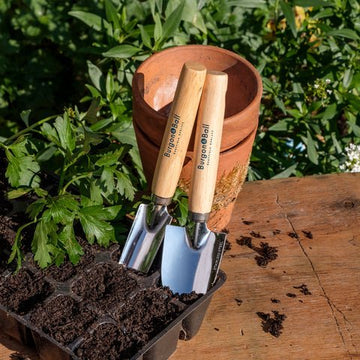
Particularly natural to pair with our Burgon & Ball Cell Tray Trowels for a complete propagation kit, or with the BoronGreen Mid-Handled Trowel for a heavier-duty planting partner.
About Burgon & Ball
Burgon & Ball have been making garden tools in Sheffield since 1730, drawing on the city's centuries-old expertise in steel. They hold the official Royal Horticultural Society endorsement — a designation given to tools that meet exacting standards for performance, durability and design. We're proud to stock their range; British-made tools at this quality are increasingly rare.
A small thought: the cottage garden bench is a slow accumulation of right tools for right jobs. The trowel, the dibber, the snips, the scoop — each one chosen for a specific moment that comes round dozens of times a season. Spring planting goes from a tedious morning of digging individual holes to something genuinely satisfying — the rhythm of push, drop, firm, repeat. Tools like this are why.
What's included
Care and use
- Dry before storing
- Lightly oil the hardwood handle (linseed) once or twice a year
- Store dry, out of damp sheds
- An occasional polish keeps the stainless steel bright
Pairs well with
Other products from the potting shed that work alongside this one.