

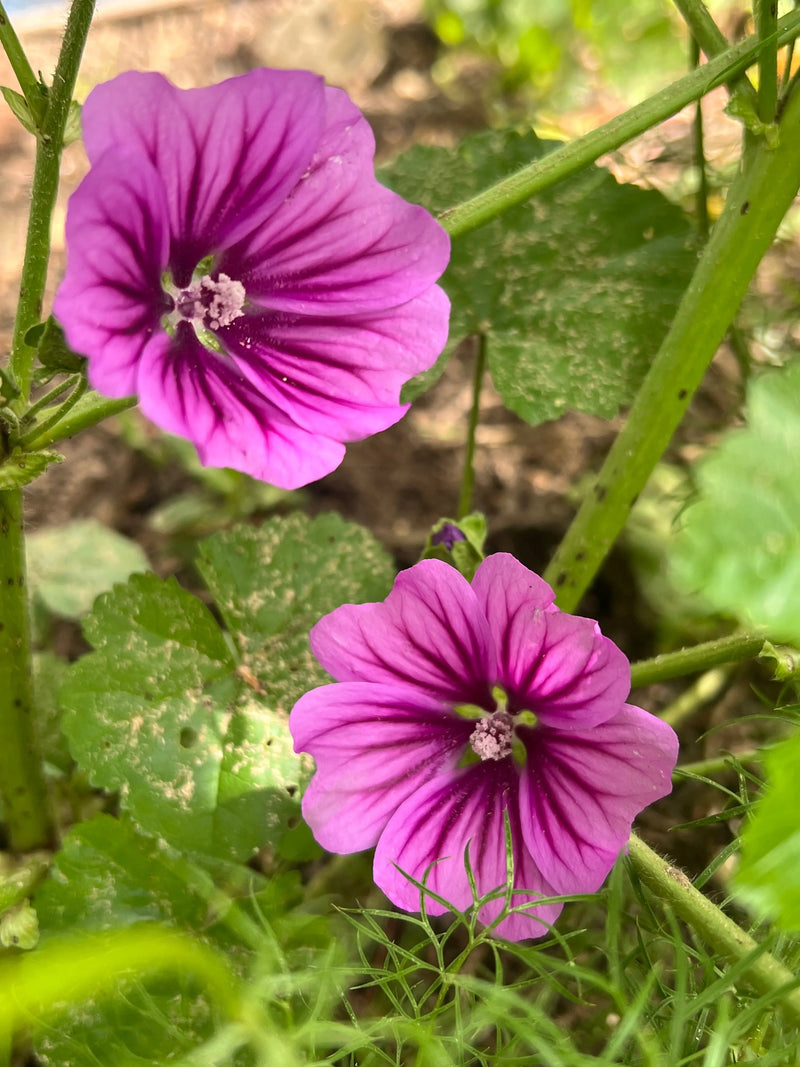
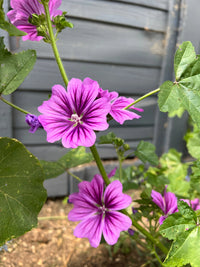
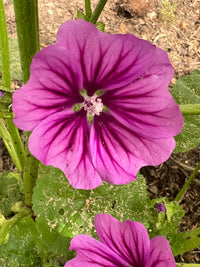
Malva Mystic Merlin
Malva sylvestris var. mauritiana 'Mystic Merlin' -- French Mallow
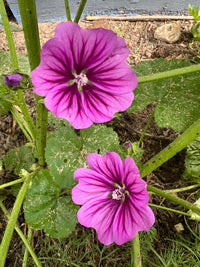
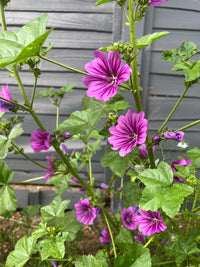
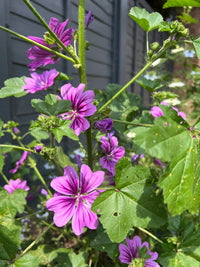
Tall sturdy spikes of deep violet-purple silky flowers with darker maroon veining — the Hollyhock alternative without rust problems. Hardy perennial, edible flowers.
About this variety
Malva sylvestris 'Mystic Merlin' Magic Mallow 'Mystic Merlin'
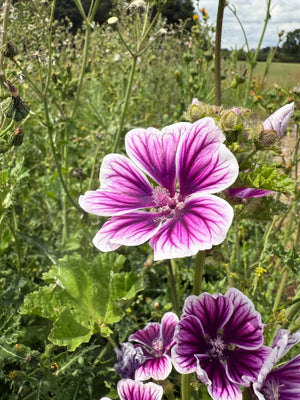
Tall sturdy spikes loaded with silky saucer-shaped flowers in a rich, mesmerising shade of deep violet-purple, intricately veined with darker maroon — true to its name, the colour is quite magical, shifting between deep indigo-purple and rich magenta depending on temperature and soil. 'Mystic Merlin' is the cottage garden's most dramatic dark-Malva, providing Hollyhock-style architectural drama in a more manageable perennial form.
If you love the height and drama of Hollyhocks but struggle with their rust problems, Malva sylvestris 'Mystic Merlin' is the perfect alternative. This stunning variety produces tall (1.2–1.5m) sturdy spikes loaded with silky saucer-shaped flowers in a mesmerising deep violet-purple, intricately veined with darker maroon. The colour has genuine character — it shifts subtly between deep indigo-purple and richer magenta tones depending on temperature, soil chemistry and time of day, giving the plant a different appearance under different conditions. The plant forms a substantial shrubby mound that flowers tirelessly from early summer through autumn, providing a dramatic dark backdrop that makes brighter neighbours appear to glow. Short-lived hardy perennial (H5) — typically lives 3–4 years, gaining size and drama each season. RHS Plants for Pollinators recognised. The flowers and young leaves are 100% edible.
A note on growing
Malvas are robust and easy from seed. Sow indoors February–May or direct outdoors May. Surface-sow onto moist compost and cover with a light dusting of vermiculite. Maintain 15–20°C; germination 14–21 days. Transplant carefully. Plant in full sun or partial shade — 'Mystic Merlin' is unfussy about soil type, thriving in everything from heavy clay to dry sandy ground, provided drainage is reasonable. Its impressive height makes it ideal for the back of borders or against sunny walls.
The mid-summer chop: if the plant becomes straggly after its first flush, shear stems back by half. Water in well; a fresh flush follows for autumn display. This is the most important maintenance practice for Malvas — without it, plants become woody and less floriferous as the season progresses.
Self-seeds prolifically — once you have 'Mystic Merlin', a permanent colony of mystical purple blooms tends to follow indefinitely.
Where it shines
At the back of cottage borders as architectural vertical drama — 'Mystic Merlin' provides Hollyhock-style impact without the susceptibility to rust that plagues actual Hollyhocks. As a complementary planting partner for warm yellow and orange perennials — purple and orange are classic complementary colours, and 'Mystic Merlin' against Rudbeckia or Calendula 'Touch of Red' creates a "colour clash" border that genuinely glows in late summer. In wildlife gardens, where the open saucer flowers are exceptional bumblebee plants. Against sunny walls and fences where the structural form provides architectural cottage character.
Plant alongside
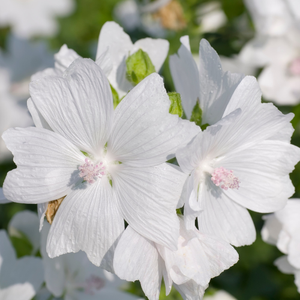
For high-impact late-summer colour clash, pair 'Mystic Merlin' with Rudbeckia or Calendula 'Touch of Red' for the purple-and-orange complementary combination that defines designer cottage borders. For an all-Malva three-tone scheme, combine with Malva moschata 'Alba' (refined white) and Malva 'Zebrina' (soft lilac-pink with veining). With Echinops ritro 'Veitch's Blue' for blue-and-purple architectural drama.
Plant alongside
Malva Mystic Merlin pairs beautifully with these cottage garden classics


RHS Plants for Pollinators
This plant has been assessed by the Royal Horticultural Society and recommended as especially beneficial to bees, butterflies and other pollinators. Growing plants like this directly supports UK pollinator populations — something close to our hearts at Salle Moor Hall Farm, where we see the difference a cottage garden full of the right plants can make.
Learn more at RHS.org.uk →