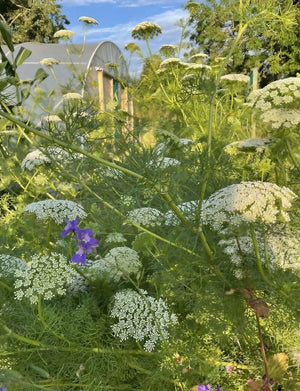



Feverfew
Tanacetum parthenium — feverfew; featherfew; wild chamomile
The cottage garden's hardest-working white daisy — clouds of yellow-centred white flowers on aromatic ferny foliage. Hoverfly magnet, cut flower filler, self-seeding perennial.
About this variety
Tanacetum parthenium Feverfew
The cottage garden's hardest-working white daisy — clouds of small white flowers with yellow button centres on aromatic ferny foliage. Feverfew is a hoverfly magnet that controls aphids throughout the garden, a 10–14 day cut flower filler that lifts every arrangement it joins, a medicinal herb with centuries of use, and a prolific self-seeder that renews its colony free of charge year after year.
If we had to pick the single most useful all-rounder in the cottage garden, Feverfew would be on the shortlist. Each plant produces clouds of small white daisy flowers (typically 1.5–2cm across, each with a prominent yellow button centre) held on branched stems above finely-divided, aromatic ferny foliage. The flowers come in genuine abundance from May or June right through to September, and the plant has a distinctive, sharp, slightly camphor-like scent when brushed (the smell is said to deter aphids from neighbouring plants — historically Feverfew was planted around vegetable gardens specifically for this protective function). Short-lived hardy perennial that flowers in its first year from seed and continues for 2–3 years before declining, but self-seeds so reliably that established colonies essentially renew themselves indefinitely. Height 45–60cm, spread 45cm. Self-seeds politely into permanent informal colonies.
A note on growing
Feverfew is genuinely one of the easiest perennials to grow from seed. Sow indoors from February to April or direct outdoors May/June. Surface-sow as the tiny seeds need light to germinate; press gently into moist compost without covering. Germination is rapid — 7–14 days at 15–20°C. Plant out into full sun or light shade, in any well-drained soil. Feverfew tolerates poor or average soils and is genuinely drought-tolerant once established.
Self-seeding management: Feverfew self-seeds with enthusiasm. In most cottage garden settings this is desirable (a permanent, self-renewing white-flowered carpet at the front of borders). Where controlled spread is wanted, deadhead before seed-set or pull excess seedlings each spring — they are very shallow-rooted when young.
⚠️ Historical medicinal use: Feverfew has been used in herbal medicine for centuries, particularly for migraine prevention. The leaves contain parthenolide and other bioactive compounds. This product is sold as a cottage garden ornamental and not for medicinal use — anyone considering Feverfew for therapeutic purposes should consult a qualified medical herbalist or pharmacist, as the active compounds can interact with medications and cause mouth ulcers if leaves are chewed raw.
Where it shines
In cottage borders as the all-rounder white daisy — Feverfew fills the role of cheerful, reliable, season-long colour that few other plants match. In the kitchen garden, planted around vegetables to attract hoverflies and other beneficial predators that control aphids on the crops nearby. In the cutting garden as one of the most useful "filler" flowers — the clouds of small white daisies lift heavier arrangements with airy character, and the vase life is exceptional at 10–14 days. As a dried flower — Feverfew dries to a warm cream colour, retaining its daisy form perfectly for wreaths and naturalistic everlasting arrangements. In wildlife gardens, where the open daisy form is exceptional for hoverflies and short-tongued bees.
Plant alongside
For a cottage cutting garden combination, pair Feverfew with Ammi majus (matching white lace at greater height), Cosmos 'Purity' (pure white substance against Feverfew's airy lift), and the silvery foliage of Lychnis coronaria (if stocked). In the kitchen garden as a beneficial-insect attractor, plant alongside Calendula and Nasturtium for a comprehensive companion-planting team. For dried flower harvesting, combine with Bunny Tails, Briza Maxima and Statice.
Plant alongside
Feverfew pairs beautifully with these cottage garden classics