

Bishy Barnabees · Salle Moor Hall Farm
Cornflower Dried Flowers | Norfolk Meadow Bunch
Centaurea cyanus (post-flowering seed heads)
Bunch details
- Also known as
- Cornflower Seed Heads · Bachelor's Button Seed Heads · Wild Cornflower Stems
- Stems per bunch
- 25 Stems
- Stem length
- 60cm
- Colour
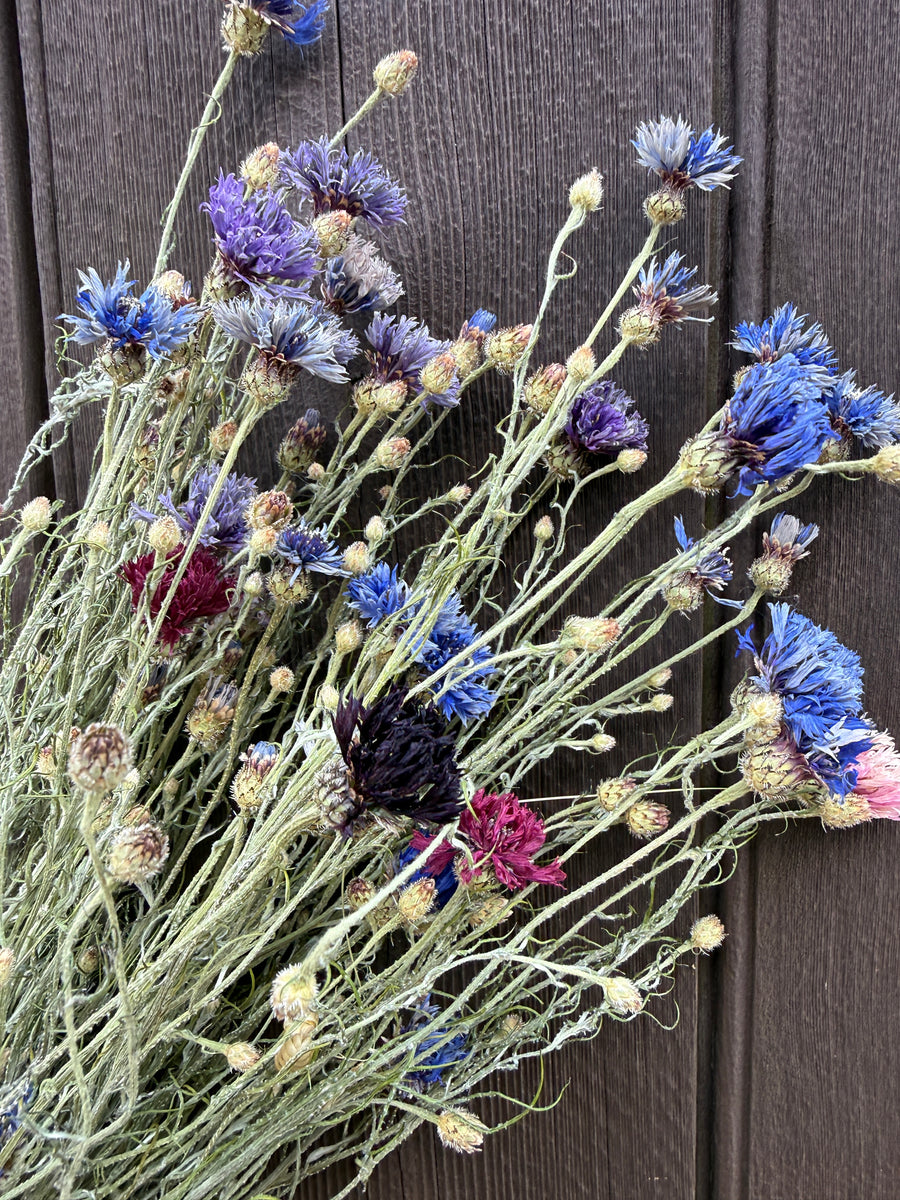
- Cream to pale yellow papery calyx-bracts on wiry silver-green stems, with occasional retained dark purple or blue-violet petal fragments scattered through the bunch as accents
- Texture
- Papery small star-shaped calyx-bracts (each about 1-2cm across), wiry slightly brittle stems, naturally branching wild-habit form
- Colour treatment
- Natural - no dyes, bleaches or preservatives
- Harvest season
- Late summer harvest (August-September) when flower heads have set on stem after petals have finished
- Drying method
- Barn air-dried at Salle Moor Hall, hung upside-down to preserve airy structure
- Growing method
- Chemical-free, hand-grown on our cutting field
- Expected longevity
- Several years given proper care - keep out of direct sunlight (particularly south-facing windowsills) to preserve retained purple accents. Cream calyx-bracts hold their character for years.
The other half of the cornflower story. Dried cornflower products preserve a faded coloured beauty for posy work. Not the tidy cottage-garden cornflower of a wedding buttonhole. Something closer to a a July meadow at the point when the pollinators have moved on and the flowers are quietly fading to a nostalgic haze. Foraged-looking, architectural, and honest about what late-season cornflowers actually look like.
Barn-dried at Salle Moor Hall, Norfolk. Generous hand-tied bunches of Centaurea cyanus stems, each around 60cm long with the naturally wiry, wild-habit character that gives cornflowers their distinctive silhouette. Grown chemical-free on our own cutting field. Hand-harvested during the flowering season, hung upside-down in the barn to preserve the airy, branching structure. No air miles, no imported stems, no dyes or preservatives. Seasonal, available while our late-summer stock lasts.
What you're actually getting
Because this differs from what most customers expect from "dried cornflowers," it's worth being clear:
- Small papery flower heads — blues, pinks, whites and mauve. A beautiful faded mix of colours and wiry stems.
- Wiry silver-green stems — branching, slightly bent, naturally wild-habit. The stems themselves are properly part of the aesthetic, not just supporting structure
- An open, airy bunch — each stem carries multiple small heads at different heights, giving the bunch dozens of visual points across a generous spread
- What you're NOT getting — full petal masses, or a product suitable for wedding confetti. If you want cornflowers for confetti, our loose petal range and our dried flower confetti mixes are the right products
The value of the "gone to seed" moment
There's a category of dried plant material that captures the character of a wild meadow or hedgerow at the specific moment the flowers are finishing and the seed-setting has just begun. This is one of them — alongside dried Hesperis Sweet Rocket (silique seed pods), dried grasses (Bunny Tails, wheat), and dried Nigella seed heads. The shape, structure, and texture that give arrangements air, movement, and a naturally-foraged feel that grows-in-the-wild flowers deliver but nursery-grown perfect stems don't.
Styling ideas
- The wild meadow arrangement — combine with dried oxeye daisies, dried grasses, dried Hesperis Sweet Rocket, and dried wheat for a jug arrangement that reads as gathered from a summer hedgerow rather than assembled from purchase
- Vintage cornfield vase — the traditional July harvest palette: cornflower stems + wheat + barley + dried oats. Warm straws with faded colours.
- Airy filler in mixed bouquets — where big-headed dried flowers (helichrysum, achillea, hydrangea) can look crowded, cornflower stems provide the negative space between them. Reads as "breathable" rather than "cluttered"
- Modern minimalist arrangements — three to five stems in a plain glass bottle, standing tall with nothing else. The linear silhouette suits Scandi and gallery-white interiors surprisingly well
- Autumn wreaths — the wiry stems bend easily into wreaths. Particularly good with dried grasses and warm-toned seed heads
- Craft supplies — individual heads snip cleanly from stems for detail work in mixed dried arrangements or resin art
Pairs beautifully with with Dried Wheat for the vintage cornfield combination, with dried grasses (Bunny Tails, reed) for softening the wiry angular lines, and with dried Nigella seed heads. For contrast rather than complement, pair with soft dried flowers (Feverfew, Achillea 'Ballerina') where the cornflower stems provide structural line against their fluffy texture.
Care note. These are naturally brittle stems — expect a few loose fragments during unpacking, which is normal for wild-habit dried material and no cause for concern. Handle from the base of the bunch. The retained purple accents are UV-sensitive (as with all blue-pigment plants) — keep out of direct sunlight, particularly south-facing windowsills, to preserve any retained colour for years rather than months. Store dry, away from steam and damp. The papery cream calyx-bracts hold their character for several years given proper conditions.
Growing your own. Cornflowers (Centaurea cyanus) are one of the easiest and most rewarding cottage garden annuals from seed — direct-sown in April or September, they germinate readily and produce a full flush of flowers within about 12 weeks. Self-seed prolifically once established. If you leave a few flowers on the plants at the end of the flowering season, they'll dry naturally to exactly the character in this bunch, and produce plenty of seed for next year's sowing. Bishy Barnabee's sell cornflower seeds in the annual flower seed range — growing your own gives you both the summer garden colour and this dried stem harvest without any drying-quality guesswork.
About our dried flowers
Every bunch is grown, hand-harvested and barn-dried at Salle Moor Hall Farm in Reepham, Norfolk — our own cutting field, our own drying barn, our own hands. Grown chemical-free with no dyes, no bleaches, and no preservatives. Packed in compostable packaging in a rigid box to protect the stems in transit. Dispatched within 2-3 working days. Properly good English dried flowers with the story of the summer they came from.