

Bishy Barnabees · Salle Moor Hall Farm
Dried Clary Sage | Salvia sclarea | Norfolk Cottage Garden
Salvia sclarea (mixed-colour variety)
Bunch details
- Also known as
- Clary Sage · Clary · Clear-Eye · Common Clary · Muscatel Sage
- Stems per bunch
- 15 Stems
- Stem length
- 40cm
- Colour
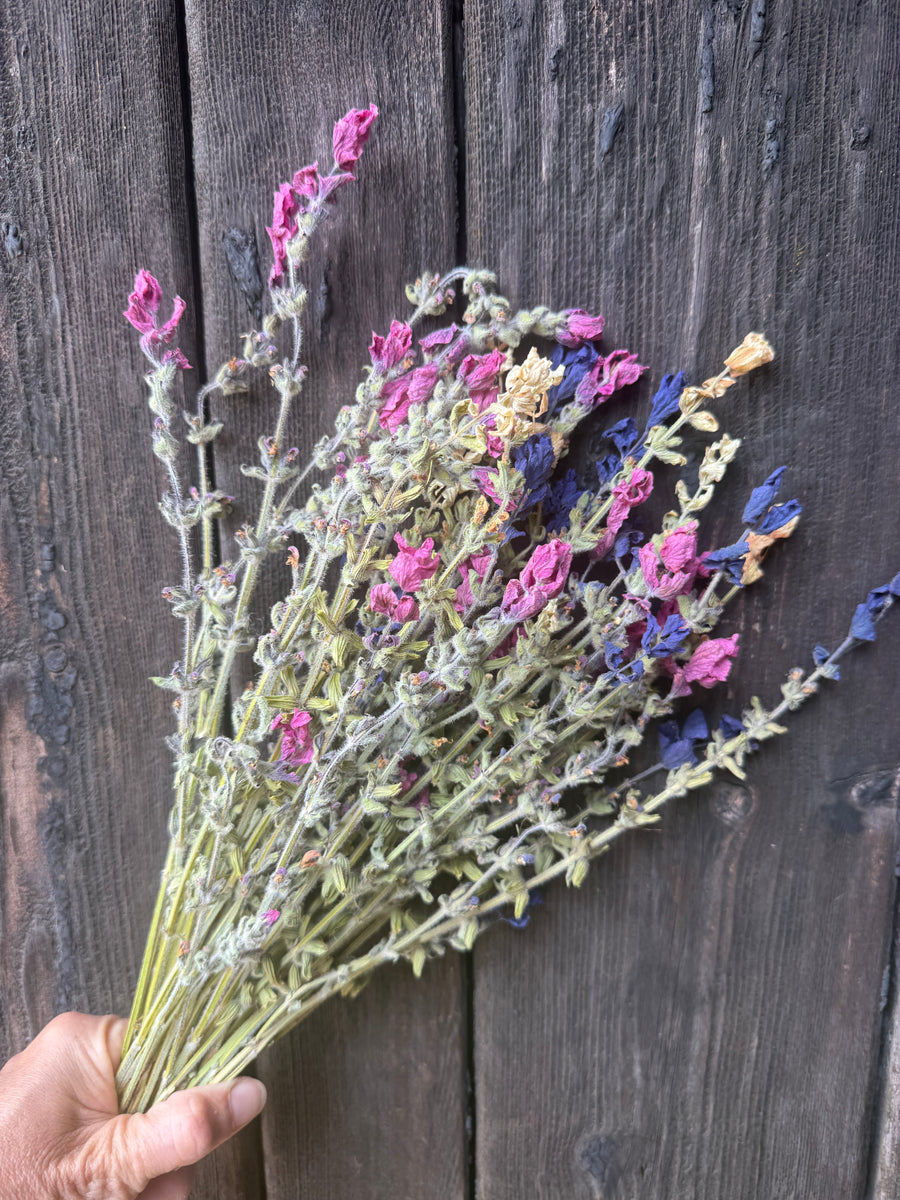
- Vivid mixed palette - magenta pink flowers dominant, royal blue-violet flowers secondary, occasional cream/pale petals. Distinctive fuzzy silver- green stems throughout.
- Texture
- Ruffled labiate flowers (2-3cm across) arranged in whorls along stems. Soft downy stems covered in fine silver-green hairs - "botanical velvet" to the touch.
- Colour treatment
- Natural - no dyes, bleaches or preservatives. The vivid colours are the plant's natural pigments retained through careful drying.
- Harvest season
- Summer harvest (June-July) at peak bloom when colour intensity is highest
- Drying method
- Barn air-dried at Salle Moor Hall, hung upside-down to preserve both flower form and colour intensity
- Growing method
- Chemical-free, hand-grown on our cutting field
- Expected longevity
- Several years indoors given proper care - Clary Sage is properly one of the most colour-retentive dried flowers available. Keep out of direct sunlight (particularly south-facing windowsills) for maximum colour life.
Most dried flowers give up their colour during drying. Clary Sage doesn't. The magenta pinks stay magenta pink. The deep royal blue-violets stay deep blue-violet. The occasional cream and pale petals retain their character. And the flowers themselves — large, ruffled, distinctly labiate — sit in whorls along tall silver-green stems covered in a soft downy fuzz that feels like botanical velvet to the touch. There isn't much else in the dried flower world that combines this kind of retained colour intensity with such distinctive stem texture. Properly extraordinary is the honest word for it, and even that undersells the effect.
Barn-dried at Salle Moor Hall, Norfolk. Bunches of Salvia sclarea, hand-harvested at peak bloom when the colours are at their most intense and hung upside-down to preserve both flower form and stem structure. Grown chemical-free on our own cutting field from the mixed-colour variety that produces the full spectacular range of pinks, blues, and creams within a single bunch. No air miles, no imported stems, no dyes or preservatives — just genuinely honest English cottage garden Clary Sage, cultivated and cared for entirely by us. Seasonal, available while our summer stock lasts.
About the plant
Clary Sage — Salvia sclarea, sometimes called Clear-Eye, Common Clary, or Muscatel Sage — is a Mediterranean biennial in the Lamiaceae family (the mint and sage relatives). Tall, aromatic, and bee-magnificent in flower, it's been grown across Europe for centuries as an aromatherapy essential oil crop, a wine-flavouring herb (hence "Muscatel Sage" — used historically to give German muscatel wines their distinctive character), and a traditional medicine for eye complaints (hence "Clear-Eye"). Modern cottage gardeners grow it for the summer display and the pollinators; commercial growers grow it for the essential oil, which is one of the most highly valued in aromatherapy for its calming, mood-balancing properties. Very little of that oil survives the drying process, but a subtle herbaceous fragrance often remains for the first few months after harvest.
What makes this bunch distinctive
- Retained colour intensity — the magenta pink, royal blue-violet, and cream flowers keep their vivid character through the drying process. Unlike many dried flowers that fade to muted straw tones, Clary Sage holds its garden colour indefinitely if kept out of direct sunlight
- Distinctive fuzzy silver-green stems — the soft downy stems are essentially decorative on their own. The whole plant is covered in a fine hair layer that dries to a soft velvety silver-green, giving the bunch visual and tactile interest beyond the flowers
- Whorled flower structure — the labiate flowers cluster in whorls around the stem at regular intervals up the length of the spike. Reads as sculpturally organised rather than randomly floral
- Tall stems for statement scale — individual stems around 50-70cm long give this bunch presence in larger vessels and dominant display positions
- Large ruffled flower petals — each flower is 2-3cm across with a distinctive ruffled edge that's characteristic of Salvia. Nothing else in the dried flower world quite matches the visual character of a Salvia bloom
- Mixed-colour variety — the pinks and blues appear alongside each other within a single bunch, giving you a naturally-mixed palette rather than a single-colour arrangement
Styling ideas
- Statement single-species display — a full bunch in a tall ceramic vase creates a properly dramatic focal point. The stems are tall enough and the flowers substantial enough that Clary Sage stands entirely on its own without needing companions
- Wedding tablescapes — the mixed-colour flowers work beautifully in country wedding styling. The magenta pinks complement bridesmaid dresses, while the royal blue accents pick up cornflower colours or navy stationery
- Modern cottage arrangements — combine with dried grasses (Bunny Tails, wheat), dried Feverfew (soft cream contrast), and any pale-toned dried elements. The vivid Clary Sage colours read fresh and modern against neutral companions
- Autumn wreaths — the stems bend into wreath rings, and the mix of pink and blue flowers gives autumn wreath work a colour palette beyond the usual russet and gold
- Aromatherapy-inspired displays — Clary Sage's aromatherapy heritage makes it a natural fit for bedroom and bathroom displays. The calming associations are properly gentle and lovely
- Kitchen herbal displays — alongside dried lavender, rosemary, and other kitchen-appropriate botanicals, Clary Sage adds colour and history to the traditional herb-hanging tradition
- Craft and pressed-flower work — the ruffled flower shape presses beautifully and translates well to greeting cards, pressed-flower jewellery, and shadow-box art
Pairs beautifully with dried lavender for the classic cottage garden aromatic combination (a proper "physic garden" pairing), with dried grasses (Bunny Tails, wheat) for soft contrast against the vivid flower colour, with dried Feverfew or Achillea 'Ballerina' for a cream-and-colour palette, and with dried cornflower seed heads for a bee-friendly cottage garden mix. The mixed colour palette of Clary Sage lets it slot into either warm-toned or cool-toned arrangements, depending on which flowers you emphasise.
A note on the aromatic heritage. Clary Sage essential oil is one of the most valued in aromatherapy, traditionally associated with calming, mood-balancing, and hormone-regulating properties. The dried flowers retain a subtle version of the herbaceous, slightly nutty fragrance for the first few months after harvest — not a strong scent, but a gentle presence when the bunch is disturbed. This fades over time as the volatile compounds continue to evaporate. If you value the aromatherapy connection, keep the bunch somewhere it's regularly handled — brushing past it releases what fragrance remains.
Care note. Clary Sage is one of the more colour-retentive dried flowers, but the vivid pinks and blues are UV-sensitive as with all pigmented flowers. Keep out of direct sunlight (particularly south-facing windowsills) to preserve the colour for years rather than months. Handle from the base of the bunch. The fuzzy stems can shed a few silvery hairs during handling — this is normal and no cause for concern. Store dry, away from steam and damp. Kept correctly, the character holds for several years.
Growing your own. Salvia sclarea is one of the easier biennials to grow from seed — direct-sown in spring or summer for foliage in year one and flowers in year two. Bees, butterflies, and hoverflies swarm the flowering spikes in June and July. Self-seeds gently once established. If you leave the flowers on the plant at the end of the flowering season, they dry naturally to the character in this bunch. Bishy sells Clary Sage seeds — growing your own gives you the summer garden performance (properly one of the great bee-forage plants), the aromatherapy essential oil harvest if you're interested in distilling, and the autumn drying harvest without any of the drying-quality guesswork. Our growing guide covers the specific timing and conditions here.
Recommended uses
Styling context
English cottage garden · Country wedding · Physic garden / herbal display · Farmhouse kitchen · Rustic mantelpiece · Bedroom aromatherapy display · Bathroom aromatic bunch · Modern cottage · Autumn styling · Traditional Norfolk cottage
About our dried flowers
Every bunch is grown, hand-harvested and barn-dried at Salle Moor Hall Farm in Reepham, Norfolk — our own cutting field, our own drying barn, our own hands. Grown chemical-free with no dyes, no bleaches, and no preservatives. Packed in compostable packaging in a rigid box to protect the stems in transit. Dispatched within 2-3 working days. Properly good English dried flowers with the story of the summer they came from.