Bhut Jolokia Red
The legendary ghost chilli - the first pepper ever to break a million Scoville
The world-famous Ghost Pepper - the first chilli ever verified over a million Scoville and Guinness world's hottest in 2007. A slow-building, fruity-smoky, utterly ferocious superhot from Northeast India.
Handle with care — this is a superhot chilli
This variety is exceptionally hot. The capsaicin in superhot chillies can cause real discomfort and even burns to skin and eyes, so a few simple precautions make all the difference when handling the fresh or dried fruit:
- Wear disposable gloves whenever you cut, deseed, or handle the fruit
- Keep your hands well away from your eyes, nose, and face while working
- Never touch contact lenses with hands that have handled the fruit
- Work in a well-ventilated space — the fumes from cooking or drying can irritate the lungs and eyes
- Wash hands, knives, and boards thoroughly with soapy water afterwards
- Keep fresh and dried fruit well out of reach of children and pets
The plants themselves are perfectly safe to grow and handle — these precautions apply to the ripe fruit and its seeds.
About this variety
Capsicum chinense 'Bhut Jolokia' (Red Ghost Pepper) The legendary ghost chilli — the first pepper ever to break a million Scoville
A genuine legend, and one of the most famous chillies on earth. The Bhut Jolokia — better known across the world as the Ghost Pepper — made history in 2007 when Guinness World Records certified it as the hottest chilli on the planet, and it became the very first pepper ever scientifically verified to exceed one million Scoville heat units. It held that crown until 2011, and though hotter superhots have since been bred to dethrone it, the ghost pepper remains the variety that started the modern superhot era and captured the world's imagination.
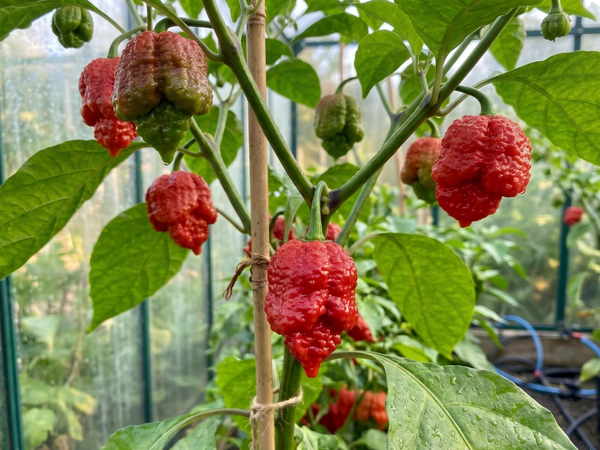
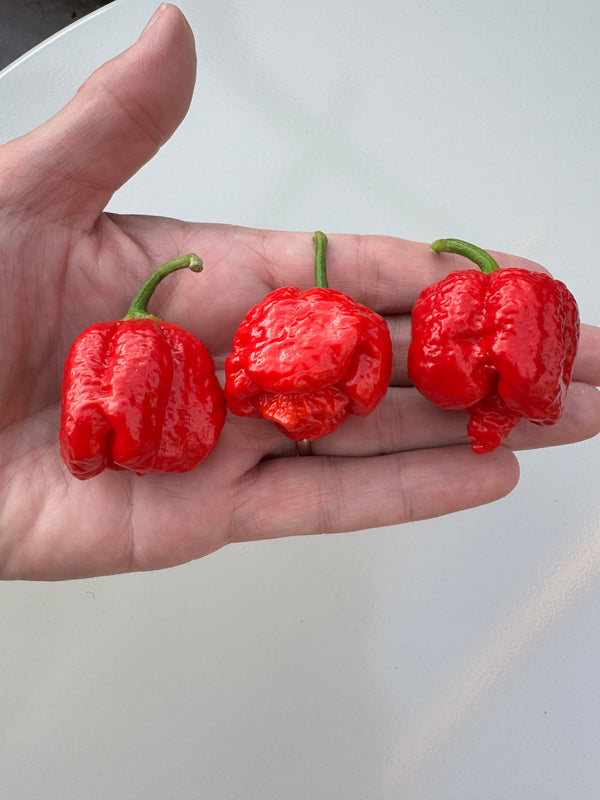
It comes from the misty hills of Northeast India — Assam, Nagaland, and Manipur — where it has been grown for generations and is known as the "king chilli." The name is wonderfully evocative: bhut means "ghost" in Assamese, said to describe the way the heat creeps up on you like a phantom, deceptively slow to arrive and then utterly overwhelming. The pods are slim and tapered, 6–8cm long, with a characteristically wrinkled, dented, papery-thin skin, ripening to a fierce glowing red.
And the heat is the real, historic thing: 855,000 to over 1,040,000 Scoville units, roughly four hundred times hotter than a dash of Tabasco. But what makes the ghost pepper so notorious isn't just the magnitude — it's the delay. The heat builds slowly, almost gently at first, behind a genuinely pleasant fruity, faintly smoky flavour, and then climbs and climbs into a fierce, sustained, ghostly burn that catches out even seasoned chilli-eaters. It's a true superhot, to be treated with real respect.
It's a Capsicum chinense — technically a natural hybrid, mostly chinense with a touch of frutescens in its ancestry — and like all the superhots it's a warmth-hungry, long-season plant for the experienced grower. Reaching around a metre tall and cropping heavily under glass, it's a moderately challenging but enormously satisfying chilli to grow, and a real badge of honour in any collection.
A note on growing
Sow early — this is essential with a superhot chinense. Sow indoors from December to February in a heated propagator at 28–30°C; ghost pepper seeds need genuine warmth and are slow and sometimes erratic to germinate, often taking three to six weeks. Patience is everything: the seeds can sit apparently lifeless for ages before suddenly coming up, so don't give up on a tray too soon.
Prick out into 9cm pots once the seedlings have two true leaves, and grow on at a minimum of 22°C with bright light. Pot on progressively to final 25–30cm pots, keeping the plants warm through spring in a heated greenhouse, conservatory, or on a sunny windowsill, before moving to an unheated greenhouse or polytunnel from June. A long, warm season under cover is essential in the UK — this is not a chilli for an exposed outdoor bed in most of the country.
Water consistently but never let the roots stand waterlogged, and feed weekly with a high-potash tomato food from the first flowers onwards. Pinch out the growing tip at around 25–30cm to build a bushy, branching, heavy-cropping plant. Harvest from late summer through autumn, once the pods are fully red — finishing the season indoors under a grow light will help ripen the last of the crop. Always wear gloves and eye protection when picking, handling, and processing the fruit — full safety guidance is shown at the top of this page.
Where it shines
In the kitchen, the ghost pepper is for the dedicated chilli enthusiast and the serious hot-sauce maker — but its fruity, smoky depth means it brings flavour as well as ferocity. In its Indian homeland it goes into fiery curries, chutneys, and pickles; in the wider world it's prized for intense hot sauces, especially smoky ones where the pepper's own smokiness shines. A tiny fragment is enough to bring serious heat to a whole pot of curry or chilli, and the pods dry beautifully — the thin skin dries quickly — to be ground into a fearsome ghost-pepper powder, used a single pinch at a time. One well-grown plant will supply a household with more heat than it could reasonably use in a year.
In the garden, it's a genuinely prestigious thing to grow — a piece of chilli history, hung with glowing scarlet pods, and guaranteed to impress any fellow grower who knows what they're looking at.
At a glance
- Heat: superhot, 855,000–1,040,000+ SHU — the heat builds slowly, then overwhelms
- Flavour: fruity and faintly smoky beneath an intense, creeping, ghostly burn
- History: the first chilli ever verified over 1 million SHU; Guinness world's hottest, 2007–2011
- Plant: bushy, around 1m, heavy-cropping — long-season, so sow early
- Origin: Northeast India (Assam, Nagaland, Manipur) — the "king chilli"
- Sow: January to February, heated propagator at 28–30°C
- Harvest: late summer to autumn, fully red
- Grow under cover: greenhouse or polytunnel essential in the UK
Plant alongside
Chillies do well with companions that draw in pollinators and help keep pests down. Plant alongside French Marigold 'Spanish Brocade' to deter aphids and whitefly, and Calendula 'Neon' to attract beneficial predators. Basil is a traditional greenhouse companion that enjoys the same warmth, and if you'd like to grow a small collection of superhots together, the ghost pepper shares its greenhouse needs with our 7 Pot Infinity, 7 Pot Yellow, and Armageddon.
Plant alongside
Bhut Jolokia Red pairs beautifully with these kitchen garden companions