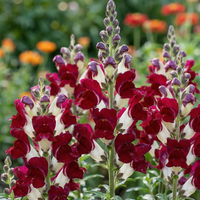
Antirrhinum Night & Day
Spikes of deep, velvety crimson flowers each cut through with a sharp, pure white throat, rising above unusually dark bronze-green foliage in a bicolour combination of extraordinary richness that earns its name with every flower it opens.
About this variety
Antirrhinum majus 'Night and Day' Snapdragon 'Night and Day'
Spikes of deep, velvety crimson flowers each cut through with a sharp, pure white throat, rising above unusually dark bronze-green foliage in a bicolour combination of extraordinary richness that earns its name with every flower it opens.
An offspring of the famous heirloom 'Black Prince' snapdragon, Night & Day takes its parent's deep crimson-to-black flower colour and amplifies it with a striking pure-white lower lip. As cooler autumn weather arrives, the red petals deepen toward near-black while the foliage shifts to dark burgundy — intensifying the bicolour effect just when most annuals are fading. Surprisingly spicy-scented for a snapdragon, beloved by bumblebees, and with edible blooms that make a striking garnish for salads or summer drinks.
A note on growing
Antirrhinum seeds need light and warmth. Sow indoors from January to March or September to October at 18–22°C — surface-sow onto moist compost and do not cover. Germination takes 10–21 days; some growers chill the seeds overnight in the fridge first to improve rates. Pinch out the growing tip when seedlings reach 10cm with 6–8 true leaves — this multiplies your flowering stems significantly. Plant out after the last frost at 25–30cm spacing in full sun to light shade and well-drained soil. Deadhead through the season for continuous flowering from June to first frosts; watch for rust in humid weather.
Where it shines
In the cutting garden, where the dark spikes bring proper drama to mixed arrangements and last 5–7 days in the vase. In cottage borders, plant in groups of five or seven for the proper visual effect — single plants are easily lost amongst other planting. The cool-weather colour transformation makes it one of the few annuals that genuinely improves as the season winds down, holding its own through September and October when most summer flowers are over.
Plant alongside
For maximum drama, combine with the bronze-green grasses of Stipa tenuissima or the soft cream plumes of Pennisetum 'Bunny Tails'. For deep-toned cottage schemes, plant alongside Cosmos atrosanguineus (chocolate cosmos), dark dahlias, or its parent Antirrhinum 'Black Prince' if you can find it. For high-contrast bicolour schemes, the pure-white throats sing alongside white Ammi majus, white Cosmos, or the silver foliage of Stachys byzantina.

