
Bahamian Goat Chilli
A quirky, pumpkin-shaped Caribbean chilli with sweet habanero heat
A legendary Caribbean chilli from the Bahamas - little pumpkin-shaped pods with a sweet, fruity, habanero-class heat and a wonderfully odd name. A characterful, more interesting alternative to the habanero.
About this variety
Capsicum chinense 'Bahamian Goat' A quirky, pumpkin-shaped Caribbean chilli with sweet habanero heat
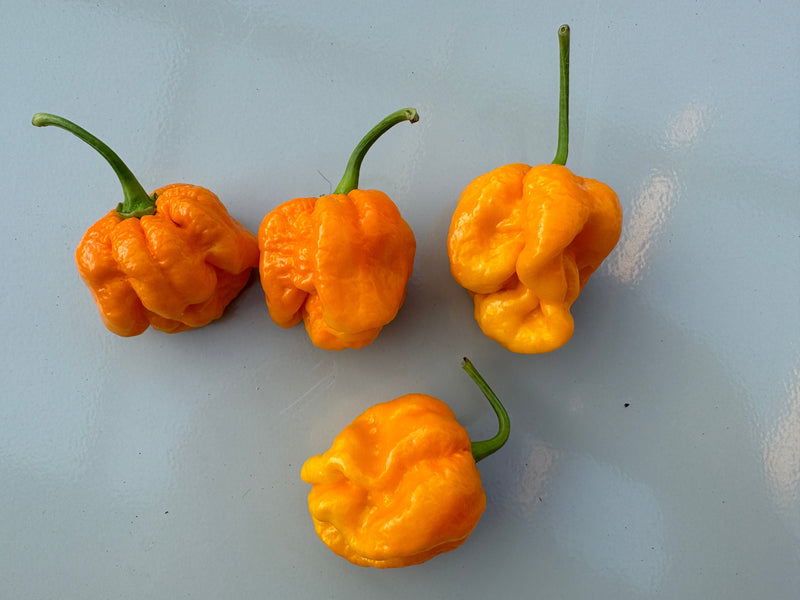
One of the most charming and characterful chillies you can grow — and a real talking point in the greenhouse. The Bahamian Goat is a legendary Caribbean pepper from the islands of the Bahamas, a close relative of the habanero and the Scotch bonnet, but with a look entirely its own: small, round, slightly squashed pods with deep vertical ridges, so that each one looks for all the world like a tiny pumpkin. They ripen from green to a glorious peachy-orange, and slicing one open reveals a surprise — flesh with an almost snowy, frosting-white sheen against the pale membrane. It's as pretty as it is unusual.
The flavour lives up to the looks. Like its famous cousins, the Bahamian Goat carries a sweet, rich, fruity character — many growers rate it as good as, or better than, a Scotch bonnet — behind a proper, satisfying heat that builds gradually rather than slamming in all at once. At 100,000 to 350,000 Scoville units it sits firmly in habanero territory: genuinely hot, with real depth and complexity, but a clear step below the searing superhots, which makes it a wonderful, usable chilli for anyone who loves Caribbean food and wants serious flavour with their fire.
And then there's the name. Nobody is quite sure where "Goat" comes from, and the theories are all delightful: that the pepper has a fierce "kick" like an angry goat; that its knobbly shape looks faintly goat-like; that in the Bahamas the chillies are so often grown near the goats and livestock; or — the favourite — that when you slice one open it releases a pungent, musky aroma that some swear smells distinctly goaty. Whichever you believe, it's a chilli with personality to spare.
It's a Capsicum chinense, the species behind the world's hottest and most aromatic chillies, and like its relatives it's a vigorous, productive, and pleasingly easy plant to grow — reaching around 1.2m, hung with white flowers and then with dozens of those cheerful little pumpkin pods. As a chinense, it does take a good long season to ripen, so an early start is the key to success.
A note on growing
Sow early — this is the most important thing with a chinense. Sow indoors from January to early March in a heated propagator at 25–30°C; chinense seeds need genuine warmth and can be slow, taking anywhere from two to four weeks (sometimes more) to germinate, so be patient and don't give up on a tray too soon.
Prick out into 9cm pots once the seedlings have two true leaves, and grow on at a minimum of 20–22°C with bright light. Pot on progressively to a large final pot. The Bahamian Goat grows best under cover in the UK — a greenhouse, polytunnel, or warm conservatory gives it the long, warm season it needs to ripen a full crop — though it can be grown on a very warm, sunny windowsill, and moved to the sunniest sheltered spot outdoors in high summer once all danger of frost has passed. It likes warmth: the warmer and sunnier the conditions, the better the heat and flavour develop.
Water consistently but never let the roots sit waterlogged, and feed weekly with a high-potash tomato food from the first flowers onwards. Pinch out the growing tip at around 25cm to build a bushy, branching, heavy-cropping plant. Harvest from late summer into autumn, once the pods have ripened to their full peachy-orange — this is when the sweet, fruity flavour is at its best. As with any hot chilli it's wise to wash your hands well after handling the cut fruit and to keep it away from your eyes.
Where it shines
In the kitchen, the Bahamian Goat is a Caribbean cook's delight and a brilliant, more interesting alternative to the habanero. Its sweet, fruity heat is made for tropical and island cooking: blitz it into fiery jerk seasonings and marinades, stir it through Caribbean stews and rice dishes, or build it into a bright, fruity hot sauce alongside mango, pineapple, or papaya. It dries and grinds into an excellent chilli powder, and is particularly good smoked. A little goes a long way at this heat level, so a single plant's worth of pods will keep a kitchen in Caribbean fire for a good long while.
In the garden, it's simply a joy — a generous, productive plant studded with those unmistakable little orange pumpkins, and guaranteed to draw comment from anyone who sees it.
At a glance
- Heat: very hot, 100,000–350,000 SHU — habanero class, building gradually
- Flavour: sweet, rich and fruity — as good as a Scotch bonnet, many say
- Look: distinctive little pumpkin-shaped, ridged pods, ripening green to peachy orange
- Plant: vigorous, productive and easy, around 1.2m — long-season, so sow early
- Sow: January to early March, heated propagator at 25–30°C
- Harvest: late summer to autumn, fully peachy-orange
- Grow under cover in the UK for the best, fullest crop
- Best for: jerk seasoning, Caribbean dishes, fruity hot sauces and smoked powder
Plant alongside
Chillies do well with companions that draw in pollinators and help keep pests down. Plant alongside French Marigold 'Spanish Brocade' to deter aphids and whitefly, and Calendula 'Neon' to attract beneficial predators. Basil is a classic greenhouse companion that enjoys the same warmth and sun, and makes a natural culinary partner too.
Plant alongside
Bahamian Goat Chilli pairs beautifully with these kitchen garden companions