

Armageddon Chilli
British-bred superhot - the world's first F1 hybrid super-chilli
The world's first F1 hybrid superhot - British-bred by Tozer Seeds, around 1.3 million SHU, and bred for vigour: more robust, earlier and higher-yielding than open-pollinated superhots. The grower-friendly way into extreme heat.
Handle with care — this is a superhot chilli
This variety is exceptionally hot. The capsaicin in superhot chillies can cause real discomfort and even burns to skin and eyes, so a few simple precautions make all the difference when handling the fresh or dried fruit:
- Wear disposable gloves whenever you cut, deseed, or handle the fruit
- Keep your hands well away from your eyes, nose, and face while working
- Never touch contact lenses with hands that have handled the fruit
- Work in a well-ventilated space — the fumes from cooking or drying can irritate the lungs and eyes
- Wash hands, knives, and boards thoroughly with soapy water afterwards
- Keep fresh and dried fruit well out of reach of children and pets
The plants themselves are perfectly safe to grow and handle — these precautions apply to the ripe fruit and its seeds.
About this variety
Capsicum chinense 'Armageddon' F1 British-bred superhot — the world's first F1 hybrid super-chilli
A genuine landmark in chilli breeding, and a proudly British one. Armageddon was developed by Tozer Seeds after a five-year breeding programme and first grown commercially by Salvatore Genovese in Bedfordshire, launching to a great deal of fanfare in the summer of 2019. Its claim to fame isn't only the heat — it's that Armageddon is the world's first F1 hybrid super-hot chilli, and that changes everything about how it grows.
Most superhots — the Carolina Reaper, the 7 Pots, the ghost peppers — are open-pollinated varieties that can be slow, fussy, and uneven from plant to plant. As an F1 hybrid, Armageddon was specifically bred for vigour and reliability: the plants are noticeably more robust, more uniform, earlier to crop, and higher-yielding than the older open-pollinated superhots. It's often described as the earliest-maturing superhot of all, ripening up to a fortnight ahead of its rivals — a real advantage in the short British summer. In short, it's the most grower-friendly way into genuine superhot territory.
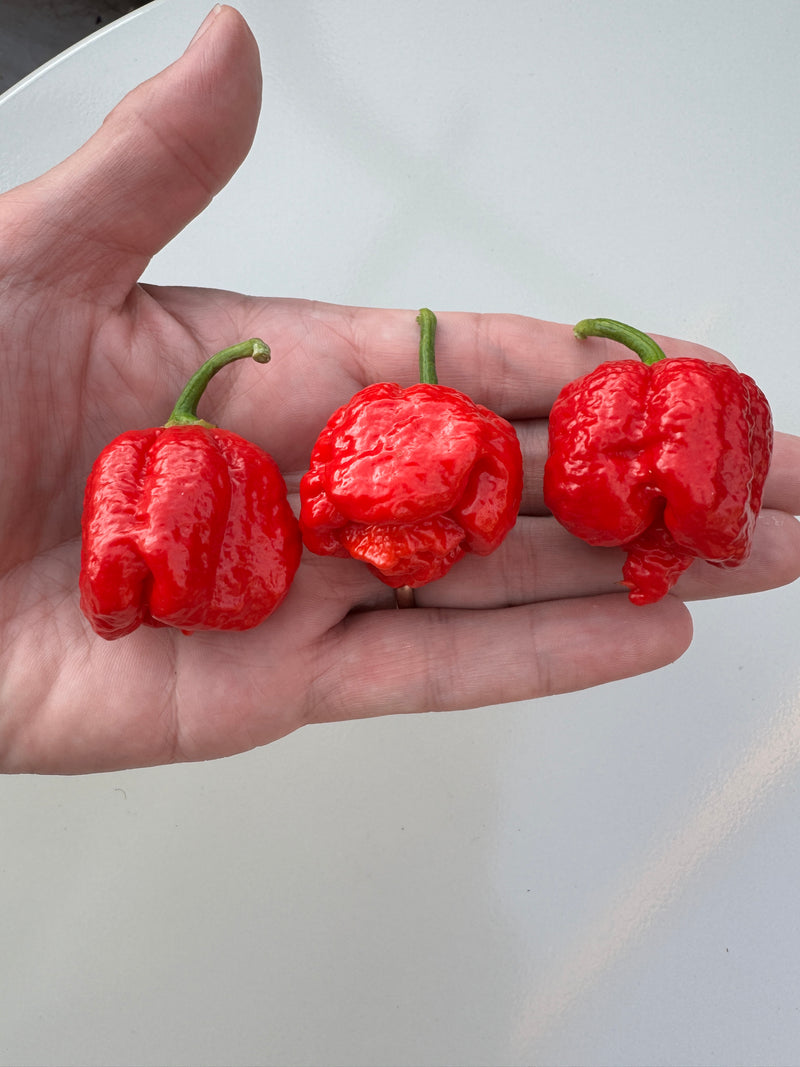
And the heat is the real thing. At around 1,300,000 Scoville units — roughly four hundred times hotter than a jalapeño, with some strains testing higher still — Armageddon sits squarely among the hottest chillies on earth, the hottest British-bred commercial chilli yet grown. The medium-sized pods are wrinkled and crumpled in the classic superhot fashion, ripening from green to a vivid red. Behind the ferocious heat is a genuinely good flavour: fruity, with a bright citrus tang and a faint smoky undertone, and a heat that builds slowly and then keeps on building.
Armageddon belongs to Capsicum chinense, the species behind habaneros, Scotch bonnets, and most of the world's hottest peppers, and is widely thought to carry a little Capsicum frutescens in its lineage to give it that extra vigour. As an F1 hybrid, it's worth knowing that seed saved from your own fruits will not grow true to type the following year — the uniformity and vigour come from the controlled cross, so fresh seed each season is the way to get the real thing.
This is still a superhot, and still a chilli for the experienced grower and the confident cook — but of all the superhots, it's the one most likely to reward a first attempt.
A note on growing
Sow indoors from December to early March in a heated propagator at 25–30°C. As a chinense superhot the seed needs real warmth to germinate, though Armageddon's hybrid vigour means it tends to come up a little more readily and evenly than open-pollinated superhots — usually within 14–28 days. Patience still pays: don't give up on a tray too soon.
Prick out seedlings into 9cm pots once they have two true leaves, and grow on at a minimum of 20–22°C with bright light. Pot on progressively to final 25–30cm pots, keeping the plants warm through April and May in a heated greenhouse, conservatory, or on a sunny windowsill, before moving to an unheated greenhouse or polytunnel from June. A warm, sunny, sheltered spot is essential — this is not a chilli for an exposed outdoor bed in most of the UK.
Water consistently but never let the roots stand waterlogged, and feed weekly with a high-potash tomato food from the first flowers onward. Pinch out the growing tip at around 25–30cm to build a bushy, branching, heavy-cropping plant — and Armageddon does crop heavily, so a single plant produces a serious quantity of pods. Harvest from August through October once the fruits are fully red. Always wear gloves and eye protection when picking, handling, and processing the fruit — full safety guidance is shown at the top of this page.
Where it shines
In the kitchen, Armageddon is for the serious hot-sauce maker and the dedicated chilli enthusiast — but its fruity, citrusy flavour means it brings more than just punishment. It's excellent in small-batch hot sauces, especially fermented ones, where the fruit notes develop alongside the heat; pair it with mango, pineapple, or citrus for the classic superhot-and-fruit combination. A tiny sliver is enough to bring serious heat to a whole pot of curry, chilli, or marinade, and the pods dry and grind well into a superhot powder to be used a single pinch at a time. One well-grown plant will supply a household for a year and then some.
In the garden, it's one of the more satisfying superhots to grow precisely because it performs — vigorous, productive, and earlier than its rivals, hung with crumpled scarlet pods at the height of the season.
At a glance
- Heat: superhot, around 1,300,000 SHU (roughly 400× a jalapeño)
- Flavour: fruity with a bright citrus tang and a slow, building heat
- Plant: vigorous bushy hybrid, 60–120cm, very high-yielding
- F1 hybrid: easier, earlier, and more uniform than open-pollinated superhots
- Sow: January to early March, heated propagator at 25–30°C
- Harvest: August to October, fully red
- Grow under cover: greenhouse, conservatory or sunny windowsill
- Heritage: British-bred (Tozer Seeds), the world's first F1 superhot, launched 2019
Plant alongside
Chillies do well with companions that draw in pollinators and help keep pests down. Plant alongside French Marigold 'Spanish Brocade' to deter aphids and whitefly, and Calendula 'Neon' to attract beneficial predators. Basil is a traditional greenhouse companion that enjoys the same warmth, and if you'd like to grow a small collection of superhots together, Armageddon shares its greenhouse needs with our 7 Pot Infinity and 7 Pot Yellow.