

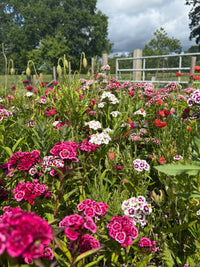
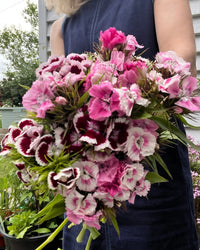

Sweet William Auricula Eyed Mixed
Dianthus barbatus 'Auricula Eyed Mixed' — Hardy Biennial
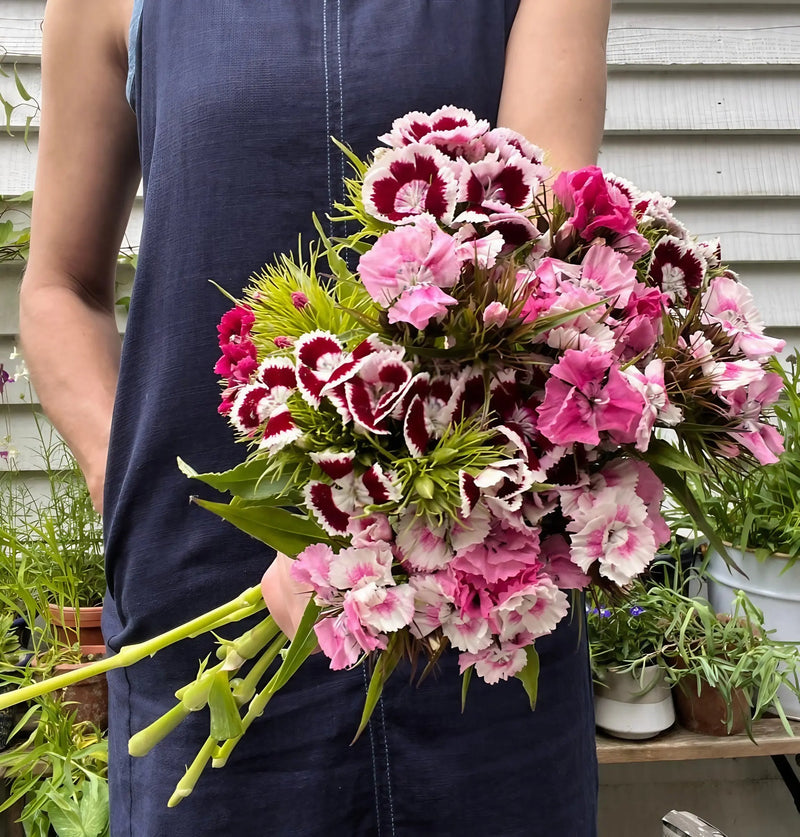
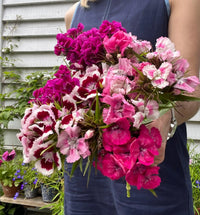
Dense clusters of crimson, purple and pink bicolour florets with characteristic pale "auricula eyes" — the cottage biennial classic with intense clove fragrance and 10-14 day vase life.
About this variety
Dianthus barbatus 'Auricula Eyed Mixed' Sweet William 'Auricula Eyed Mixed'
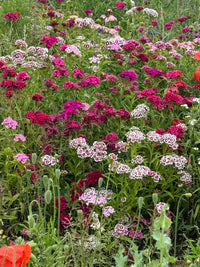
The cottage garden biennial classic — dense clusters of crimson, purple and pink bicolour florets with characteristic contrasting pale or white "auricula eyes" at the petal bases, releasing an intense clove-like fragrance through the late-spring garden. Sweet William 'Auricula Eyed Mixed' is the Victorian cottage favourite that defines the early-summer cottage cutting garden, on tall sturdy 45–60cm stems built for the vase.
This is the Sweet William that defines the genus. The dense flat-topped clusters of small florets carry the unmistakable bicolour "auricula eye" pattern — each individual flower marked with a contrasting pale or white centre against the crimson, purple or pink outer petals, the effect referencing the elaborately-patterned eye markings of Victorian auricula primulas. The flowers carry the traditional Sweet William fragrance — a rich clove-like perfume that scents an entire room from a single small bunch, and that has been valued for cutting in British cottage gardens for over 400 years (Sweet Williams have been in continuous British cultivation since the 1500s). Hardy biennial (H7) following the classic two-year cycle: rosette of strong green leaves in Year 1, spectacular flowering and seed-setting in Year 2. RHS Plants for Pollinators. Edible petals with a mild clove flavour — usable as cake decoration and salad garnish. Self-seeds freely once established, creating permanent cottage colonies. Height 45–60cm. Outstanding cut flower with 10–14 day vase life.
A note on growing
Like all biennials, Sweet Williams follow a two-year rhythm:
- Year 1: sow outdoors May to July in a nursery bed or modules. Cover seeds with 5mm fine soil. Germination 10–14 days at cool temperatures. Plants develop strong green rosettes through summer and autumn.
- Year 1 autumn: transplant to final flowering position in September or October, where plants overwinter as established rosettes.
- Year 2: spectacular flowering from May through June with dense clusters of fragrant blooms.
A cool winter outdoors is essential for flowering — Sweet Williams need the cold period to trigger their second-year flowering. Plants kept indoors over winter typically fail to flower.
Same-year flowering alternative: Sow February–May indoors at 15–20°C, harden off carefully, and plant out after frost — flowers in approximately 10 weeks. This bypass works but produces shorter-stemmed less-substantial plants than the proper biennial cycle.
After the main flush: cut back spent flower heads to encourage smaller side-shoot flowers. Once the main season ends, pull plants up and compost — they are short-lived and unlikely to produce a satisfying second display. However, self-seeded volunteers the following year are welcome.
Where it shines
In the cottage cutting garden as the spring-into-early-summer fragrance flower — Sweet Williams arrive between the spring biennials (Forget-me-nots, Wallflowers) finishing and the summer annuals (Cosmos, Zinnias) beginning, filling the gap with cottage perfume and substantial cutting material. As a vase essential — a small bunch fills a room with the unmistakable Sweet William clove fragrance. In wedding flowers for cottage-themed late-spring weddings. As a self-seeding informal colony plant. In wildlife gardens for the high bee value. In children's gardens for the edible petals and the proper cottage character.
Plant alongside
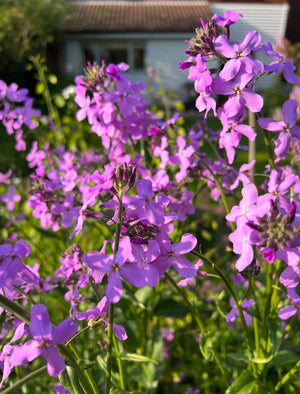
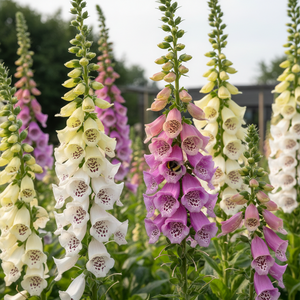
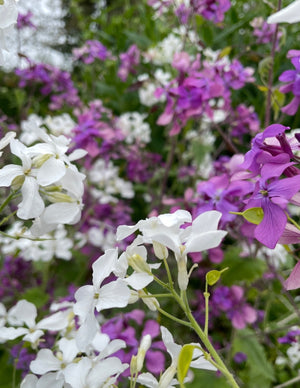
The classic biennial-into-perennial transition combination: pair Sweet William 'Auricula Eyed' with Honesty (Lunaria) and Hesperis 'Purple' (Sweet Rocket) — all three flower simultaneously in May/June, all are classic cottage biennials, and all provide the layered late-spring romantic cottage scheme. With Foxglove 'Excelsior Mix' for matching biennial timing with contrasting vertical structure. With Aquilegia 'Barlow Mixed' for matching mid-height layer with cottage pastel character.
Plant alongside
Sweet William Auricula Eyed Mixed pairs beautifully with these cottage garden classics

RHS Plants for Pollinators
This plant has been assessed by the Royal Horticultural Society and recommended as especially beneficial to bees, butterflies and other pollinators. Growing plants like this directly supports UK pollinator populations — something close to our hearts at Salle Moor Hall Farm, where we see the difference a cottage garden full of the right plants can make.
Learn more at RHS.org.uk →