

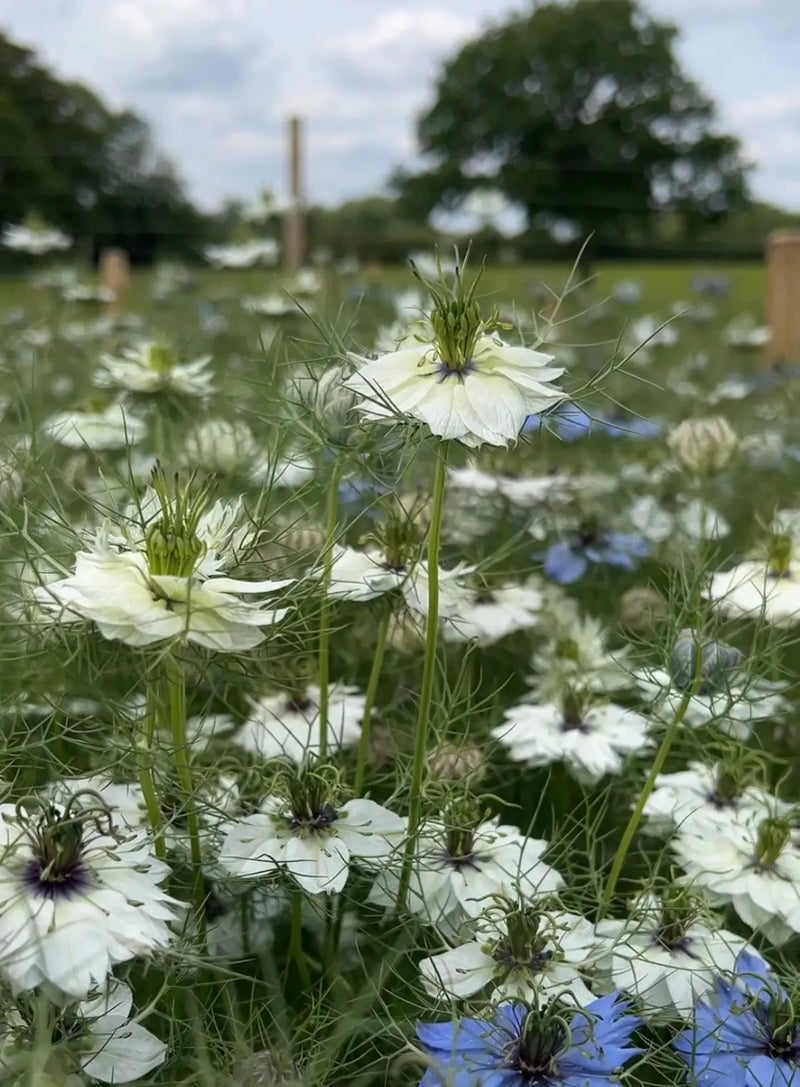
Nigella 'Miss Jekyll' White (Love-in-a-mist)
Nigella damascena 'Miss Jekyll White' -- White Love-in-a-Mist; RHS AGM
The pure snowy sister of classic blue Love-in-a-Mist — semi-double white flowers in a misty ruff of fine foliage. Romantic cottage classic for cutting, weddings and moon gardens.

About this variety
Nigella damascena 'Miss Jekyll' White Love-in-a-Mist 'Miss Jekyll' White
The pure snowy sister of the classic blue Love-in-a-Mist — beautiful semi-double white flowers nestled within a ruff of fine fennel-like foliage. From a distance, a drift of these plants looks like a low-hanging cloud or a sea of foam. 'Miss Jekyll White' is the cottage garden's pure-white Nigella, equally beloved by Gertrude Jekyll for softening formal borders and equally architectural in autumn with its magnificent striped seed pods.
This is a plant of two halves. In early summer, 'Miss Jekyll White' is soft, romantic, and frothy — perfect for wedding bouquets and cottage borders, the pure white of the semi-double flowers reading as fresh and luminous against the haze of thread-fine green foliage. From a distance, a drift looks like a low-hanging cloud or sea of foam — an effect that few other annuals can match. But as the petals fall, the second half of the show begins: the centre of each flower swells into a magnificent balloon-like seed pod that stands tall through autumn, providing structural interest and drying beautifully for winter arrangements. Hardy annual (H3). Listed on RHS Plants for Pollinators. Named after the legendary British garden designer Gertrude Jekyll. Reaches 45–60cm.
The generous guest: Nigella is one of the most prolific self-seeders in the UK garden. If you allow the pods to dry on the plant in late summer, they will eventually split and scatter their black seeds — ensuring a fresh drift of "Love-in-a-Mist" appearing the following spring for free.
Edible seeds: the seeds of Nigella damascena are edible and commonly known as Kalonji or Black Cumin. They have a subtle nutty, peppery flavour and are delicious when sprinkled on homemade naan bread or used to add a spicy kick to summer curries.
A note on growing
One of the easiest "scatter and grow" seeds. Direct sow only — Nigella resents transplanting. Sow direct outdoors in September for early flowers the following year, or March–May for summer blooms. Scatter onto finely raked soil and cover lightly (3mm deep). Germination 14–21 days.
Full sun or light shade. Average garden soil or even gravel — Nigella doesn't need feeding. Rich soil produces more "mist" (leaves) and fewer "jewels" (flowers). No staking required. Self-seeds reliably.
Where it shines
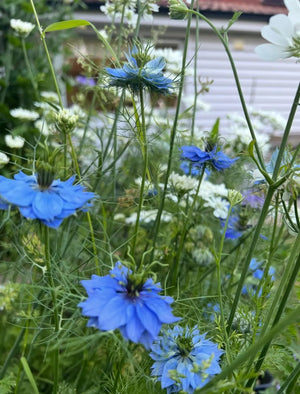
In moon gardens and white borders, where the pure white "cloud" effect creates magical evening luminosity. In wedding flowers, where the cool romantic white suits bridal arrangements perfectly. As a "fresh highlight" against stronger colours — the snowy white acts as a bright neutral that makes adjacent reds, blues and purples appear more vivid. As an architectural autumn seed-pod plant for dried arrangements. Combined with the blue 'Miss Jekyll' for a classic blue-and-white cottage tapestry. In wildlife gardens for the high pollinator value.
Plant alongside
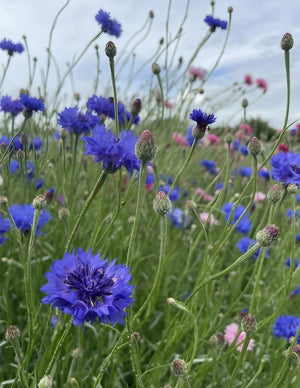
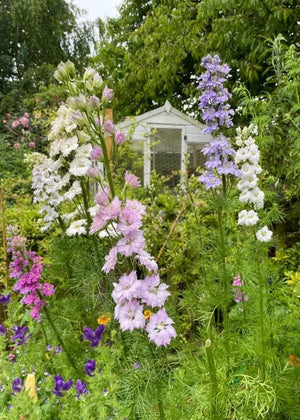
The classic cottage cutting combination: pair 'Miss Jekyll White' with Cornflower 'Blue Ball' for the timeless UK electric-blue-and-snowy-white combination — the spiky Cornflower stems contrast perfectly with the misty Nigella foliage. With Larkspur 'Giant Hyacinth Mix' for vertical structure rising out of the soft Nigella cloud. With Nigella 'Miss Jekyll' Blue for the classical blue-and-white Nigella pairing.
Plant alongside
Nigella 'Miss Jekyll' White (Love-in-a-mist) pairs beautifully with these cottage garden classics

RHS Plants for Pollinators
This plant has been assessed by the Royal Horticultural Society and recommended as especially beneficial to bees, butterflies and other pollinators. Growing plants like this directly supports UK pollinator populations — something close to our hearts at Salle Moor Hall Farm, where we see the difference a cottage garden full of the right plants can make.
Learn more at RHS.org.uk →
RHS Award of Garden Merit
The RHS Award of Garden Merit is given to plants of outstanding excellence for ordinary garden use. To earn this award a plant must be of good constitution, available to the gardening public, and perform reliably across a range of UK growing conditions. It is one of the most trusted plant recommendations in British gardening and a genuine mark of quality.
Learn more at RHS.org.uk →