

Malva Zebrina
Malva sylvestris var. mauritiana 'Zebrina' -- Zebra Mallow
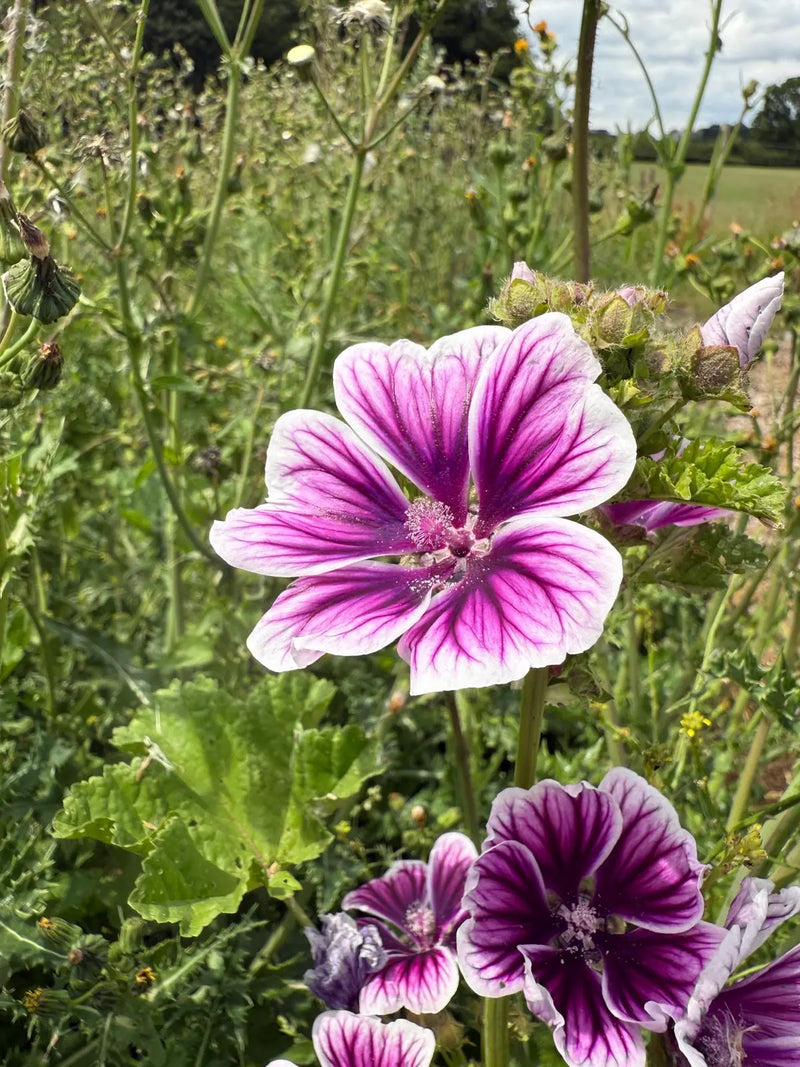
Soft lilac-pink saucer flowers painted with deep dark purple veins — the Zebra Mallow that flowers in its first summer from seed. Vintage cottage character, bee magnet.
About this variety
Malva sylvestris 'Zebrina' Zebra Mallow 'Zebrina'
Masses of open saucer-shaped flowers in soft lilac-pink, intricately painted with deep dark purple veins that stripe outwards from the centre — like miniature watercolour paintings on every flower. 'Zebrina' is the personality-packed cottage perennial bringing vintage character and exceptional bee value, with the unusual gift of flowering in its very first summer from seed.
This is a plant with genuine personality. Unlike most Malvas which take a year to come into full flower, 'Zebrina' is the rare cottage perennial that flowers in its very first summer if sown early in spring. Each flower is a soft lilac-pink saucer, dramatically painted with deep dark purple veins that stripe outwards from the centre like brush-strokes — no two flowers identical, the whole plant displaying a tapestry of slightly different patterns. The plant forms a bushy shrub-like mound (90–120cm) that blooms tirelessly from early summer through to the first frosts, bringing proper vintage cottage character to borders and creating spectacular drifts where the intricate flower patterns build into a watercolour effect across the planting. Vigorous short-lived perennial (often grown as a hardy annual). Typically lives 2–3 years but self-seeds brilliantly, ensuring permanent garden colonies once established. Bee magnet — the open accessible flowers make nectar easily reached.
A note on growing
Tough, unfussy and easy from seed. Sow indoors February–May or directly outdoors in May. Sow seeds on the surface of moist compost and cover lightly with vermiculite. Keep warm (15–20°C); germination 14–21 days. Plant out in sun or partial shade — 'Zebrina' is not fussy about soil type and thrives in heavy clay or dry sandy soil as long as drainage is reasonable.
The mid-summer chop: if the plant starts to look "leggy" or tired in mid-summer, cut it back by half. Water well, and a fresh flush of foliage and flowers follows for autumn display. This single intervention transforms a tired mid-season Malva into a productive late-season performer.
Self-seeds reliably; volunteer seedlings appear around the parent plant and largely retain the striped colour pattern.
Where it shines
In drifts and mass plantings, where the intricate watercolour-stripe pattern builds into a tapestry effect that reads beautifully from a distance. In cottage borders for vintage character. As a first-year flowering perennial — 'Zebrina' is the rare perennial-from-seed that delivers proper flowering in its first season. In wildlife gardens, where the open flower form provides exceptional pollinator forage throughout the long season. The flowers are also 100% edible and bring decorative pattern to summer salads and botanical cakes.
Plant alongside
For calm contrast, pair 'Zebrina' with Cosmos 'Purity' — the pure white simple flowers of Cosmos provide a rest for the eye against the intricate purple stripes of the Malva, creating a sophisticated cottage cutting combination. For complementary jewel-box colour, combine with golden-orange Rudbeckia (or Calendula 'Touch of Red' if Rudbeckia not stocked) — the purple and orange contrast creates a rich glowing late-summer display. For an all-Malva three-tone border, plant alongside Malva moschata 'Alba' and Malva 'Mystic Merlin'.
Plant alongside
Malva Zebrina pairs beautifully with these cottage garden classics



RHS Plants for Pollinators
This plant has been assessed by the Royal Horticultural Society and recommended as especially beneficial to bees, butterflies and other pollinators. Growing plants like this directly supports UK pollinator populations — something close to our hearts at Salle Moor Hall Farm, where we see the difference a cottage garden full of the right plants can make.
Learn more at RHS.org.uk →