
Lavatera Arborea
Lavatera arborea (syn. Malva arborea ) -- Tree Mallow
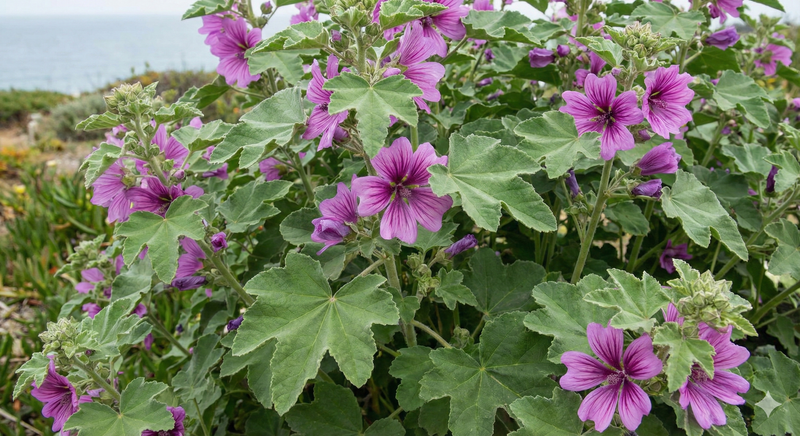
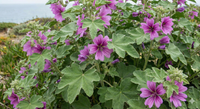
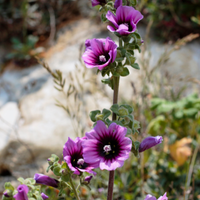
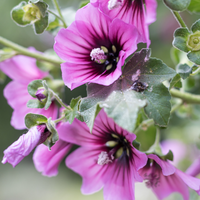
A magnificent biennial that grows into a small tree — a 2-metre woody structure with large velvety leaves and masses of purplish-pink hibiscus flowers. Thrives in coastal exposure.
About this variety
Lavatera arborea (now botanically Malva arborea) Tree Mallow
A magnificent biennial that grows into a small tree — a thick woody-stemmed structure rising to 2 metres in its second year, clothed in large velvety ivy-shaped leaves and covered from June to September with hundreds of saucer-shaped purplish-pink hibiscus-like flowers. Tree Mallow is the architectural giant that thrives where almost nothing else survives: coastal exposure, salt-laden winds, poor stony soil, and the toughest positions any garden offers.
This is genuinely one of the most architectural biennials you can grow from seed. Native to the windswept cliff-tops and rocky coastal margins of western Europe — from Ireland down to the Mediterranean — Tree Mallow has evolved over millennia to handle the conditions that defeat most ornamental plants: salt-laden coastal air, persistent strong winds, thin poor stony soil, and the drought of exposed rock faces. In a garden context, this evolutionary toughness translates to a plant of extraordinary reliability. The plant itself is remarkable in ambition: a biennial that grows a thick, woody-stemmed structure resembling a small tree, clothed in large velvety ivy-shaped leaves of saturated green, covered from June to September with masses of purplish-pink hibiscus-like flowers. Hardy biennial (H4). In milder coastal regions of the UK individual plants often survive for 3–4 years, transitioning from biennial to short-lived perennial. A note on naming: Tree Mallow is still widely known as Lavatera arborea but current botanical classification places it in the genus Malva as Malva arborea — the genus Lavatera has been largely merged into Malva following genetic analysis.
A note on growing
Sow indoors March–May in individual deep pots (9cm minimum) — Tree Mallow develops a deep taproot quickly and resents disturbance. Sow one seed per pot, 1cm deep, at 15–20°C. Germination in 14–21 days. The plants grow quickly and develop a woody stem and substantial root — pot on into 1-litre pots when roots emerge from drainage holes. Do not allow plants to become pot-bound.
Plant out after hardening off when all frost risk has passed (late May or June). Tree Mallow is genuinely the right plant for the wrong conditions: it thrives in poor stony or sandy soil where other plants fail, and the lean ground actually produces stronger, more compact plants than rich fertilised soil. Full sun. Drought-tolerant once established. The salt-excretion glands in its leaves allow it to grow in direct coastal exposure — it actually excretes excess salt through the leaf surface, a capability most plants simply lack. Year 1: rosette and woody-stem development. Year 2: spectacular flowering.
Self-seeds reliably once established — in coastal gardens it can form permanent self-renewing colonies.
Where it shines
In coastal gardens where the salt-tolerance is genuinely valuable — Tree Mallow is one of the very few large-scale flowering plants that thrives rather than tolerates coastal exposure. In exposed positions with thin poor soil where most ornamentals struggle. Against walls and fences in sheltered gardens, where a group of three or five creates dramatic exotic-looking structural presence reminiscent of conservatory plants. As a fast-growing screen for unsightly views — a single year of growth produces meaningful height. In wildlife gardens, where the open-faced flowers are highly accessible to bees and bumblebees.
Plant alongside
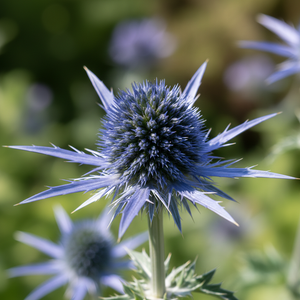
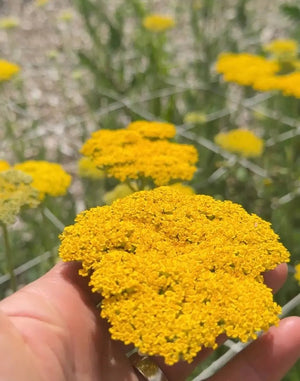
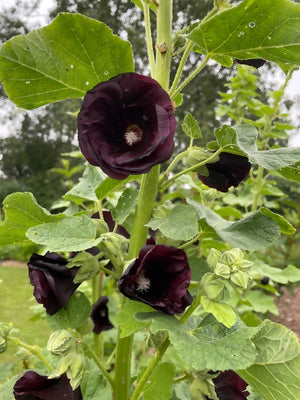
For a coastal cottage garden scheme, combine Tree Mallow with Eryngium (Sea Holly) for shared salt tolerance and architectural form, and Achillea 'Cloth of Gold' for warm-tone contrast against the purplish-pink. For sheltered garden walls, pair with Hollyhock 'Nigra' (matching biennial cycle, contrasting dark form) and Larkspur 'Giant Imperial Mix' for the layered vertical English cottage wall effect.
Plant alongside
Lavatera Arborea pairs beautifully with these cottage garden classics