

Hollyhock Nigra
Alcea rosea 'Nigra'
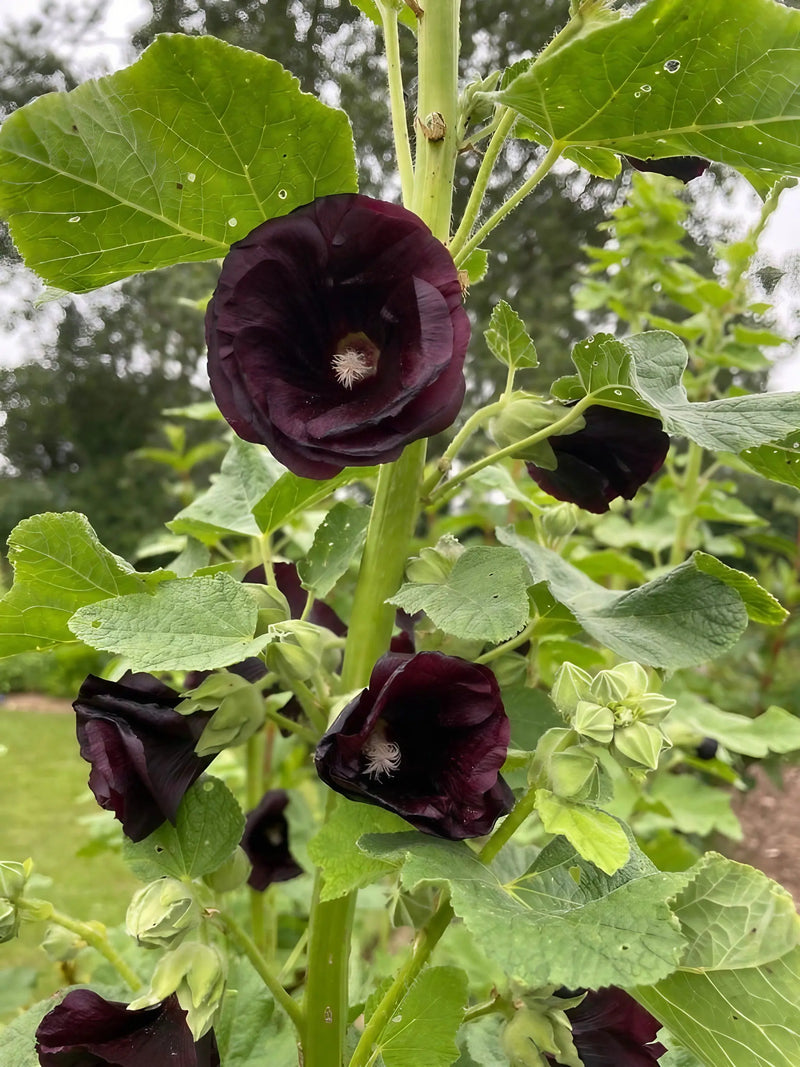
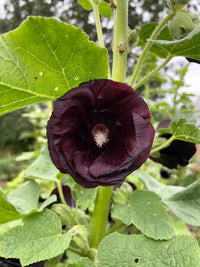
The legendary heritage Hollyhock with near-black maroon-purple single flowers and small yellow eyes — rising 2m against walls. Continuously cultivated since the 1600s.
About this variety
Alcea rosea 'Nigra' Black Hollyhock 'Nigra' / The Black Watchman
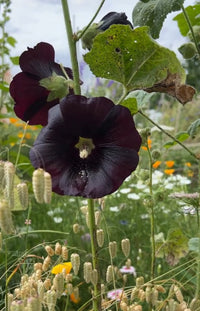
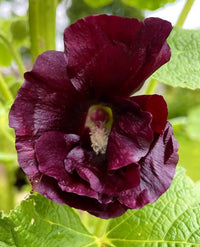
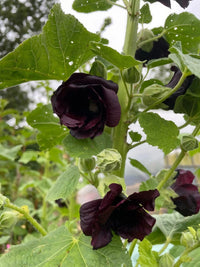
The legendary heritage Hollyhock — single saucer-shaped flowers in the deepest, almost-black maroon-purple imaginable, the colour of crushed blackcurrants or dark velvet, with a small contrasting yellow centre that catches the light. 'Nigra' is the dramatic Gothic cottage garden showpiece, rising to 2 metres against walls and fences, and one of the most photographed Hollyhocks in any heritage planting.
There is genuinely nothing else in the cottage garden quite like 'Nigra'. The deep almost-black maroon flowers are open single saucers (rather than the heavy doubles of Chater's varieties), held in dense columns up the substantial 2-metre flowering stems. The colour is the closest to true black any flower achieves — far darker than 'Black' cornflower or 'Queen of Night' tulip — and the small yellow eye at the centre of each flower creates a beautifully precise focal point. A heritage variety with documented use in English gardens since the 1600s, 'Nigra' was a favourite of Thomas Jefferson and has been continuously cultivated for over 400 years. Hardy biennial (H5). RHS Plants for Pollinators recognised — the open single flower form is particularly valued by bumblebees, who can access the central nectar more easily than they can with doubles.
A note on growing
Like all Hollyhocks, 'Nigra' has a deep taproot and resents disturbance. Sow indoors April–May in deep pots (root trainers or 9cm pots minimum) or direct outdoors June–July. Sow at 1cm depth; germination 14–21 days. Move plants to final position September/October. Plant in full sun in rich well-drained soil — a position against a warm wall or fence is ideal.
Staking is essential in most positions: 'Nigra' can reach 2 metres (6ft+) and unless you have a very sheltered walled garden, you will need to stake the main stem to stop it snapping in summer storms. A simple bamboo cane and twine works well.
⚠️ Rust management: as with all Hollyhocks, watch for orange spots on leaves and remove affected foliage promptly. Water only at the base, never on the leaves. Cut down to ground level after flowering.
⚠️ Skin irritation: rough bristly hair coats stems and leaves — wear gloves when handling.
Where it shines
Against warm walls and fences as a Gothic architectural focal point — 'Nigra' is at its most dramatic when seen against a pale stone wall, weathered fence or whitewashed surface that lets the near-black colour read most intensely. In heritage and historical garden schemes where the 400-year cultivation history justifies a place. As a designer cottage garden showpiece — even one or two plants create proper visual impact. In modern monochrome garden design, where the deep black-purple anchors more colourful companions. As cut flowers for dramatic arrangements (with toxicity caution).
Plant alongside
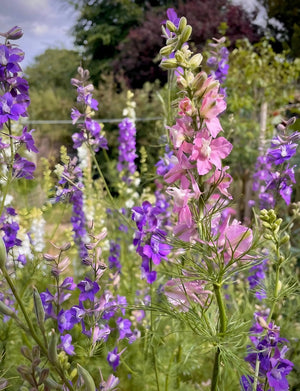
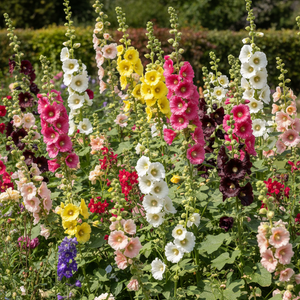
For high-contrast Gothic drama, pair 'Nigra' with Cosmos 'Purity' — the pure white airy saucers of Cosmos provide a stark, sophisticated contrast to the heavy black columns of the Hollyhock, creating one of the most photographed combinations in modern cottage gardening. For a zesty lift, combine with Larkspur 'Limelight Mix' — the greenish-white spikes act as a highlight, making the dark maroon of the Hollyhock look richer and warmer by comparison. With Hollyhock 'Bishy Barnabee Mix' (matching height; full colour range) for a layered Hollyhock border.
Plant alongside
Hollyhock Nigra pairs beautifully with these cottage garden classics


RHS Plants for Pollinators
This plant has been assessed by the Royal Horticultural Society and recommended as especially beneficial to bees, butterflies and other pollinators. Growing plants like this directly supports UK pollinator populations — something close to our hearts at Salle Moor Hall Farm, where we see the difference a cottage garden full of the right plants can make.
Learn more at RHS.org.uk →