






Hesperis White (Sweet Rocket)
Hesperis matronalis
Tall luminous white Sweet Rocket spikes that release violet-and-clove fragrance at dusk — the moon-garden hero filling the gap between spring and summer.
About this variety
Hesperis matronalis 'White' Sweet Rocket / Dame's Violet 'White'
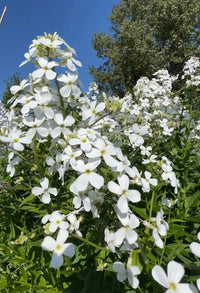
Tall luminous white spikes that release a heady fragrance of violets and cloves after dark — Hesperis 'White' is the moon-garden hero that fills the tricky gap between spring tulips and summer roses, providing pure-white evening-scented flowers in shaded borders where few other plants will perform.
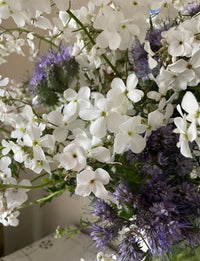
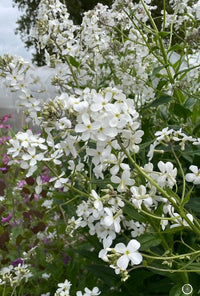
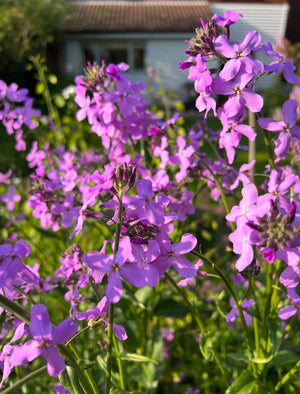
While the classic Sweet Rocket is violet-purple, the white form brings crisp, sophisticated elegance to the cottage evening garden. The tall 75–90cm branching stems carry the same loose clusters of four-petalled flowers, but in pure luminous white that genuinely glows in low evening light. This is the variety for moon gardens — plant a drift beneath a north-facing tree or alongside a white-painted garden seat, and the pale flowers will appear to glow at dusk just as their fragrance releases. The scent itself is identical to the purple form — powerful sweet violets-and-cloves designed to attract night-flying moths. Hardy biennial (H7). RHS Plants for Pollinators recognised. Orange Tip butterfly larval food plant — the white form is equally valuable to the butterfly as the purple. Bees, hoverflies and small pollinators visit during the day; moths visit at dusk.
A note on growing
Sow direct outdoors May–July, or in modules indoors at 15–18°C. Cover lightly with 3–5mm fine soil. Germination 14–21 days. Move plants to their final positions in October — partial shade or sun in moist humus-rich soil. As with all Sweet Rocket varieties, partial shade with consistent soil moisture is the most reliable position.
Self-seeding: white Hesperis self-seeds reliably, though offspring can revert to the purple form over time as Hesperis colours are genetically variable. To maintain pure-white colonies, rogue out any purple-flowered seedlings before they set seed — this maintains genetic purity over generations.
About Cabbage White caterpillars: same Brassica family connection as the purple form — check for caterpillars from July onwards.
Cutting tip: same as for the purple — cut when one-quarter of florets are open; the stem continues to open in the vase.
Where it shines
In moon gardens and white borders, where the luminous pure-white flowers glow in evening light just as the fragrance releases — combining visual and olfactory dusk magic. In shaded woodland borders. As an essential "moon garden bridge" — Hesperis 'White' fills the tricky gap between spring tulips ending and summer roses beginning, providing white flowers in May, June and July when many other moon-garden whites are absent. As cut flowers for white-themed romantic arrangements. In wildlife gardens for Orange Tip butterfly support.
Plant alongside
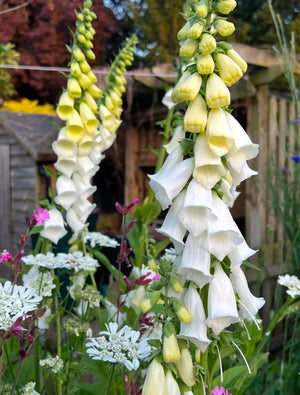
The classical moon-garden combination: pair 'White' Hesperis with Cosmos 'Purity', Ammi majus, Foxglove 'Alba White', and Cornflower 'Snowman' for a layered all-white cottage cutting garden that genuinely glows at dusk. For colour contrast, combine 'White' with 'Purple' for the timeless purple-and-white Sweet Rocket pairing. With Honesty (Lunaria, related Brassica) for the classic biennial woodland partnership.
Plant alongside
Hesperis White (Sweet Rocket) pairs beautifully with these cottage garden classics


RHS Plants for Pollinators
This plant has been assessed by the Royal Horticultural Society and recommended as especially beneficial to bees, butterflies and other pollinators. Growing plants like this directly supports UK pollinator populations — something close to our hearts at Salle Moor Hall Farm, where we see the difference a cottage garden full of the right plants can make.
Learn more at RHS.org.uk →