

Bishy Barnabees · Salle Moor Hall Farm
Camelina Sativa Dried | Gold-of-Pleasure Norfolk Bunch
Camelina sativa
Bunch details
- Also known as
- Camelina · Gold-of-Pleasure · False Flax · German Sesame · Wild Flax · Dutch Flax
- Stem length
- 50-60cm
- Colour
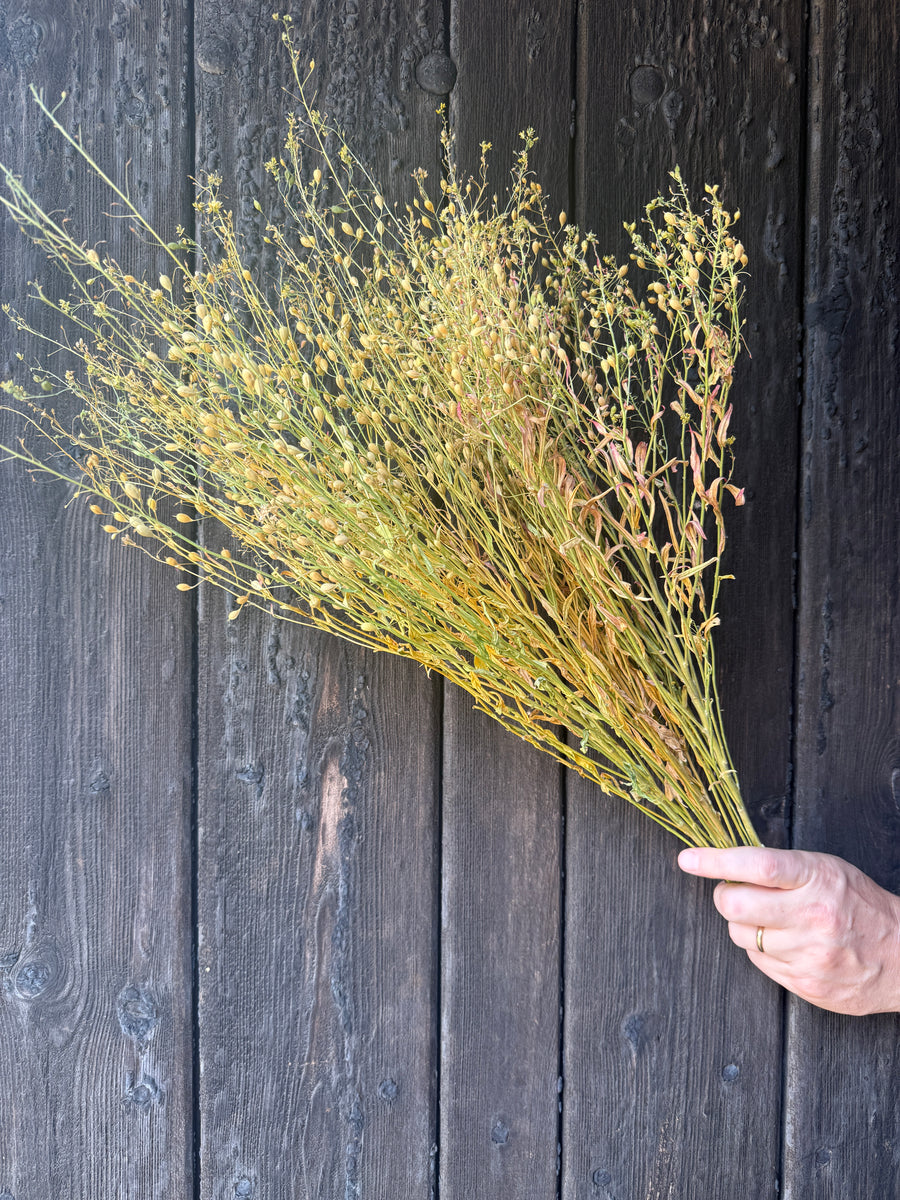
- Warm straw-gold seed pods along branching stems. Occasional greenish tones on younger pods. Reads as sunshine gold rather than pale straw.
- Texture
- Papery capsule seed pods (5-9mm teardrop/pear-shaped) with characteristic ridge lines. Generously branching stems. Firm but not rigid - "durable delicate" middle ground.
- Colour treatment
- Natural - no dyes, bleaches or preservatives. The warm straw-gold is the plant's natural pigment as pods mature.
- Harvest season
- Late summer / early autumn harvest (August-September) when pods are fully mature
- Drying method
- Barn air-dried at Salle Moor Hall, hung upside-down to preserve branching structure
- Growing method
- Chemical-free, hand-grown from spring-sown seed on our cutting field
- Expected longevity
- Years indoors given proper care. Camelina pods are properly durable when dry - papery capsule walls resist normal handling well. Keep out of direct sunlight to preserve warm straw-gold colour.
An ancient crop for a modern arrangement. Camelina sativa — also known as Gold-of-Pleasure, False Flax, or German Sesame — is one of the oldest cultivated plants in Europe, grown as an oilseed crop since the Bronze Age. What draws us to it for the dried flower field isn't the small yellow summer flowers or the historical oil pressing tradition, though both are lovely. It's the seed pods that follow: distinctive teardrop or pear-shaped capsules on generously-branching stems, drying to a warm straw-gold that reads as "wild wheat" or "ancient grain" in arrangements. Genuinely rare in UK dried flower ranges — and one of the most architecturally interesting seed head stems you can buy.
Barn-dried at Salle Moor Hall, Norfolk. Small bunches of 3 stems, each 50-60cm long, generously branched with dozens of teardrop-shaped seed pods along each stem. Priced per bunch (£9.00) reflecting the substantial branching scale — each stem does the work of several typical dried flowers, giving one bunch enough visual coverage for a proper statement arrangement. Grown chemical-free on our own cutting field. No air miles, no imported stems, no dyes or preservatives — just genuinely honest English cottage garden Camelina, cultivated and cared for entirely by us. Seasonal, available while our summer stock lasts.
The seed pods make the plant
- Teardrop / pear-shaped capsules — each pod is a small silicle (the technical name for the fruits of Brassicaceae plants) shaped like a tiny green pear or teardrop, approximately 5-9mm long. Dozens per stem
- Generously branching stems — unlike single-stem flowers, Camelina produces stems that branch multiple times, with the seed pods distributed along all the branches. One stem does the work of many
- Warm straw-gold colour — the pods dry to a natural warm gold-tan that suits autumn palettes, harvest arrangements, and vintage cornfield aesthetics. Reads as sunshine rather than pale straw
- Papery-textured when dry — the pod walls dry to a firm papery texture with characteristic ridge lines. Not fragile, but not as rigid as a wheat kernel — sits in the "durable delicate" middle ground
- Slight rattle — some pods contain retained tiny seeds that make a very gentle rattle sound when the stem is moved. Not enough to worry about for arrangements, but part of the plant's character
A crop with proper history
Camelina sativa is one of a small handful of plants that have been cultivated in Europe continuously since the Bronze Age — carbon dating on archaeological sites has recovered Camelina seeds from settlements dating back 3,000+ years. The name "Gold-of-Pleasure" refers to the yellow oil pressed from the seeds, which was one of the most important lighting fuels in medieval Europe (lamp oil before petroleum), a cooking oil in Northern European traditions, and an industrial oil for tanning leather and softening textile fibres. The crop fell out of use in the 20th century as petroleum-based alternatives took over, but has recently seen a revival as a sustainable biofuel crop and a source of healthy plant oil rich in omega-3 fatty acids. Modern dried flower use is a genuinely new application for a very old plant.
Styling ideas
- Wild meadow arrangements — the branching architectural stems suit "gathered from a summer field" styling. Combine with dried grasses, wildflower seed heads, and grasses for the classic cornfield-going-to-seed aesthetic
- Autumn wreaths — the warm straw-gold pods bend easily into wreath rings, and the abundant branching gives you focal detail without needing multiple stems. Particularly good with dried wheat, dried grasses, and warm-toned dried flowers
- Ancient grain / harvest displays — the historical crop association makes Camelina a natural fit for country kitchen displays, farmhouse mantelpieces, and harvest-themed arrangements. Reads as rustic history rather than commercial decoration
- Modern minimalist single-species — two or three stems in a plain tall vessel creates an entirely modern architectural sculpture. The branching structure suits contemporary interiors surprisingly well
- Airy structural filler — slotted through dense arrangements, Camelina provides architectural line and warm colour without adding heavy visual weight. Excellent partner for statement flowers like Amaranthus or Alliums that need airy space around them
- Christmas garlands — the warm straw-gold works beautifully with dried oranges, cinnamon sticks, and pinecones for traditional cottage Christmas styling. Alternative to wheat for those wanting something more distinctive
- Craft and pressed art — individual pods can be stripped from stems for craft work, and whole branches translate well to pressed-flower shadow boxes and framed art
Perfect dried companions
- Dried Hesperis Sweet Rocket — the botanical cousin. Both are Brassicaceae family with silique/silicle seed pods, but Hesperis is long and thin while Camelina is teardrop and branched. Together they show the family variation beautifully
- Dried Wheat — the harvest partnership. Warm straw wheat + straw-gold Camelina creates the classic cornfield harvest palette
- Dried Cornflowers — the seed head trio. Cornflower's faded flowers + Camelina's gold pods + Hesperis's thin siliques capture the character of a summer meadow gone to seed
- Dried Nigella Seed Heads — the fourth seed head. Nigella's inflated striped pods provide sphere-shaped contrast to Camelina's teardrop pods
- Dried Bunny Tails and grasses — the soft contrast against Camelina's structural pods
- Dried Amaranthus (Red or Green) — the cascading counterpoint to Camelina's upright branching structure
Care note. Camelina pods are properly durable when dry — the papery capsule walls resist normal handling well, and the branching structure means individual pod losses don't affect the overall appearance. A few loose seeds may rattle out during unpacking, which is normal. Give new bunches a gentle shake outdoors before bringing them inside for arrangements. Keep out of direct sunlight to preserve the warm straw-gold colour for years rather than months. Store dry. Given proper care, expect years of use.
Growing your own. Camelina sativa is one of the easier annuals to grow from seed — hardy, drought-tolerant, and remarkably self-sufficient. Direct-sown in April, it germinates readily and produces plants of 60-90cm with continuous yellow flowering from June through August, followed by the distinctive teardrop pods through late summer and autumn. Excellent bee and hoverfly forage during the flowering season. Bishy sells Camelina seeds — growing your own gives you the flowering season interest, the pod harvest for drying, and access to one of the most historically significant crops most gardeners have never grown. Our growing guide covers the specifics here.
Recommended uses
Styling context
English cottage garden · Wild meadow · Harvest arrangement · Farmhouse kitchen · Autumn wreath · Modern minimalist · Country cottage · Rustic country · Gallery-style interior · Ancient grain themed
About our dried flowers
Every bunch is grown, hand-harvested and barn-dried at Salle Moor Hall Farm in Reepham, Norfolk — our own cutting field, our own drying barn, our own hands. Grown chemical-free with no dyes, no bleaches, and no preservatives. Packed in compostable packaging in a rigid box to protect the stems in transit. Dispatched within 2-3 working days. Properly good English dried flowers with the story of the summer they came from.