




Cosmos Daydream
Cosmos bipinnatus 'Daydream' — extra-early white-to-blush bicolour
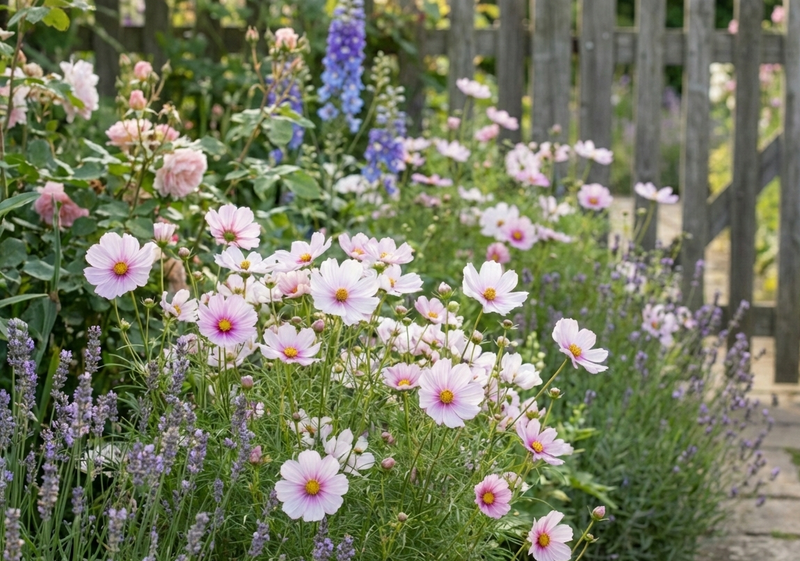
Watercolour Cosmos with white outer petals melting through blush to deep rose-pink centres — the early-flowering bicolour bred to fill the June cutting-garden gap.
About this variety
Cosmos bipinnatus 'Daydream' Cosmos 'Daydream'
A specific visual quality distinguishes 'Daydream' from every other Cosmos — the flowers look as though they have been painted in watercolour by hand. Pure white at the outer petal edges, softening through pale blush toward the centre, culminating in a distinct ring of deeper rose-pink immediately surrounding the small golden disc at the heart.
Three tones, blending without any perceptible boundary between them, in a flower 7–8cm across that somehow conveys the precision and intentionality of a botanical illustration. Beyond the painterly appearance, 'Daydream' has one further quality that makes it uniquely useful: it flowers exceptionally early. Where standard Cosmos varieties typically begin blooming eight to ten weeks after sowing, 'Daydream' was specifically bred for early, consistent, uniform flowering — reaching first bloom just seven to eight weeks from sowing. This makes it the Cosmos that fills the cutting-garden gap in June, when standard Cosmos haven't yet begun, and continues right through July, August, September and into October. Tall airy stems (90–150cm — among the tallest in the Cosmos range) with characteristic feathery foliage. Half-hardy annual. RHS Plants for Pollinators recognised — the open accessible flowers are exceptional for bees, butterflies and hoverflies.
A note on growing
The same critical Cosmos rule applies: do not feed. Cosmos in rich soil produces lush foliage and few flowers. In poor, lean, dry ground it flowers prolifically. This is the single most common cause of disappointing Cosmos results.
Sow indoors February to April at 18–22°C. Surface-sow as Cosmos seeds need light to germinate. Germination 7–14 days. Pot on and harden off carefully. Plant out after last frost (late May/June) in full sun and lean, well-drained soil. Pinch out the growing tip at 15cm to encourage bushy multi-stemmed plants. Plants reach 90–150cm — position at the back of borders or in dedicated cutting rows. The tall airy stems with their fine feathery foliage create the characteristic Cosmos "see-through" quality that obscures nothing behind them.
Where it shines
Position 'Daydream' where it will be visible in low-angle morning or evening light — when the translucent petals are backlit, the white outer zone glows luminously while the blush centre deepens in warmth, achieving the watercolour quality that makes the variety so distinctive. In the cutting garden, 'Daydream' is uniquely useful for filling the early summer gap (June) before standard Cosmos have begun. As an exceptional vase-life cut flower (7–10 days) for romantic pastel arrangements. In moon gardens and white-themed borders where the predominantly pale colour glows in evening light. In wildlife gardens as a long-season pollinator support, providing accessible flowers from June through November.
Plant alongside
For a romantic June-flowering cutting combination, combine 'Daydream' with Sweet Peas (also at June peak), Nigella, Ammi majus and Cornflower 'Snowman' — all flowering at the same time when other Cosmos varieties are still in vegetative growth. For a soft pastel cottage palette, pair with Cosmos 'Apricotta' and Antirrhinum 'Sweet Duet Apple Blossom'. The pale-with-blush-centre quality also works beautifully alongside the deep indigo of Clary Sage 'Oxford Blue'.
Plant alongside
Cosmos Daydream pairs beautifully with these cottage garden classics



RHS Plants for Pollinators
This plant has been assessed by the Royal Horticultural Society and recommended as especially beneficial to bees, butterflies and other pollinators. Growing plants like this directly supports UK pollinator populations — something close to our hearts at Salle Moor Hall Farm, where we see the difference a cottage garden full of the right plants can make.
Learn more at RHS.org.uk →