

Malva Alba
Malva moschata f. alba -- White Musk Mallow; RHS AGM
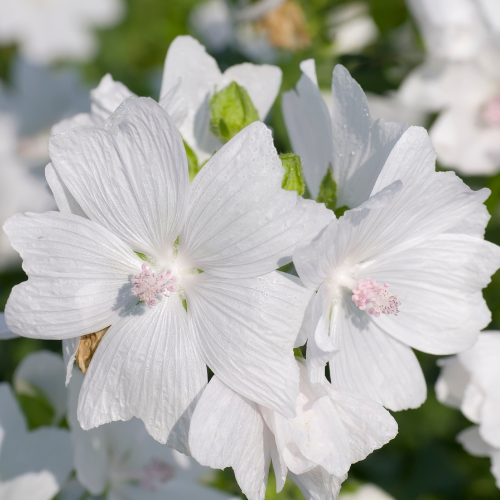
Masses of pure white satiny saucer flowers above ferny musk-scented foliage — the most desirable of all Musk Mallows. Hardy perennial, edible, drought-tolerant.
About this variety
Malva moschata 'Alba' White Musk Mallow
Masses of pure white satiny saucer-shaped flowers above finely-divided ferny musk-scented foliage — Malva moschata 'Alba' is considered by many gardeners to be the most desirable of all Malva species, an elegant pure-white hardy perennial that flowers all summer into autumn and brings refined cottage character to any sunny border.
The pure white form of the Musk Mallow, and arguably the most elegant of all the Malvas. Unlike the larger, taller Malva sylvestris varieties ('Zebrina' and 'Mystic Merlin'), moschata 'Alba' is a refined hardy perennial reaching just 60–90cm in compact bushy form, producing masses of silky pure-white saucer-shaped flowers from June through September. The foliage adds another distinct charm: finely-divided, ferny, almost dissected in appearance — far more elegant than the rounded leaves of sylvestris Malvas — and gently musk-scented when brushed, giving the plant its name. Hardy perennial (H7), surviving below -20°C. Drought-tolerant. RHS Plants for Pollinators recognised — the open accessible saucers are loved by bees, bumblebees and hoverflies. The flowers and young leaves are 100% edible with a mild lettuce-like flavour, making them spectacular as edible garnish on summer salads and botanical cakes.
A note on growing
Sow indoors February–May or directly outdoors in May. Surface-sow onto moist compost and cover with a light dusting of vermiculite — Malva seeds prefer some light during germination. Maintain 15–20°C; germination 14–21 days. Transplant carefully to minimise root disturbance. Plant out in full sun or partial shade — 'Alba' is unfussy about soil and will grow happily in everything from heavy clay to dry sandy ground, provided there is reasonable drainage.
The mid-summer chop: if the plant becomes straggly or leggy after the first flush of flowers in July, shear the stems back by about half. Water in well, and a fresh flush of foliage and flowers follows for autumn display. This is the single most important maintenance practice for keeping moschata 'Alba' productive throughout the entire summer.
Self-seeds reliably once established, producing a permanent, slowly-expanding colony.
Where it shines
In refined cottage borders where the elegant ferny foliage and pure white flowers add proper sophistication. In white moon gardens, where the satiny petals glow in evening light. In wildlife gardens for the high pollinator value and the edible flowers. In container plantings — Malva 'Alba' adapts well to large pots provided drainage is good. The ferny foliage adds genuine textural interest even outside the flowering period, making 'Alba' an asset for foliage as well as flowers.
Plant alongside
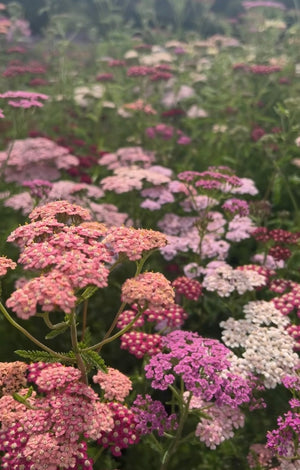
For a refined cottage white-and-pastel scheme, combine moschata 'Alba' with Achillea 'Pastel Mixed' (matching pastel palette) and Cosmos 'Purity' (matching airy white substance). For colour contrast, pair with the deep violet of Malva 'Mystic Merlin' (same genus, dramatic colour difference) and the soft lilac-pink of Malva 'Zebrina' for an all-Malva three-tone border. As a moon garden plant, plant alongside Hesperis 'White' and Cosmos 'Purity' for a luminous evening display.
Plant alongside
Malva Alba pairs beautifully with these cottage garden classics


RHS Plants for Pollinators
This plant has been assessed by the Royal Horticultural Society and recommended as especially beneficial to bees, butterflies and other pollinators. Growing plants like this directly supports UK pollinator populations — something close to our hearts at Salle Moor Hall Farm, where we see the difference a cottage garden full of the right plants can make.
Learn more at RHS.org.uk →
RHS Award of Garden Merit
The RHS Award of Garden Merit is given to plants of outstanding excellence for ordinary garden use. To earn this award a plant must be of good constitution, available to the gardening public, and perform reliably across a range of UK growing conditions. It is one of the most trusted plant recommendations in British gardening and a genuine mark of quality.
Learn more at RHS.org.uk →