
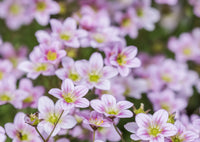
Gypsophila Rosea
Gypsophila repens Rosea
Low ground-hugging carpet of soft pink starry flowers — the cascading creeping perennial Baby's Breath for walls, rockeries, and spilling over container edges.
About this variety
Gypsophila repens 'Rosea' Creeping Pink Baby's Breath 'Rosea'
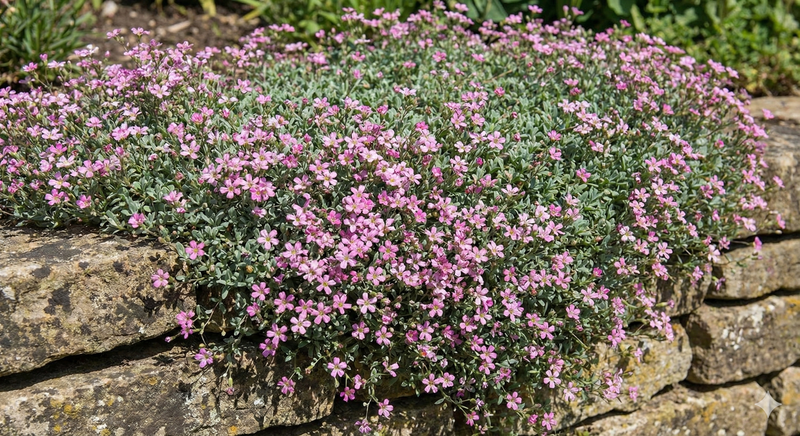
A low ground-hugging carpet of starry pink flowers tumbling and cascading over edges, walls, paving cracks and container rims — Gypsophila 'Rosea' is the hardy mat-forming perennial that brings the romantic Baby's Breath aesthetic to vertical planting, rockeries, gravel gardens, and any position where spilling cascade is wanted.
Unlike its tall annual cousins (the cutting-garden 'Covent Garden' and 'Pink'), Gypsophila 'Rosea' is the creeping perennial form — a low, prostrate, mat-forming species that grows to just 15–20cm high but spreads to 40–60cm wide, producing masses of small star-shaped flowers in soft rose-pink over silvery-grey foliage from June to August. The natural prostrate habit makes it ideal for cascading over the edges of retaining walls, terracotta pots, raised beds and rockery faces — creating the appearance of a "pink floral waterfall" spilling down vertical surfaces. Hardy perennial (H6), surviving most UK winters reliably. Drought-tolerant. Bee-friendly. Self-seeds politely into available cracks and crevices. Genuinely low-maintenance once established.
A note on growing
Sow indoors from late winter through spring at 18–20°C, or direct sow outdoors in April/May. Surface-sow or cover only very lightly with vermiculite (Gypsophila seeds prefer some light). Germination 14–21 days. Plant out into full sun in well-drained soil — the Greek name reveals the preference: "Gypsophila" means "gypsum-loving", referring to the species' natural affinity for alkaline, chalky, well-drained soils. Acid heavy clay is not its natural habitat.
Drought-tolerance is excellent once established. The plant strongly prefers lean dry conditions — in rich moisture-retentive soils it can become floppy and shorter-lived. Gravel gardens, rockeries, sandy borders and raised beds suit it perfectly. Plant at the very edge of retaining walls or large pots for the most dramatic cascading effect — the natural prostrate habit will encourage 'Rosea' to spill over the edge, creating a stunning pink floral waterfall.
Where it shines
As a vertical-planting specialist — 'Rosea' is among the very best plants for cascading over walls, raised bed edges, terracotta pots and rockery faces. In gravel gardens and Mediterranean-style plantings where the drought-tolerance suits the conditions. As a "softener" at the front of cottage borders, where the spreading mat covers bare ground beneath taller perennials. In paving cracks and crevices, where it establishes naturalistic colonies. In wildlife gardens, where the open accessible flowers support short-tongued solitary bees and hoverflies. As a self-seeder, gradually colonising hospitable positions over time.
Plant alongside
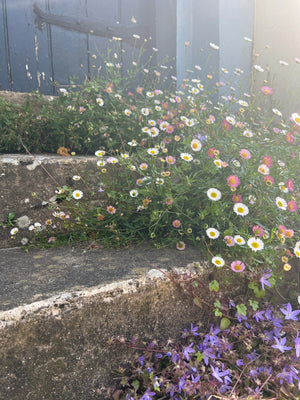
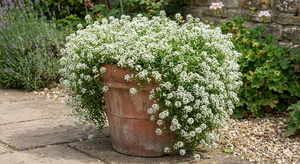
For wall and edge partnerships, combine 'Rosea' with Erigeron karvinskianus 'Profusion' (Mexican Fleabane) — both share love of dry sunny positions and create a romantic pink-and-white frothy cascade together. For rockery and gravel plantings, pair with Thyme (matching aromatic carpet of contrasting texture) and Alyssum 'Carpet of Snow' for layered low cottage colour. For container cascade displays, combine 'Rosea' as the cascading element with upright dwarf companions like Calendula 'Oopsy Daisy' as the central feature.
Plant alongside
Gypsophila Rosea pairs beautifully with these cottage garden classics