

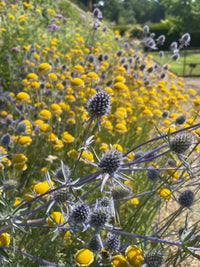
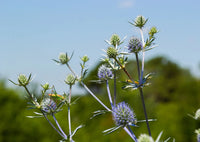
Eryngium (Sea Holly)
Eryngium planum — flat sea holly; native Eastern European steppe
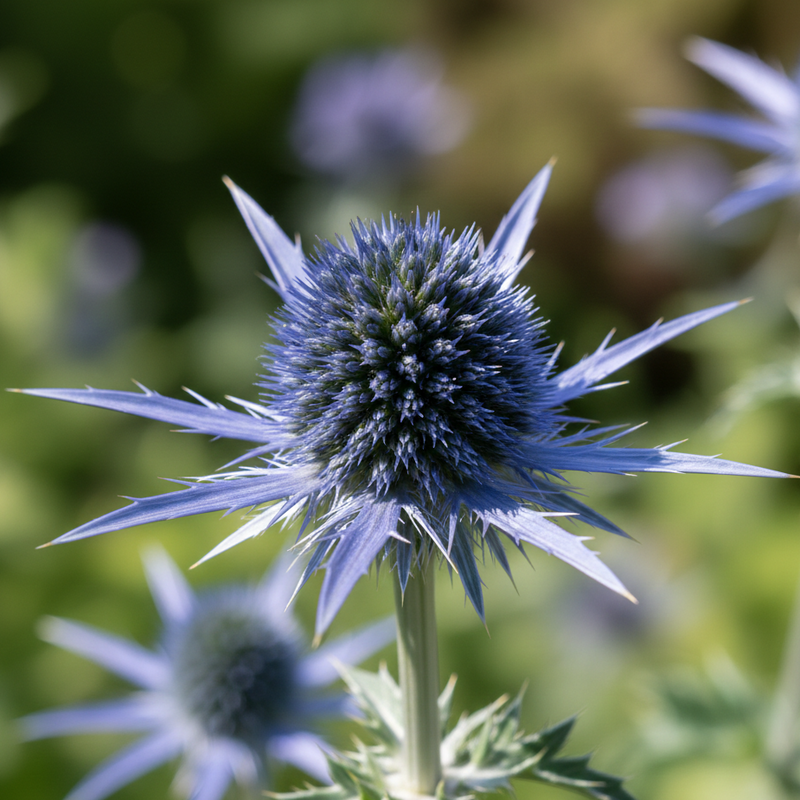
Steel-blue spiky thistle-like flowers above architectural silvery-blue stems — the dramatic Sea Holly that thrives on poor dry ground. Outstanding cut and dried.
About this variety
Eryngium planum Sea Holly / Flat Sea Holly
Steel-blue spiky thistle-like flowers above architectural silvery-blue stems and basal foliage — Sea Holly is the structural perennial that brings unmistakable seaside character, prairie-grade drought tolerance, and an entire summer of dramatic blue colour to any sunny well-drained position.
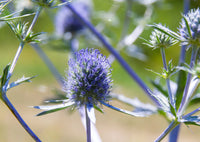
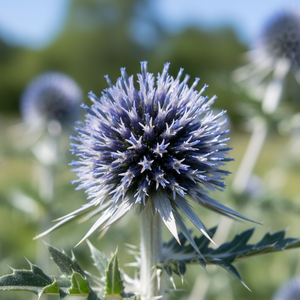
Sea Holly genuinely earns the "holly" in its name. The flower heads are cones of densely-packed tiny florets surrounded by a striking ruff of spiky, holly-like bracts in saturated metallic steel-blue — far more architectural than ornamental, the whole plant reading as a piece of natural sculpture. Above silvery-blue branching stems and a basal rosette of mid-green leathery leaves, the flowers appear from June through August, with the structural bracts persisting into autumn long after the central florets have finished. Hardy perennial (H7), surviving harsh UK winters with ease. Drought-tolerant in the extreme — Eryngium is one of the most reliable plants for sun-baked positions where almost nothing else will grow. RHS Plants for Pollinators recognised, particularly valued by bees and a wide range of beneficial insects. Height 70–90cm.
A note on growing
Eryngium has a long taproot and resents transplanting — direct sowing where plants are to grow is the most reliable method. Direct sow outdoors from March to June. Cover with about 5mm of soil. Germination is slow and erratic — typically 14–30 days, sometimes longer; do not give up early. A pre-sowing cold treatment (a few weeks in the fridge before sowing) can improve germination significantly. Indoor-sown seedlings should be moved into deep individual pots and planted out before the taproot reaches the bottom.
Plant out into full sun in poor, dry, well-drained soil. Eryngium genuinely prefers lean, sandy, gravelly conditions and resents rich or moisture-retentive ground (where it tends to flop and lose its characteristic compact form). Coastal gardens are ideal — Sea Holly is naturally adapted to salt-laden coastal conditions. Once established, drought tolerance is essentially complete. Like most taproot-perennials from seed, expect Year 1 establishment with modest flowering and Year 2+ for the full architectural display.
⚠️ Spiky: the bracts are genuinely sharp. Wear gardening gloves when cutting or working around mature plants.
Where it shines
In coastal gardens, where the natural salt tolerance and visual association make Sea Holly entirely at home. In gravel and Mediterranean-style gardens, where the drought-tolerance and architectural form suit the conditions perfectly. In modern, sculptural cottage planting where the metallic blue and spiky outlines provide proper textural contrast against rounded or softer companions. As a cut flower for modern, structural arrangements — exceptional vase life. As a dried flower — the metallic blue holds particularly well, and the spiky bracts maintain their shape for years. We particularly value Eryngium in our dried flower range here at Salle Moor Hall Farm.
Plant alongside
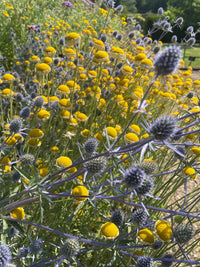
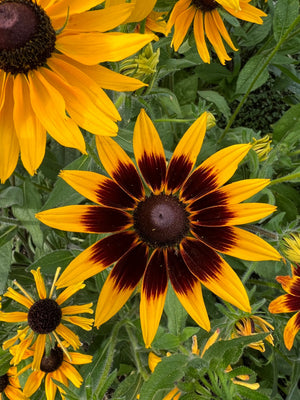
For a sun-baked dry-garden combination, pair Eryngium with Echinops ritro (matching blue but different shape — spheres against spikes, both architectural), Echinacea (flat pink discs adding colour and softness), and grasses for movement. For dried flower harvesting, combine with Bunny Tails, Bupleurum 'Griffithii' and Statice. For coastal gardens, plant alongside Lavender (if stocked) and silver-leaved companions.
Plant alongside
Eryngium (Sea Holly) pairs beautifully with these cottage garden classics

RHS Plants for Pollinators
This plant has been assessed by the Royal Horticultural Society and recommended as especially beneficial to bees, butterflies and other pollinators. Growing plants like this directly supports UK pollinator populations — something close to our hearts at Salle Moor Hall Farm, where we see the difference a cottage garden full of the right plants can make.
Learn more at RHS.org.uk →