


Penstemon Cambridge Mix
Penstemon 'Cambridge Mix' -- Borderline Hardy Perennial
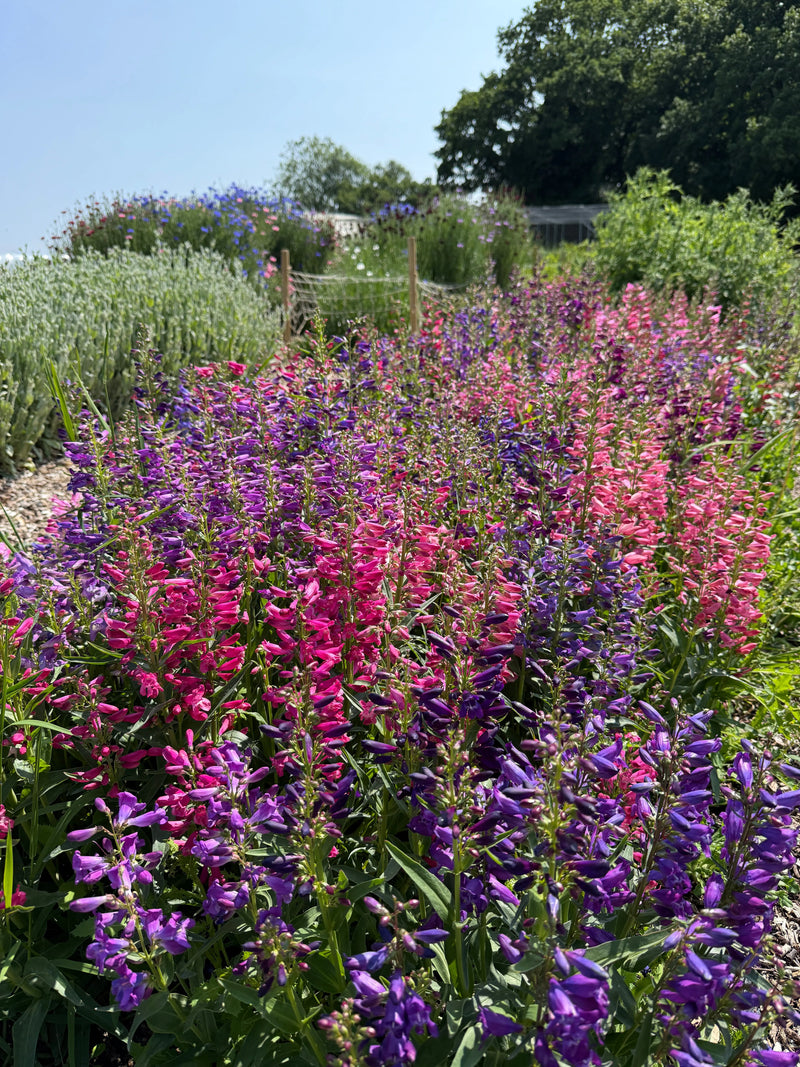
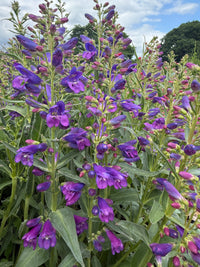
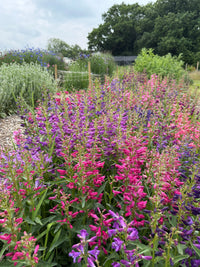
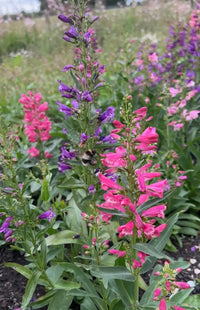
Tall jewel-toned tubular bells in crimson, purple, pink and blue with white throats — the perennial that bridges summer to winter, flowering June often through December.
About this variety
Penstemon barbatus 'Cambridge Mix' Beard-Tongue 'Cambridge Mix'
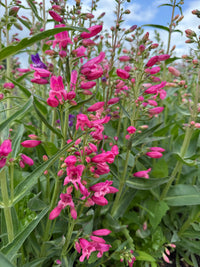
Tall slender flower spikes carrying tubular foxglove-like bells in richly-saturated crimsons, deep purples, bright pinks and cool blues — most carrying contrasting white throats — from June often through to December. Penstemon 'Cambridge Mix' is the perennial the late-summer garden cannot function without, the variety that bridges the difficult gap between summer and winter when most garden flowers have finished.
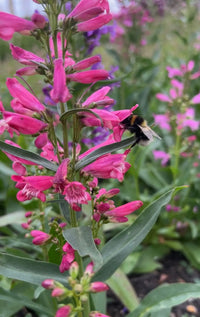
This is the perennial that solves the late-summer-into-autumn colour problem. While lupins finish in June, delphiniums in July, and most summer perennials begin their decline in August, Penstemon is building toward its best performance. The tubular foxglove-like flower bells arrive in June and often continue, with consistent deadheading, well into November or beyond — in sheltered mild UK gardens, Penstemon 'Cambridge Mix' plants are sometimes still carrying fresh flowers in December, making them among the very longest-flowering plants available from seed. The "Cambridge Mix" designation refers to the specific colour selection developed from the Cambridge strains of garden Penstemon — a mix emphasising jewel-tone colour range from deep crimsons through to cool blues, most blooms carrying contrasting white throats that give each flower a sophisticated bi-tone quality. Hardy perennial. RHS Plants for Pollinators — particularly valuable for long-tongued bumblebees who can access the deep tubular bells. Height 60–80cm. Reaches flowering maturity in its first season.
A note on growing
Surface-sow February–April at 18–20°C. Light required — do not cover, or use finest vermiculite dusting only. Penstemon seeds are small. Sow thinly onto moist free-draining seed compost. Germination 14–21 days. Seedlings grow quickly once germinated — prick out into individual 9cm pots when 2–3 true leaves appear.
Plant out in May–June in sun or partial shade in free-draining soil. Penstemon hates sitting in wet soil over winter — this is the most common cause of plant loss. In heavy clay gardens, add generous grit to the planting hole and plant on a slight slope or in raised beds. Space 40–50cm apart. Feed with balanced liquid fertiliser fortnightly from June.
Deadhead consistently throughout the season — this is the single most important care action. If you snip off the faded flower spikes promptly, the plant immediately pushes up new ones — a spent flower spike removed to the next healthy lateral bud is replaced by a new flowering spike within 10–14 days. Without deadheading, the plant progressively allocates more energy to seed production and the season shortens significantly.
⚠️ Critical winter survival guidance: DO NOT cut Penstemons back in autumn. This is the most common cause of Penstemon loss over winter in the UK. The old dried stems of the previous year's growth provide crucial insulation for the crown and root system during cold weather — the hollow stems trap air, the dead foliage creates a microclimate, and the overall effect raises the effective temperature of the crown by several degrees compared to a plant cut hard back to bare soil. Leave all old growth in place until April, when the risk of hard frost has passed and new growth begins to emerge from the base. Remove the old stems then, cutting back to where the fresh growth is appearing.
Where it shines
As the indispensable late-summer-into-autumn perennial — in any garden without Penstemon, there is often a colour vacuum from September onwards that's only addressed by autumn bedding plants. Penstemon 'Cambridge Mix' fills this vacuum with the same flower quality it produced in June — no decline in flower size or quality as the season progresses, just continuous tubular bells in jewel colours until the first serious frosts. In cottage borders, prairie-style plantings, and any sunny well-drained position. In wildlife gardens for long-tongued bumblebee support deep into autumn when other forage is increasingly scarce. As cut flowers for tall vertical arrangements with excellent vase life.
Plant alongside
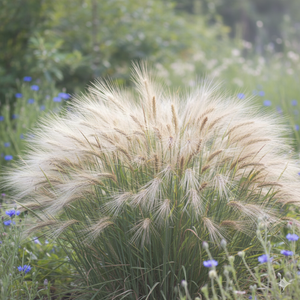
For prairie-style late-summer colour, combine 'Cambridge Mix' with Echinacea 'Bravado' (matching late-season performance, complementary daisy form against tubular bells), Echinops ritro 'Veitch's Blue' (blue spheres contrasting with the Penstemon's mixed jewel tones), and Foxtail Barley (Hordeum jubatum) for soft movement. For cottage borders, pair with Verbena bonariensis (if stocked) and Achillea 'Cerise Queen' for matching late-summer reliability.
Plant alongside
Penstemon Cambridge Mix pairs beautifully with these cottage garden classics


RHS Plants for Pollinators
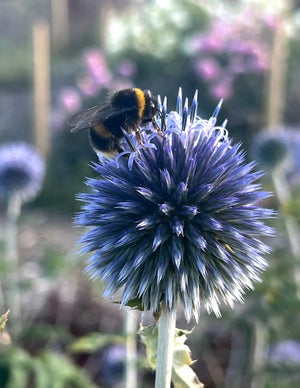
This plant has been assessed by the Royal Horticultural Society and recommended as especially beneficial to bees, butterflies and other pollinators. Growing plants like this directly supports UK pollinator populations — something close to our hearts at Salle Moor Hall Farm, where we see the difference a cottage garden full of the right plants can make.
Learn more at RHS.org.uk →