

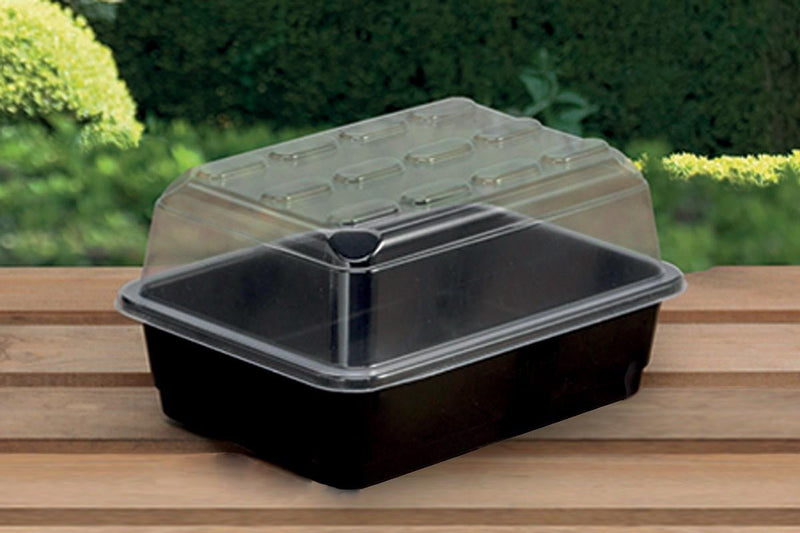
Garland Budget Propagator With Holes – Compact Seed Propagation Tray
The simplest, most reliable way to start seeds indoors is in a humid, warm environment with good drainage — and that's exactly what a propagator gives you. Pop the lid on and you've created a tiny indoor greenhouse: warmth held in, moisture held in, seedlings emerging in days rather than guesswork. Take the lid off as the seedlings grow, and you've got a robust seed tray that does the rest of the job.
These are the everyday workhorse propagators — properly made, sensibly priced, and built to be used season after season. From Garland Products, a British manufacturer who've been making horticultural plastic goods since 1968. Importantly, these are made from 100% recycled plastic and are themselves fully recyclable at the end of their (long) life — which is rather better than most plastic propagators on the market.
Supplied to us through our partners at AllotMate, who curate proper, well-made tools and equipment for gardeners and allotmenteers who'd rather buy once.
🌿 Three sizes for three uses
Each version is the same well-engineered design at a different scale, suited to different growing situations:
- Small — neat enough for a windowsill, ideal for small batches of seed or a single tray of cuttings. The everyday propagator for someone starting out, or for sowing one or two varieties at a time
- Narrow — slim profile designed to fit on a standard windowsill without protruding into the room. Particularly useful if your sowing space is a kitchen window rather than a greenhouse
- Large — a proper gardener's propagator for sowing several varieties at once, or for the gardener with a serious propagation habit. Best suited to greenhouses, conservatories or under grow lights rather than tight windowsills
Most cottage gardeners end up with two or three propagators on the go through spring — different varieties at different stages. At this price, building a small collection is genuinely affordable.
🔬 What makes them work
Garland propagators have a few thoughtful design details that distinguish them from cheaper imports:
- Robust injection-moulded base tray — strong enough to lift, carry and reuse year after year without cracking or warping. Cheaper vacuum-formed trays often split within a season
- Lightweight clear vacuum-formed lid — lets light in, holds humidity, and lifts off easily once seedlings need air
- Dual-tier drainage system — designed to support base watering (filling the lower tier with water and letting it wick up) while preventing waterlogging that rots seeds and seedlings
- Drainage holes — let excess water escape rather than pooling, which is the leading cause of seedling failure in indoor sowing
- 100% recycled plastic construction — and recyclable again at end of life, so the material stays in circulation rather than ending up in landfill
The dual-tier drainage in particular is the feature gardeners come to appreciate over time. Base watering — filling the bottom tray rather than watering from above — is gentler on fragile seedlings and helps roots grow downward in search of moisture, building stronger plants.
🌱 What to grow in them
A propagator is one of the most versatile tools in a gardener's kit. Use them for:
- Vegetable seedlings — tomatoes, peppers, chillies, courgettes, salads, brassicas, beans (after germination indoors)
- Cottage garden flowers from seed — cosmos, zinnia, dahlia, sweet peas (covered briefly until germination), nasturtiums, lupins, hollyhocks
- Herbs — basil, parsley, coriander, thyme, oregano, chives
- Microgreens — fast indoor crops on the kitchen windowsill, ready in two to three weeks
- Cuttings — semi-ripe and hardwood cuttings of woody plants, geraniums, fuchsias, herbs (rosemary, sage, thyme, lavender)
- Tricky-to-germinate seeds that need consistent warmth and humidity — many cottage garden classics fall into this category
📐 Specifications
- Sizes available: Small, Narrow, Large
- Base tray: Injection-moulded for strength and reusability
- Lid: Vacuum-formed clear plastic
- Drainage: Dual-tier system supporting base watering, with drainage holes
- Material: 100% recycled plastic — fully recyclable at end of life
- Heating: Unheated (use on a windowsill, in a warm room, or on a heated propagator base sold separately)
- Made by: Garland Products, UK (since 1968)
- Supplied through: AllotMate
Note: please refer to the product photos for exact dimensions of each size.
💧 How to use them well
A few small habits make the difference between propagators that work brilliantly and ones that disappoint:
- Use seed compost rather than general-purpose compost — finer texture, lower nutrients, better for germination
- Sow at the depth recommended on the seed packet — most seeds want to be barely covered, not buried
- Mist the surface with a spray bottle rather than watering from a can — heavy water disturbs newly sown seeds
- Put the lid on for germination, then open the vents (or lift the lid briefly each day) to prevent damping off — a fungal disease that flattens seedlings overnight
- Place somewhere warm and bright but not in direct sun — south-facing windowsills can cook seedlings under a closed lid on a sunny afternoon
- Remove the lid entirely once seedlings are properly up and have their first true leaves — they need air movement to develop strong stems
- Pot on into bigger pots when seedlings have two or three sets of true leaves
The full sowing instructions for any specific seed will give the best guidance, but these habits cover most situations.
♻️ The recycled plastic story
This is genuinely worth a moment. Most plastic propagators on the market are made from virgin plastic — newly produced, often from petrochemical sources. These are made from 100% recycled plastic, meaning the raw material has already had at least one life elsewhere and has been kept out of landfill or incineration to become something useful again. At end of life, they're recyclable themselves.
That's not a sustainability gimmick. It's a meaningful choice that uses less new material and keeps existing plastic in circulation. For a product made in plastic — which propagators essentially have to be — this is about as good as it gets without moving to entirely different materials.
✏️ About Garland Products
Garland Products are a Worcestershire-based British manufacturer who've been making horticultural plastics since 1968. They're the company behind a substantial proportion of the propagators, seed trays and pots used by professional growers and home gardeners across the UK. We stock their range because British horticultural manufacturing is increasingly rare — and because their commitment to recycled-plastic production aligns with our own approach to sustainability.
A small thought: there's something quietly hopeful about a propagator on a windowsill in February. It's the first sign that spring is coming, often weeks before there's any evidence of it outside. The plants you start in March, in a £3.60 plastic tray, end up filling your borders and your kitchen with flowers and food by July. Not bad value, when you put it like that.