
Scabiosa 'Drumstick'
Scabiosa stellata 'Drumstick' -- Paper Moon; Starflower
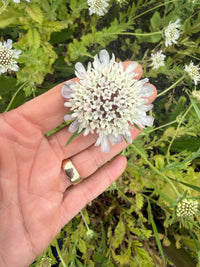
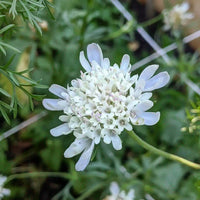
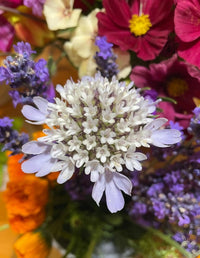
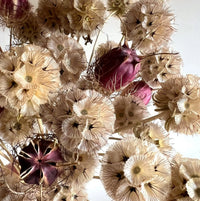
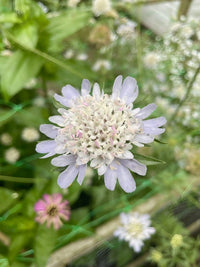
Modest pale-blue pincushion flowers that transform into perfect spherical papery seed heads — the geometric "Paper Moon" everlasting flower of the cottage cutting garden.
About this variety
Scabiosa stellata 'Drumstick' Starflower / Paper Moon / Drumstick Scabious 'Drumstick'
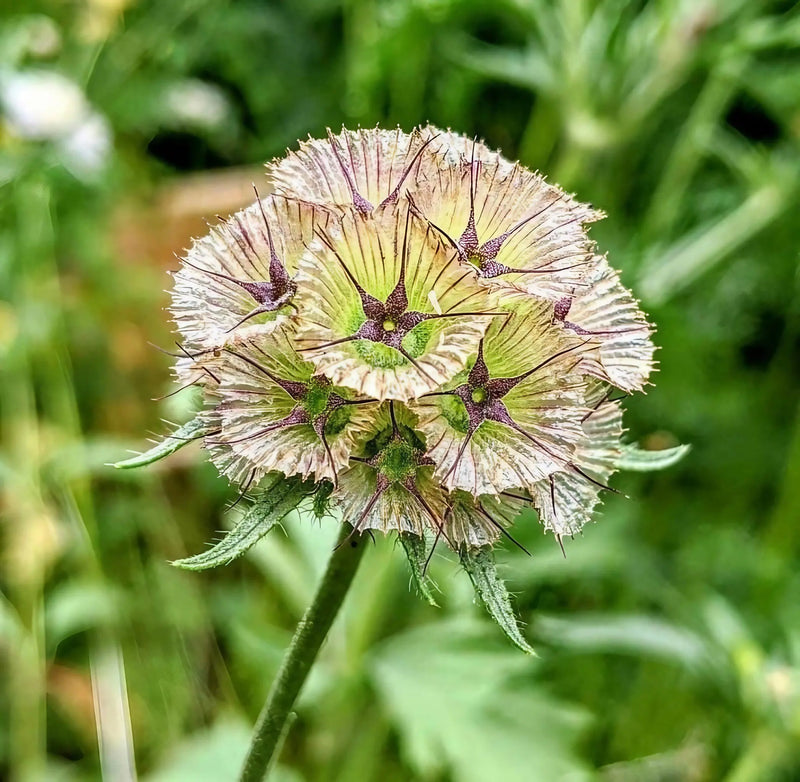
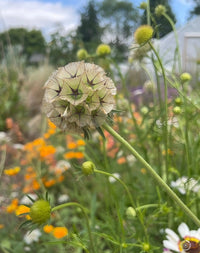
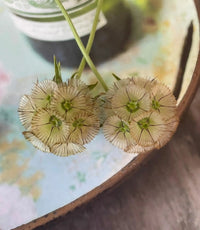
A genuine garden curiosity — modest pale-blue pincushion flowers that bloom briefly on tall wiry stems, then transform as the petals fade into something extraordinary: perfect spherical papery globes of geodesic geometry, each composed of cone-shaped bracts arranged with mathematical precision. Scabiosa 'Drumstick' is the cottage annual grown for its remarkable architectural seed heads rather than its flowers, and one of the most distinctive dried flowers any UK gardener can produce.
This is the cottage garden's geometry plant — a hardy annual whose modest pale-blue pincushion flowers (pleasant but unremarkable) are merely the precursor to the real show. As the petals fade, the seed heads develop into perfect spherical papery globes, each one a small geodesic miracle of cone-shaped bracts arranged like a tessellation across the surface of the sphere. The colour journey is part of the appeal: globes emerge pale green, mature through golden-bronze with darker veining, and finally turn to warm parchment brown. The wiry stems hold the spherical heads high above the ground, swaying in summer breezes like miniature drumsticks (the common name "Paper Moon" also captures the spherical pale-bronze appearance). Hardy annual. Height 60–90cm.
Harvest timing is critical: this is genuinely the most important growing detail. Cut the globes when they are light green to golden-bronze with dark edges — before they fully ripen and shatter. If left on the plant past full maturity, the globes split open and scatter their seeds, the spherical structure collapses, and the dried-flower value is lost. The harvesting window is roughly 2–3 weeks long for any given plant.
A note on growing
Sow indoors March–April in succession (every 2–3 weeks) or direct sow outdoors in May. Press lightly onto moist compost — light required for germination; do not cover. Maintain 18–22°C; germination 10–21 days. Support the wiry stems with twiggy pea sticks at 20–30cm height — the slender stems flop in summer storms without early staking.
Plant in full sun in well-drained neutral-to-alkaline soil. Scabiosa stellata genuinely prefers lean conditions — don't feed. Heavy waterlogged clay produces poor performance.
Drying procedure: cut stems at the critical harvest window, strip lower leaves, bundle in small groups (8–10 stems maximum to ensure good airflow), and hang upside down in a warm dark well-ventilated space for 2–3 weeks. Once fully dried, the spherical heads are stable and retain their shape and colour for years.
Where it shines
In the cutting garden specifically for dried flower harvest — Scabiosa 'Drumstick' is one of the most architecturally distinctive dried flowers you can grow. As a conversation-piece plant in cottage borders, where visitors always stop to ask about the spherical "paper moons". In modern minimalist dried arrangements, where the geometric form reads as designer-quality sculpture. In Christmas and autumn wreaths for structural contrast against softer materials. In wildlife gardens for the bee value of the flowering stage.
Plant alongside
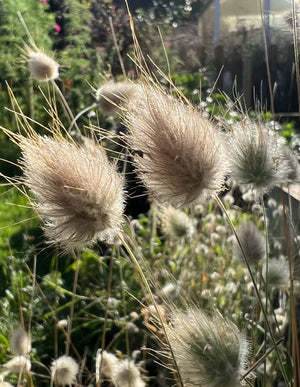
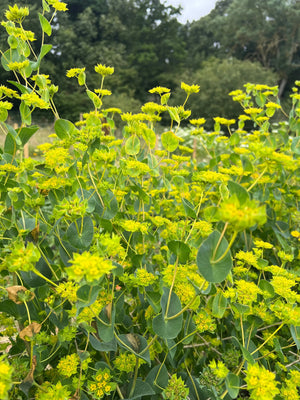
For a coordinated dried-flower harvest, plant 'Drumstick' alongside Bunny Tails (matching scale, soft cream texture), Briza Maxima (matching meadow grass character), Bupleurum 'Griffithii' and Statice 'Hipster Mixed' — together they create a complete drying garden with varied forms and colours. For garden display, the geometric spheres contrast beautifully with the airy umbels of Ammi majus and the daisy forms of Cosmos 'Purity'.
Plant alongside
Scabiosa 'Drumstick' pairs beautifully with these cottage garden classics