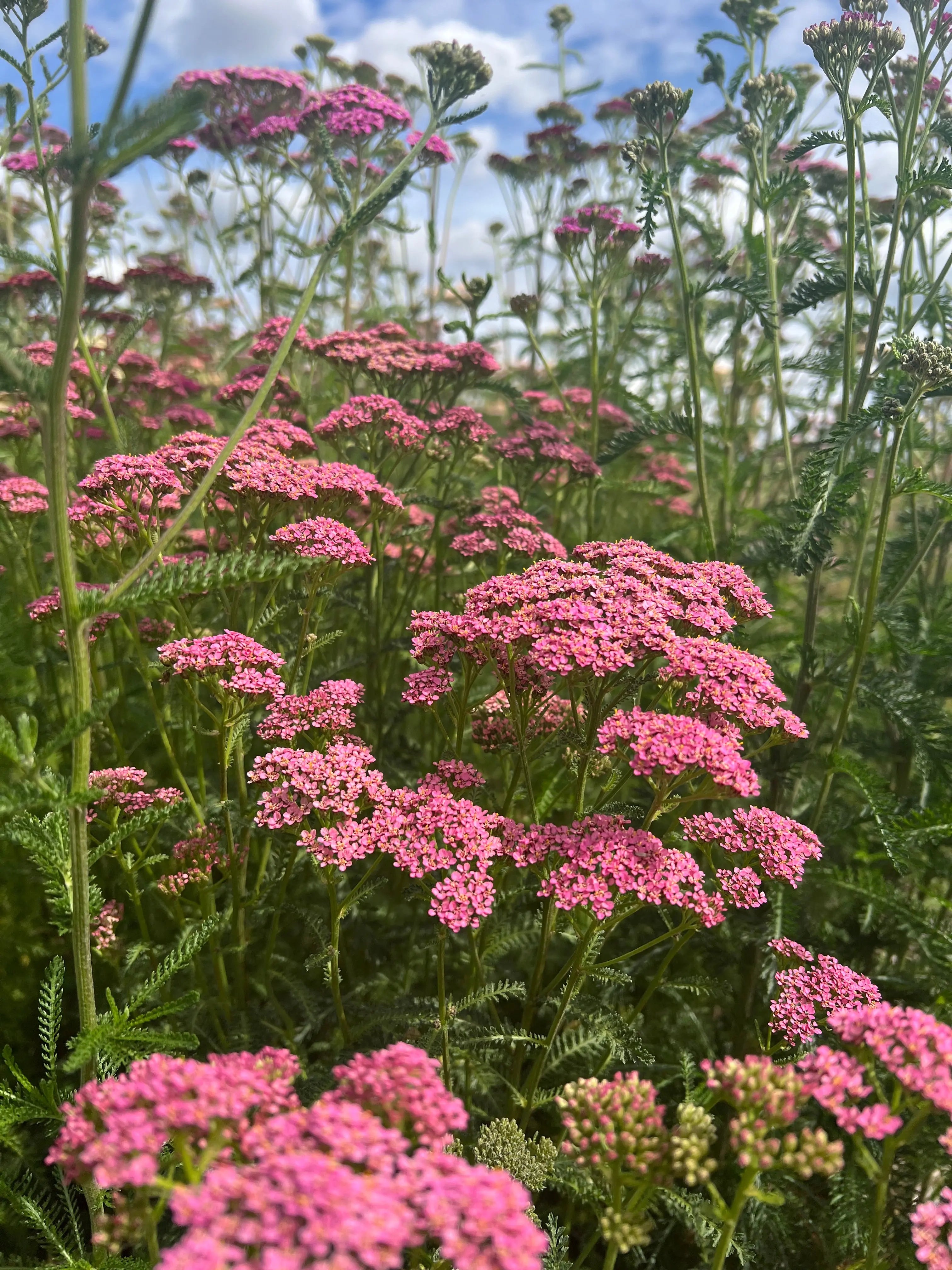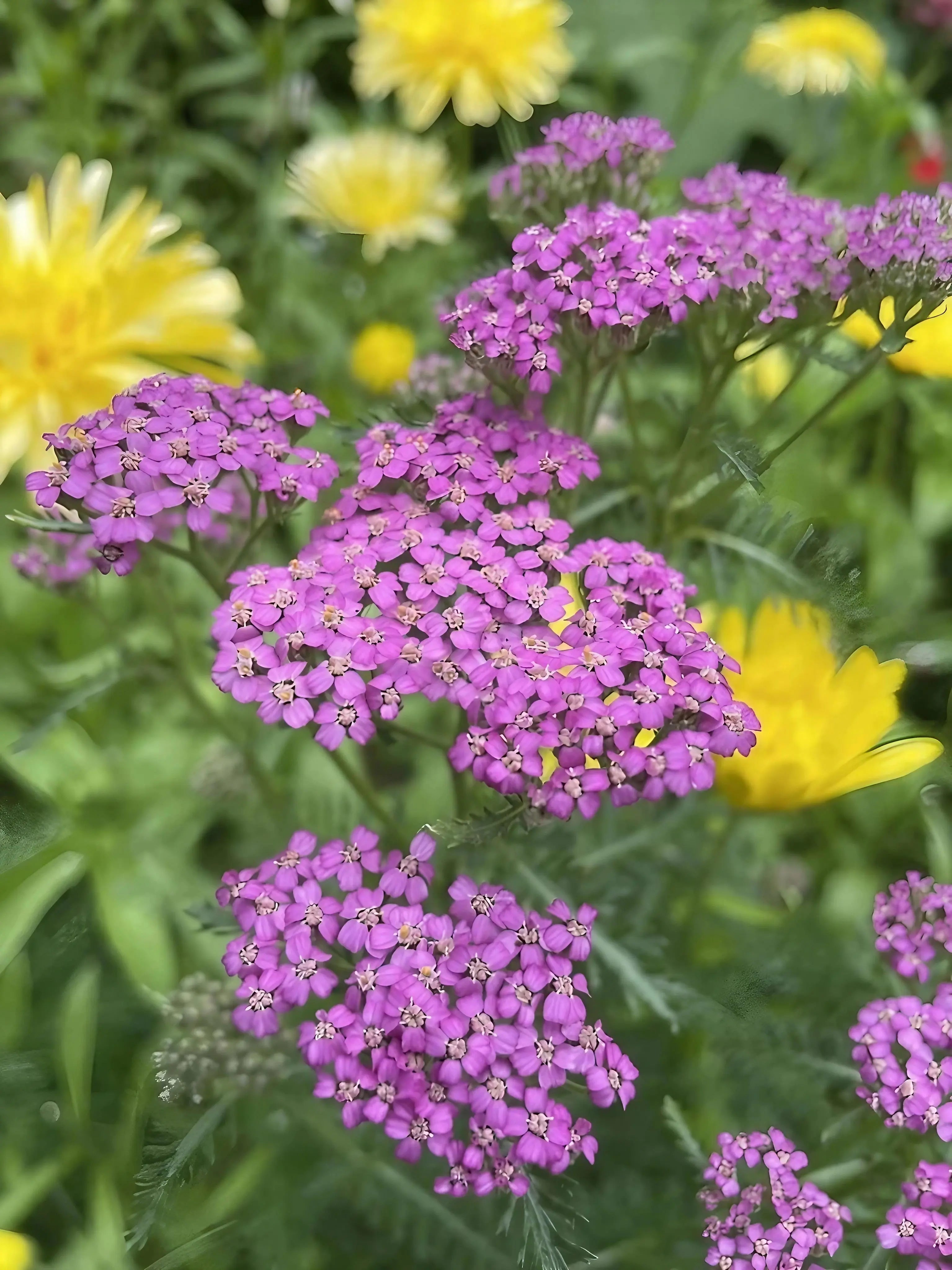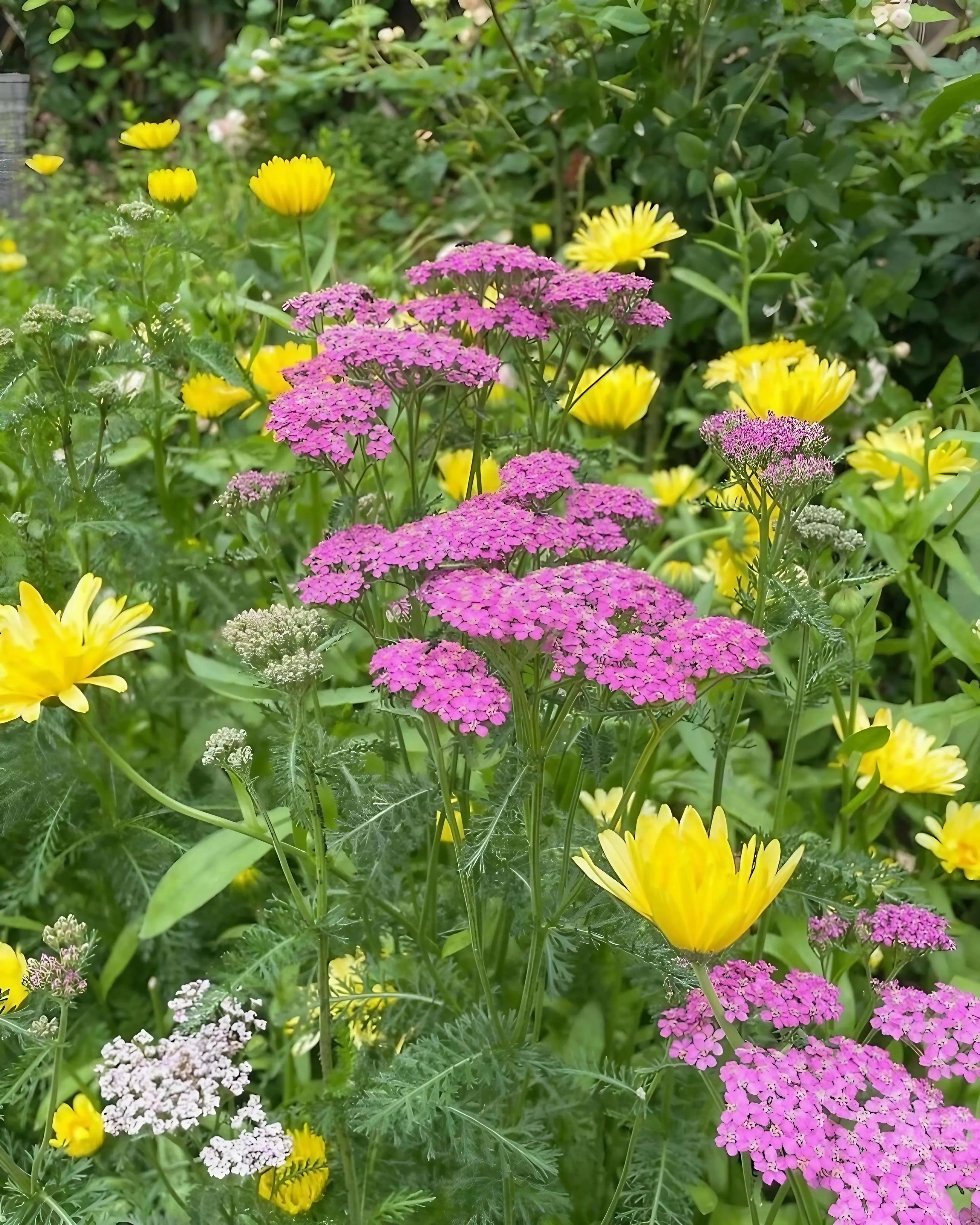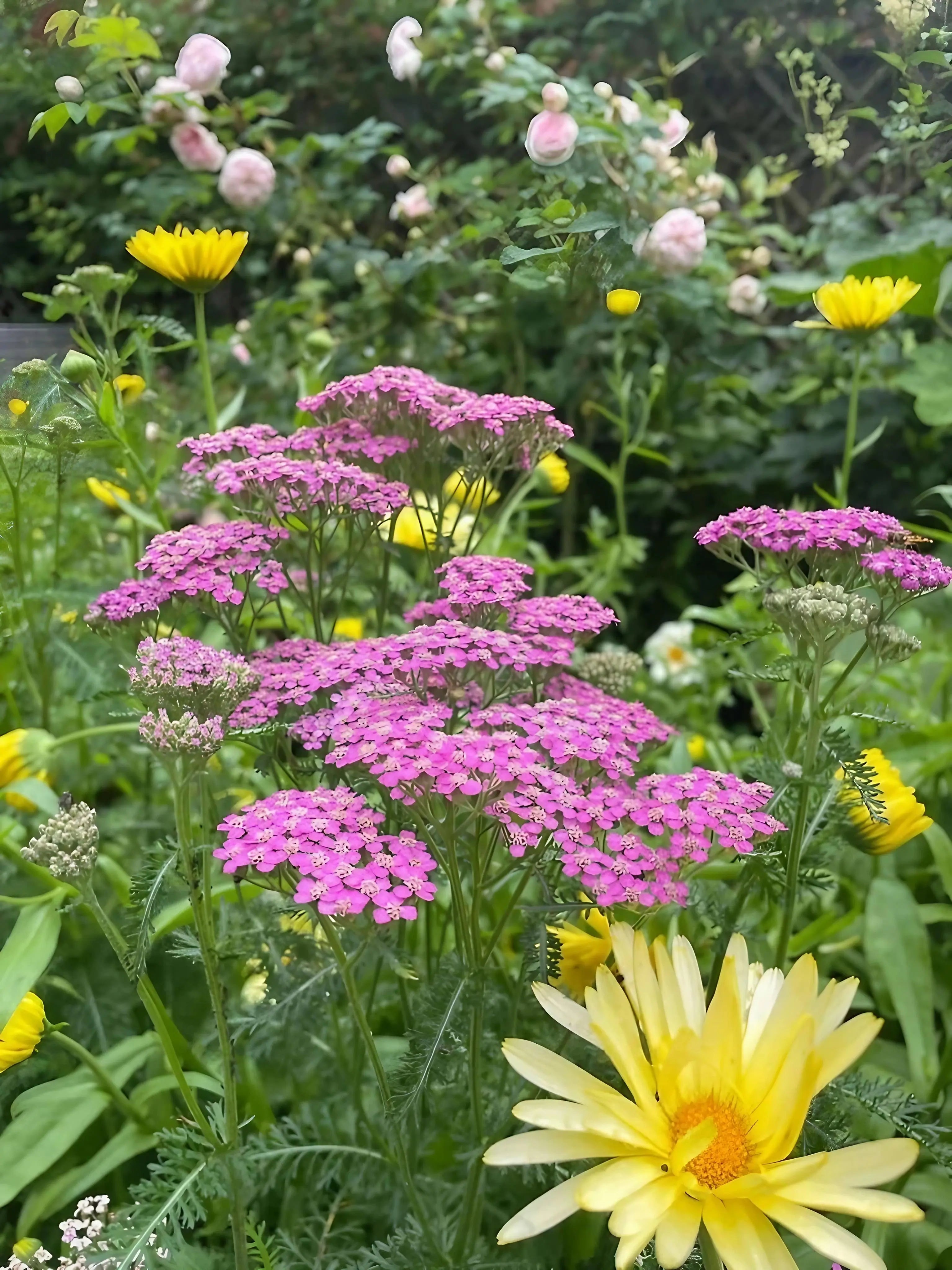


Flat-topped plates of deep cerise-pink that hold their colour through summer, age to warm vintage tones in autumn, and dry to a soft, dusty rose that is one of the finest things in any dried arrangement.
If 'Ballerina' is the achillea of refinement and restraint, 'Cerise Queen' is its vivid, warm-hearted opposite — a millefolium variety of considerable colour intensity and considerable presence in the summer border. The flowers are borne in wide, flat-topped umbels of deep cerise-pink, each tiny floret packed tightly together into a plate of colour that catches the sun and holds it, glowing with a warmth and richness that few other summer perennials achieve at this height and on this scale. It is a plant of immediate, confident visual impact.
What makes 'Cerise Queen' particularly valuable over the full season is the way its colour evolves. The fresh flowers of June and July are a vivid, saturated cerise-pink. As summer deepens they soften and warm toward a rich salmon-rose. And as the season closes and the flowers are left to dry on the plant, they fade to a soft, dusty vintage rose-terracotta that is one of the most beautiful and most sought-after tones in dried flower arranging. A single plant thus provides three distinct but equally beautiful colour moods through the season — and an almost inexhaustible supply of stems for both fresh and dried use throughout.
🌿 Understanding the Plant
Achillea millefolium 'Cerise Queen' is a Hardy Perennial belonging to the common yarrow group — the millefolium achilleas — characterised by their flat-topped flowerheads, finely divided feathery foliage, and spreading, rhizomatous habit. It holds both the RHS Award of Garden Merit and the RHS Plants for Pollinators designation. It is botanically and aesthetically distinct from the ptarmica group (Ballerina), producing wider, flatter flower plates on more spreading, mat-forming plants with notably more aromatic, finely divided foliage.
The Millefolium Difference: Where Achillea ptarmica varieties like Ballerina produce upright, clump-forming plants with rounded pompom flowers, millefolium achilleas spread more broadly at ground level, producing wide mats of feathery foliage from which flowering stems rise in summer. The flat-topped flower plates of millefolium varieties are structurally quite different — broader, more architectural, and landing platforms for pollinators in a way the more rounded ptarmica flowers are not. This flat structure is precisely what makes bees, hoverflies, and butterflies so attracted to achillea — the nectar and pollen are fully exposed and easily accessible.
The Colour Evolution: The seasonal colour journey of 'Cerise Queen' — from vivid fresh cerise through warm salmon to vintage dusty rose when dried — is one of the qualities that makes it exceptional in the cutting and drying garden. Freshly cut stems bring immediate vivid colour to summer arrangements. Stems cut at the point of colour change and dried bring the warm, faded, antique tones that are so valued in the naturalistic dried flower aesthetic currently influencing the finest contemporary floristry. Both uses are outstanding, and the plant provides both in abundance from a single sowing.
Spreading Habit: Like all millefolium achilleas, 'Cerise Queen' spreads gently by underground rhizome over time, gradually increasing its footprint in the border. This is rarely problematic — the expanding clumps can simply be divided every three to four years to maintain a defined area and maintain flowering vigour. Divided portions transplant readily in spring and can be used to expand plantings or shared with other gardeners.
🌱 Growing Guide
'Cerise Queen' is a tough, adaptable perennial that asks for very little once established — the main requirement is good drainage and adequate sun.
How to Sow:
Sow indoors from February to April in trays or modules of good-quality seed compost. As with all achilleas, the seed is fine and requires light to germinate — scatter on the surface, press gently into contact with the compost, and do not cover. Maintain a temperature of 15–18°C. Germination typically occurs within 14–21 days, though it can be variable. Prick out into individual 7cm pots once seedlings are large enough to handle and grow on in a cool, bright environment.
Transplanting:
Plant out from May to June after thorough hardening off. Space plants 30–45cm apart in well-drained soil in full sun or very light shade. Like all millefolium achilleas, 'Cerise Queen' is notably drought-tolerant once established and actually flowers more prolifically in lean, well-drained conditions than in rich, fertile soil. It is an excellent choice for gravel gardens, south-facing slopes, and any position where drainage is good and the sun is generous.
Ongoing Care:
Deadhead spent flowerheads promptly to encourage continuous production of new flowering stems throughout summer. In late autumn or early spring, cut the entire plant back to the basal rosette of feathery foliage — this encourages fresh, vigorous growth and prevents the centre of the clump from becoming congested and woody. Divide every three to four years in spring to maintain vigour. No feeding required — achillea in fertile, well-fed soil produces lush leafy growth at the expense of flowers.
Cutting and Drying:
For fresh use, cut stems when the flower plates are fully open and the colour is at its most vivid. For drying, cut just as the flowers reach full colour but before any fading begins — the dried colour will be one to two shades softer than the fresh flower. Hang upside down in small bunches in a warm, dark, ventilated space for two to three weeks. The dried stems hold their structure and their soft rose-terracotta colouring for many months.
📋 Plant Specifications
| Botanical Name | Achillea millefolium 'Cerise Queen' |
| Common Name | Yarrow 'Cerise Queen' / Milfoil |
| Plant Type | Hardy Perennial |
| Hardiness | H7 — Fully hardy throughout the British Isles |
| Light Requirements | Full Sun ☀️ (tolerates very light shade) |
| Plant Height | 60–75cm in flower |
| Plant Spread | 45–60cm, slowly spreading by rhizome |
| Flower Form | Flat-topped umbel — wide, architectural flowerhead |
| Flower Colour | Deep cerise-pink fresh; softens to salmon-rose; dries to vintage dusty rose |
| Flowering Period | June to September |
| Soil | Well-drained; tolerates dry and poor soils — avoid waterlogging |
| RHS Award of Garden Merit | Yes ✓ |
| RHS Pollinator Friendly | Yes ✓ — flat flowerhead provides exceptional pollinator access |
| Dried Flower Use | Excellent — fades to beautiful vintage rose-terracotta when dried |
| Seeds per Packet | Approximately 800 seeds |
| Perfect For |
Warm Pink & Rose Garden Schemes
Fresh & Dried Flower Arrangements
Pollinator & Wildlife Gardens
Drought-Tolerant & Gravel Gardens
Long-Lived Perennial Borders
|
🤝 Beautiful Garden Combinations
The vivid cerise-pink plates of 'Cerise Queen' are one of the most sociable colours in the summer border — warm enough to sit alongside rich purples and blues, bold enough to carry a planting on its own, and versatile enough to work in both hot and cool colour schemes:
- 🤍 Achillea 'Ballerina': The Family Contrast. Growing Cerise Queen alongside Ballerina is the most naturally satisfying pairing within the achillea range — the vivid flat cerise plates of the millefolium variety alongside the pure white rounded pompoms of the ptarmica, two plants from the same genus speaking in entirely different formal and chromatic registers. The white of Ballerina cools and brightens the cerise of Cerise Queen, making both appear more vivid than either would alone, and the contrast between the flat architectural flowerhead and the rounded double pompom creates a textural interest that is as compelling up close as from a distance. In the cutting garden, the two together provide a complete achillea combination that covers both the cool white and the warm pink ends of the palette.
- 💜 Salvia 'Violet Queen': The Hot Border Classic. The combination of cerise-pink achillea and violet-blue salvia is one of the most consistently admired and most widely planted summer perennial pairings in the cottage garden tradition — warm and cool, flat and spiky, open plate and upright spike, playing against each other in a way that creates visual excitement without ever becoming discordant. Salvia Violet Queen's deep violet-blue flower spikes provide exactly the cool, rich contrast needed to bring out the full vibrancy of Cerise Queen's warm pink, and both are outstanding pollinator plants that together sustain a remarkable density of bees and hoverflies throughout the summer months.
- 🌾 Briza Maxima (Quaking Grass): The Airy Foil. The trembling, translucent heart-shaped seed heads of Briza Maxima on their hair-fine stems create a delicate, moving cloud around the flat cerise plates of Cerise Queen that lightens the planting and adds extraordinary movement and texture. The combination is at its best in gentle summer breeze — the grass shimmering and catching the light around the bold, still achillea plates — and in a cut flower arrangement it is one of the finest pairings available from annual and perennial seed. Both dry beautifully, making them natural companions in the dried flower arrangement as well as the living border.
- 🌀 Echinops ritro 'Veitch's Blue': The Structural Drama. The steel-blue globe heads of Echinops alongside the wide cerise plates of Cerise Queen creates one of the most structurally dramatic and most chromatically satisfying combinations in the late summer border — spiky sphere against flat plate, cool steel-blue against warm cerise-pink, architectural formality against generous abundance. Both are drought-tolerant perennials that thrive in the same well-drained, sun-drenched conditions, both are outstanding for pollinators, and both dry superbly — making this combination as effective in a dried winter arrangement as in the living summer border.
📅 Sowing & Flowering Calendar
Sow indoors from February and plant out in May or June — established plants flower from their second season with increasing generosity, providing vivid fresh colour in summer and beautiful dried stems for autumn and winter arrangements.
| Jan | Feb | Mar | Apr | May | Jun | Jul | Aug | Sep | Oct | Nov | Dec | |
|---|---|---|---|---|---|---|---|---|---|---|---|---|
| 🌱 Sow Indoors | ||||||||||||
| 🪴 Plant Out | ||||||||||||
| 🌸 Flowering |
Two things make the most of 'Cerise Queen'. First, as with all achilleas, do not cover the seed — press lightly onto the surface of moist compost and provide light rather than darkness during germination. Covering the fine seed with compost is the single most common cause of failure with this genus. Second, resist the urge to deadhead every spent stem as soon as the colour begins to fade — the transitional tones of Cerise Queen as it ages from vivid cerise through salmon to dusty vintage rose are genuinely beautiful and worth leaving in the border for their own sake. Leave some stems to fade naturally on the plant through late summer and into autumn, and you will find the softened, weathered tones of the ageing flowers as valuable in the border — and in a dried arrangement — as the vivid fresh flowers of June and July.
🏆 RHS Award of Garden Merit
Achillea millefolium 'Cerise Queen' is the achillea of warmth, abundance, and seasonal evolution — a long-lived perennial that delivers vivid cerise-pink in early summer, softening warmth through midsummer, and beautiful dried stems of vintage rose through autumn and winter. Grow it alongside Ballerina for the complete achillea pairing — white pompom and cerise plate, ptarmica and millefolium, restraint and abundance — and discover why this genus has anchored the British cottage garden perennial border for over three centuries.
📖 Want more detailed growing advice?
View our Complete Growing Guide →
- Regular price
-
£2.30 - Regular price
-
- Sale price
-
£2.30
Couldn't load pickup availability
Understanding the Plant