Skip to product information
1 of 3

German Chamomile Seeds

If you love herbal tea, growing your own German Chamomile is a revelation. The dried flowers you buy in shops are often old and dusty; fresh, home-grown chamomile has a sweet, potent scent of apples and honey that is incomparable.

This is the variety grown specifically for tea making. Unlike the low-growing Roman lawn chamomile, German Chamomile grows upright (up to 50cm), producing hundreds of daisy-like flowers with raised yellow centres. It is a hardy annual that is incredibly easy to grow, often self-seeding to provide you with a lifetime supply of calming blooms.


Read More

🌿 Understanding the Plant

Matricaria chamomilla (syn. M. recutita) is a robust Hardy Annual (H5). It completes its entire life cycle within a single summer season. It is distinct from Roman Chamomile (Chamaemelum nobile), which is a perennial ground-cover; German Chamomile is the superior choice for harvesting due to its higher essential oil content and sweeter flavour profile.

The "Apple" Scent: The etymology of "Chamomile" derives from the Greek khamaimelon, meaning "ground apple." This refers to the characteristic fruity, apple-like aroma released when the foliage or flowers are crushed or brushed against.

The "Physician of the Garden": Chamomile has earned a reputation in horticultural history for improving the health of nearby plants. Biologically, it is a high-value pollinator plant that attracts hoverflies—essential predators whose larvae devour aphids—effectively acting as a natural pest-management system for the organic vegetable garden.

🌱 Growing Guide

Chamomile seeds are exceptionally tiny—almost dust-like—and require careful handling to ensure successful establishment.

How to Sow:
Direct sow outdoors in September for early blooms the following year, or in March to May for a mid-summer harvest. Scatter the tiny seeds onto the surface of finely raked, moist soil. Do not bury them; Chamomile seeds require light to trigger germination. Press them gently into the earth to ensure good soil contact. Germination typically occurs within 10-14 days.

Where to Plant:
They demand full sun and thrive in poor, sandy, or well-drained soil. They are remarkably drought-tolerant once established but cannot tolerate heavy, waterlogged clay. Their self-seeding nature makes them perfect for filling cracks in paving or establishing a permanent "pollinator strip" at the front of a vegetable bed.

Ongoing Care:
For the highest quality tea, harvest the flower heads when they are fully open—identifiable when the white petals begin to point downwards. Regular harvesting encourages the plant to continue producing fresh blooms. If you wish to ensure a crop for the following year, allow a few plants to go to seed in late summer; they will naturalise and return faithfully every spring.

📋 Plant Specifications
Botanical Name Matricaria chamomilla
Common Name German Chamomile / Scented Mayweed
Plant Type Hardy Annual
Hardiness H5 (Hardy through UK summer)
Light Requirements Full Sun ☀️
Height 40cm - 60cm
Spread 25cm
Spacing Plant 15cm apart
Flowering Period June to September
Perfect For ☕ Gourmet Home-Grown Herbal Tea
🐝 Essential Forage for Solitary Bees
💆 Natural Garden Relaxation Therapy
🥗 Edible Floral Garnishes
Seeds per Packet Approximately 750 seeds
🤝 Beautiful Kitchen Combinations

Chamomile is a legendary companion plant, offering both practical pest deterrence and biological health benefits to these available partners from our range:

  • 🥬 Brassicas (Kale & Cabbage): The Pest Confuser. The strong apple-and-honey aroma of Chamomile is believed to mask the scent of brassicas, helping to confuse Cabbage White butterflies and reduce caterpillar infestation. Its daisy flowers also attract beneficial hoverflies whose larvae prey on aphids.
  • 🥒 Cucurbits (Cucumber & Courgette): The Health Booster. Traditional lore suggests that Chamomile improves the vigour of cucumbers and courgettes while helping to deter powdery mildew. The flowers provide essential nectar for pollinators required for heavy fruit set in your cucurbit patch.
📅 Sowing & Flowering Calendar

Direct sow in spring or autumn for a summer-long harvest of fresh apple-scented blooms for the teapot and the bees.

Month J F M A M J J J A S O N D
Direct Sow
Harvest

✨ Tea-Making Tip
Harvest flowers when fully open (petals pointing downwards) for maximum oil concentration. Steep 1 tablespoon of fresh or dried flowers in boiling water for 5 minutes for a superior, apple-honey flavoured nightcap.

🏆 Robust Garden Stamina

Known for its stamina and ability to thrive in poor soils, Matricaria chamomilla is an essential choice for those wanting to create a romantic, low-maintenance garden that provides high-quality herbal harvests and essential pollinator food.

📖 Want more detailed growing advice?
View our Complete Growing Guide for Herbs →

Regular price
£2.00
Regular price
Sale price
£2.00
Tax included. Shipping calculated at checkout.

    2 total reviews

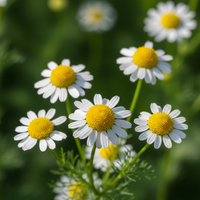
    Close-up of the white daisy-like flowers of German Chamomile
    Chamomile (Matricaria chamomilla) growing in a garden.
    Chamomile (Matricaria chamomilla) growing in a garden