

Borage Seeds — Borago officinalis
A Mediterranean annual that thrives in poor soil and full sun, produces vivid true-blue star flowers from June to October at a rate of nectar replenishment that makes it among the most valuable bee forage plants in cultivation, and whose edible flowers and leaves carry a fresh, clean, distinctive cucumber flavour.
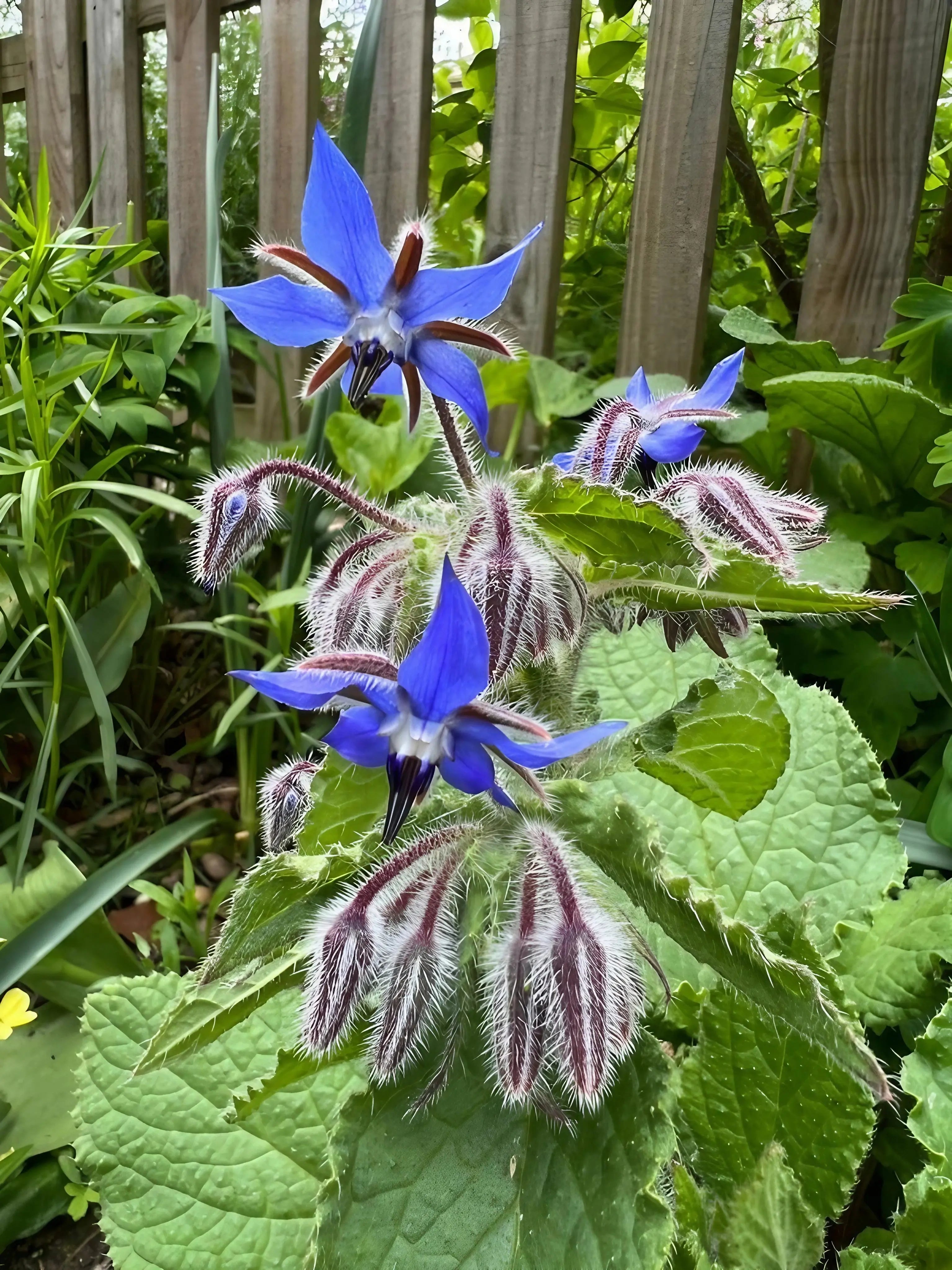
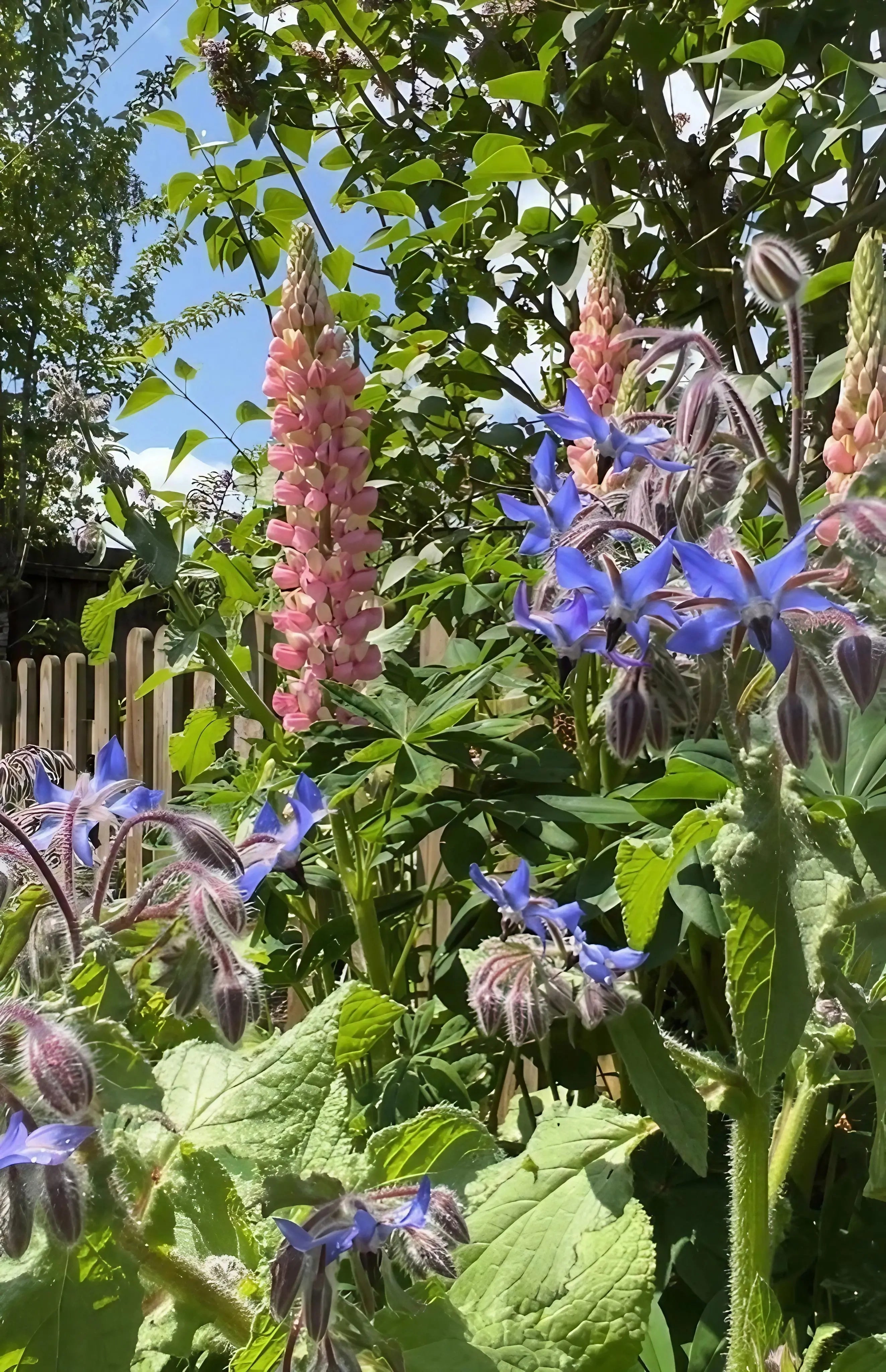
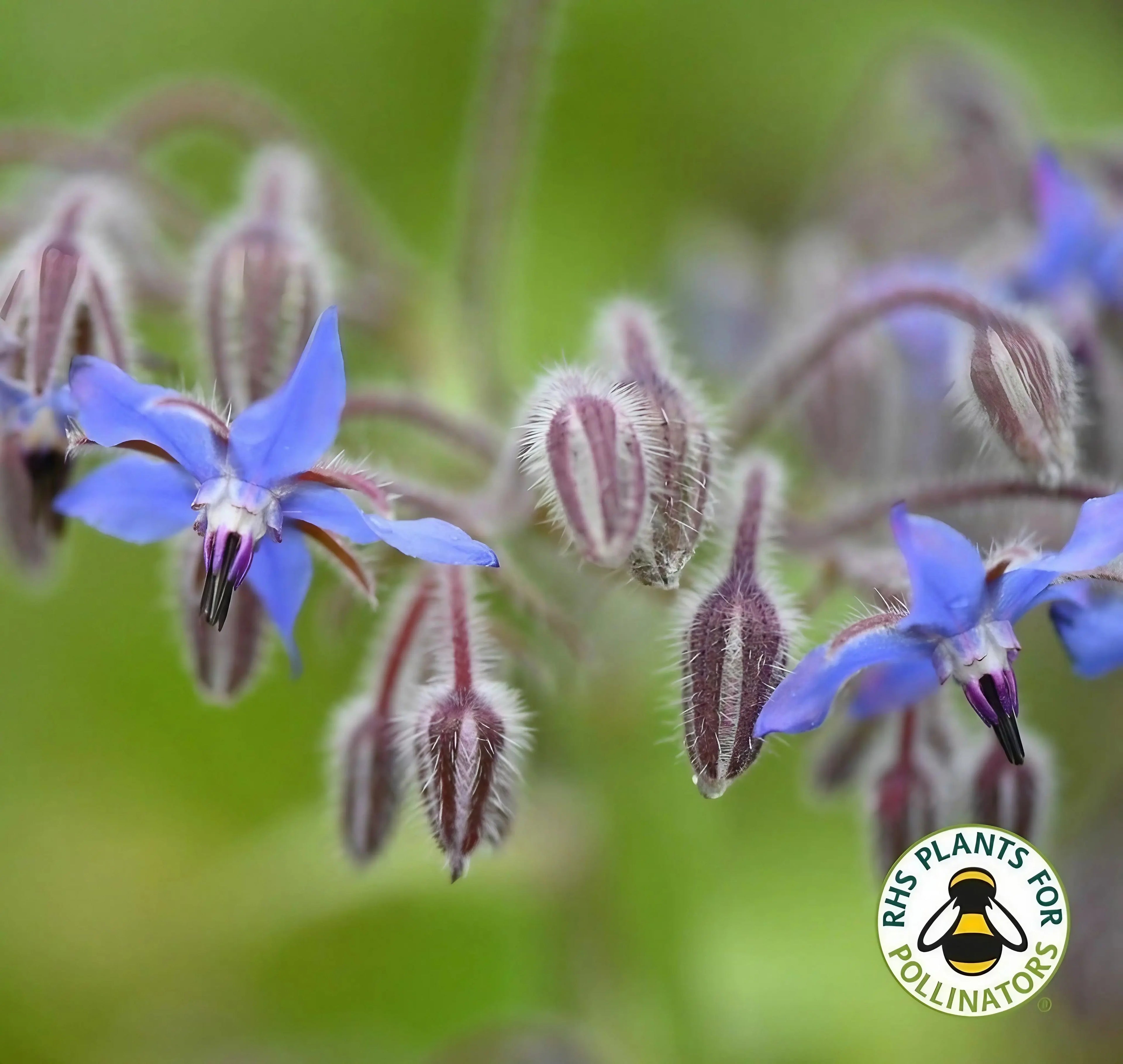
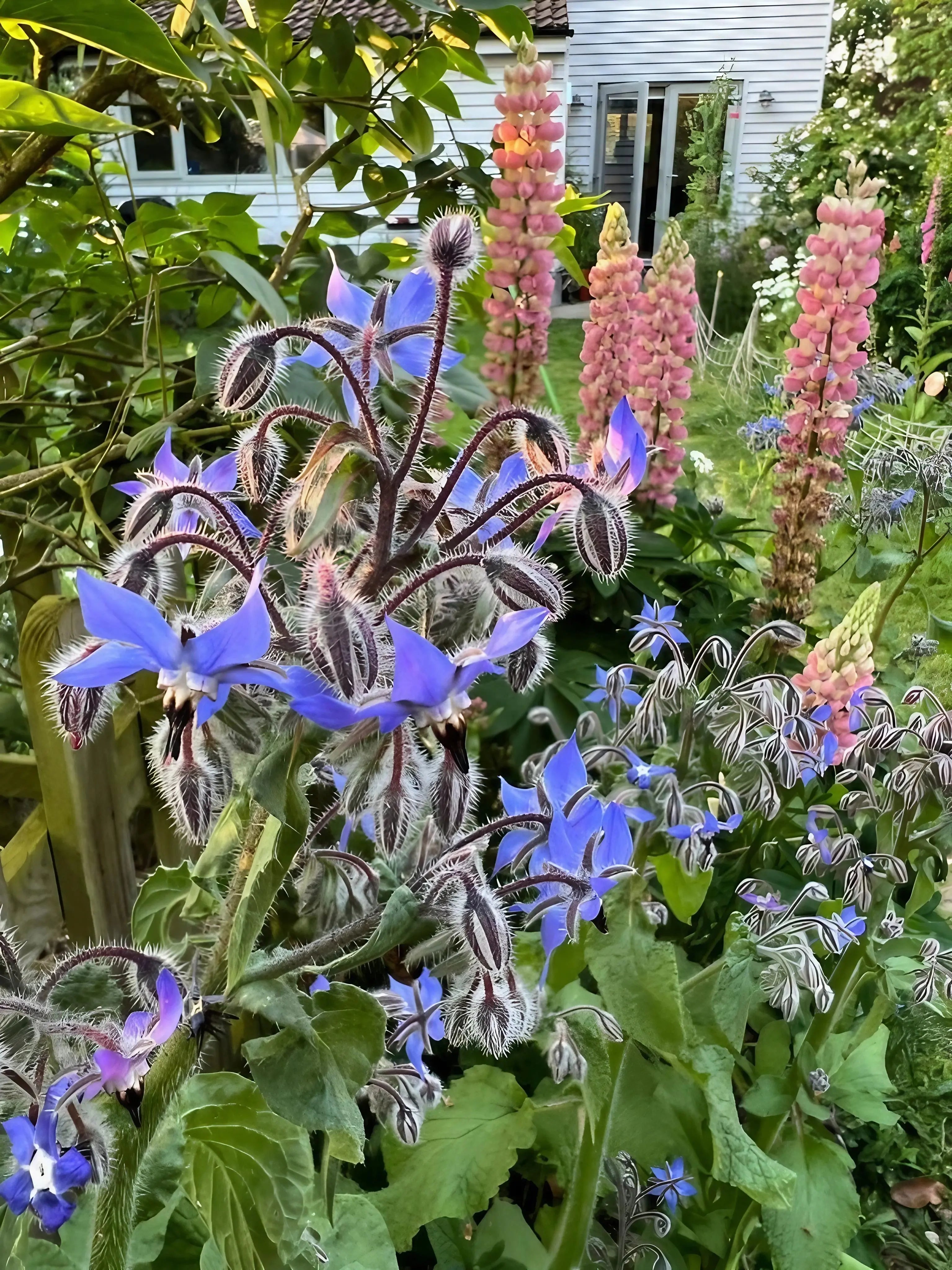
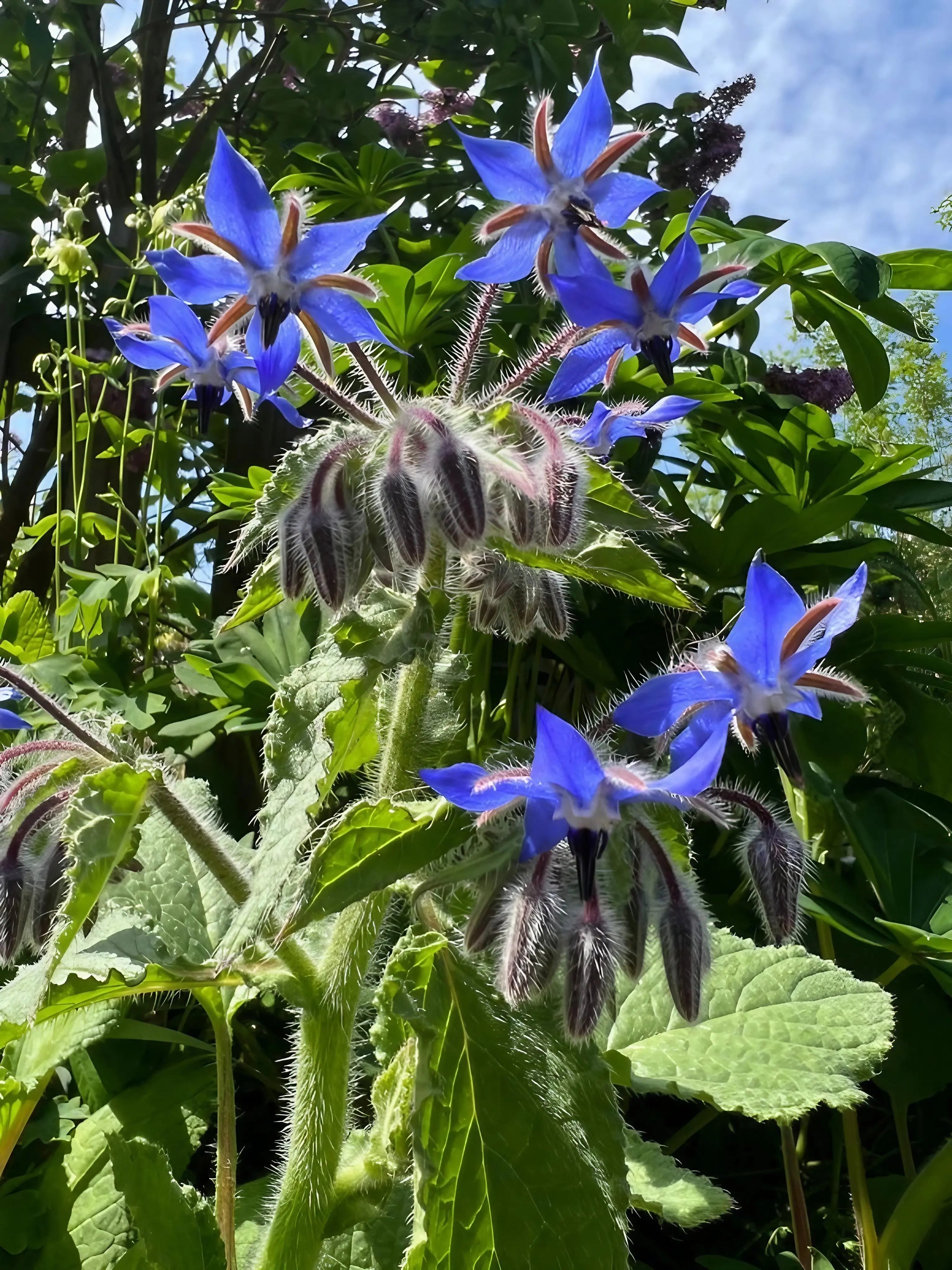
There are plants in the garden that reward attention and plants that reward neglect, and borage is unambiguously in the second category. Direct sown into ordinary, slightly poor, well-drained soil in April, it germinates reliably within a week or two, develops quickly into a substantial, somewhat sprawling, rough-hairy plant of 60–90cm, and produces its distinctive vivid blue star flowers from June through to October with an abundance and a continuity that few other annuals match. It asks for almost nothing — no feeding, no pinching, no deadheading, no staking in most situations — and returns the modest investment of sowing it with months of blue flowers, substantial bee interest, and a self-seeding habit that, if flower heads are allowed to ripen and fall, will produce a fresh generation of plants the following spring without any further effort from the gardener at all.
The edible quality is the genuinely surprising element for most growers encountering borage for the first time. Both the flowers and the young leaves taste unmistakably of fresh cucumber — a clean, green, slightly sweet, entirely pleasant flavour that comes from nonadienal, the same compound responsible for the characteristic scent of a freshly cut cucumber. The flowers frozen into ice cubes produce one of the most beautiful and most practically useful edible garnishes available from any garden plant, and the young leaves — hairy enough to be unpleasant once mature — are usable in salads and cold summer soups before they develop their full rough texture. For anyone interested in the edible garden, borage in a kitchen garden or herb bed earns its space on culinary grounds alone, alongside everything else it provides.
🌿 Understanding the Plant
Borago officinalis (Borage / Starflower / Bee Bread) is a Hardy Annual (H4) and holder of the RHS Plants for Pollinators designation — a Mediterranean native belonging to the Boraginaceae family (the same family as anchusa, forget-me-not, and comfrey) that direct-sows easily, grows rapidly, and self-seeds prolifically to create an effectively permanent garden presence from a single sowing.
The Nectar Mathematics: The live page states that borage nectar reservoirs refill every two to five minutes — and this is not an exaggeration. Borage is consistently ranked among the highest nectar producers in the British flora, and the combination of a very rapid refill rate and a very long flowering season (June to October) makes a single established plant a near-continuous nectar source for an extended period. The practical consequence in a garden setting is what anyone who has grown borage near other flowering plants will have observed: bees visiting the blue stars with an urgency and frequency that they do not show at most other flowers. Honeybees, bumblebees, and solitary bees are all regular visitors, and the plant's common name "bee bread" — a reference to the pollen that bees collect and store as winter food — reflects a centuries-long recognition of this specific quality.
The Cucumber Compound: The cucumber flavour of borage flowers and young leaves is specific and identifiable — not a vague "fresh" quality but a genuine, recognisable cucumber taste. The compound responsible is nonadienal (specifically, trans,trans-2,6-nonadienal), also called "cucumber aldehyde", which is the dominant volatile compound in fresh cucumber and which borage produces in significant concentration. The flowers are the purest expression of this flavour; the young leaves have it too but are also hairy enough to be unpleasant once the plant is well established, so leaf harvest is best done early when the leaves are small and the hairs are fine.
The Taproot and Lean Soil Principle: Like anchusa — a relative in the same plant family — borage develops a deep taproot from an early stage, which is both the source of its drought tolerance and the reason it dislikes transplanting. It is also, like anchusa, a plant that performs significantly better in lean, free-draining soil than in rich or recently fertilised ground. Rich soil produces a large, lush, heavily-leafed, somewhat sprawling plant with proportionally fewer flowers; lean soil produces a more compact, more floral, more ecologically active plant that is genuinely better in almost every respect. Do not feed borage, do not improve the soil before sowing it, and it will thrive.
The Self-Seeding Cycle: Allowed to set seed, borage produces prolific offspring that germinate in autumn or the following spring, overwinter as small rosettes in mild areas, and produce larger, earlier-flowering plants than spring-sown seed. A garden that has had borage in it for one season and allowed some plants to seed will generally maintain itself indefinitely thereafter, with new seedlings appearing in cracks, at the base of walls, in the vegetable garden, and in the most improbable and most perfectly appropriate places that the gardener would never have thought to plant. This wandering, naturalising quality is one of borage's most characteristically cottage garden properties.
🌱 Growing Guide
Borage is one of the easiest plants in the range to grow — the main requirements are direct sowing, lean soil, and patience with the self-seeding habit once established.
How to Sow:
Direct sow outdoors from April to June where the plants are to grow — no indoor sowing, no modules, no transplanting. The large seeds are easy to handle and sow in shallow drills 1–1.5cm deep. Germination is rapid and reliable at 7–14 days once the soil is warm enough in April or May. Alternatively, sow in September for plants that overwinter as rosettes and flower earlier and more substantially the following summer. Thin seedlings to 35cm apart once established.
If Starting Indoors:
If indoor sowing is necessary — for example, to get an early start for companion planting with tomatoes before the last frost — sow into deep individual modules rather than seed trays, and transplant into final positions while the seedlings are still very young (first true leaf stage) to minimise root disturbance. Transplanted borage generally establishes less vigorously than direct-sown plants, but early transplanting significantly reduces the check compared to later transplanting.
Position and Soil:
Full sun is preferred. Poor, dry, free-draining soil produces the best flowering performance — borage growing in rich, well-fed soil produces excessive leaf growth relative to flower production. Do not add compost or fertiliser before sowing; if growing in a kitchen garden with regularly enriched soil, consider a dedicated spot where the soil has not been recently improved.
Harvesting the Flowers:
Pick individual flowers by pulling them gently from the calyx — they detach cleanly at the point where the petal tube meets the sepal. Use within a few hours of picking for the best flavour and appearance; the flowers wilt relatively quickly once separated from the plant. For ice cube use, pick and freeze immediately in water for the finest result.
📋 Plant Specifications
| Botanical Name | Borago officinalis |
| Common Names | Borage / Starflower / Bee Bread |
| Plant Type | Hardy Annual — self-seeds to become effectively permanent |
| Hardiness | H4 — hardy through UK summers and light frosts |
| Light Requirements | Full Sun ☀️ |
| Plant Height | 60–90cm — upright but somewhat sprawling in habit |
| Plant Spread | 40cm |
| Plant Spacing | 35cm apart |
| Flower Colour | Vivid sky-blue — one of the few genuinely true-blue flowers |
| Flower Flavour | Fresh cucumber — from nonadienal (cucumber aldehyde); fully edible |
| Flowering Period | June to October |
| Soil Preference | Poor, lean, free-draining — lean soil produces more flowers than rich |
| Taproot | Deep — drought tolerant; dislikes transplanting; direct sow preferred |
| Nectar Production | Exceptional — refills every 2–5 minutes; among highest in British flora |
| RHS Pollinator Friendly | Yes ✓ |
| Seeds per Packet | Approximately 100 seeds |
| Perfect For |
Elite Bee & Pollinator Support
Edible Flowers & Cocktail Garnish
Vegetable Garden Companion Plant
Self-Seeding Naturalising Annual
Low-Maintenance Cottage Garden
|
🤝 Beautiful Garden Combinations
Borage's vivid blue and its companion planting ecology make it one of the most versatile and most beneficial plants in any mixed garden — these combinations work at every level:
- 🌼 Calendula 'Touch of Red': The Potager Classic. The warm amber and mahogany tones of Calendula 'Touch of Red' alongside the vivid sky-blue of borage is one of the most visually effective warm-cool colour combinations in the kitchen garden, and one of the most ecologically complete — blue and orange are complementary colours, and the contrast makes each appear more vivid, while the two plants together attract a broader range of beneficial insects than either attracts alone. Calendula's open flowers recruit hoverflies and parasitic wasps that prey on aphids; borage's high-nectar flowers recruit bees that improve pollination across the whole vegetable garden. Both are edible, both are easy from direct sowing, and both are genuinely beautiful companions for tomatoes, courgettes, and beans in a productive kitchen garden or cottage border.
- 🌿 Nasturtium 'Tom Thumb': The Edible Dream Team. Borage and nasturtium together provide the most complete edible-flower experience available from two direct-sown annuals — the borage's fresh cucumber blue stars alongside the nasturtium's peppery orange, yellow, and red trumpets, both fully edible, both easy from direct sowing, both flowering from June to October, and both providing excellent companion plant services alongside the flavour and visual interest they contribute to the kitchen garden. The contrasting flower forms (the precise five-petalled borage star against the open, loosely structured nasturtium) and contrasting colours (the cool blue against the warm orange) create a visual combination that is as pleasurable in the garden as the flavour combination of both flowers in a salad.
- 🍅 Tomato 'Gardener's Delight': The Companion Planting Partnership. Borage as a companion for tomatoes is one of the most frequently recommended and most widely observed companion planting combinations in the kitchen garden tradition — and for reasons that extend beyond folklore. Borage's high nectar production recruits bumblebees in significant numbers, and bumblebees are particularly effective pollinators of tomatoes because they practice "buzz pollination" (sonication) — vibrating their flight muscles at a frequency that shakes pollen from the tomato's flower structures more effectively than any other pollination method. A borage plant growing beside or among tomatoes actively improves fruit set through this mechanism. The aromatic compounds in borage foliage are also anecdotally reported to deter tomato hornworm and other pests, and the sprawling borage growth helps shade the soil around tomato roots, reducing moisture loss. Grow borage at the base of each tomato plant or in adjacent positions for a companion planting combination with both ecological and practical credentials.
- 💙 Anchusa 'Blue Angel': The True Blue Garden. Growing borage alongside Anchusa 'Blue Angel' creates the most purely and most densely blue planting available from any two annuals in the range — both producing a genuinely true, saturated blue that most other annuals cannot match, both members of the same Boraginaceae family, both outstanding for pollinators (borage for bumblebees and honeybees through rapid nectar refill; anchusa for the same through the same family characteristic), and both preferring lean, well-drained, full-sun positions. The two together in a border edge or cottage garden bed create a sustained blue presence from June to October that is one of the most unusual and most striking effects available from a pair of inexpensive seed packets.
📅 Sowing & Flowering Calendar
Direct sow outdoors from April — no indoor sowing, no modules, no transplanting. Alternatively, sow in September for larger, earlier plants that flower from May the following year. Once established, borage self-seeds to maintain itself indefinitely in the garden without further sowing.
| Jan | Feb | Mar | Apr | May | Jun | Jul | Aug | Sep | Oct | Nov | Dec | |
|---|---|---|---|---|---|---|---|---|---|---|---|---|
| 🌱 Direct Sow | ||||||||||||
| ⭐ Flowering |
Three things make the most of borage. First, direct sow into the leanest, most neglected soil available rather than into a well-prepared border — borage in poor, gritty, free-draining ground produces compact, free-flowering, ecologically active plants that bees work constantly; borage in rich, recently fed soil produces large, leafy, sprawling plants with proportionally fewer flowers and less bee interest. The lean soil principle is more pronounced in borage than in most other plants and is worth acting on deliberately. Second, allow some plants to set seed and scatter naturally at the end of the season — the self-sown offspring that appear the following spring are free plants that produce larger, earlier, more substantial displays than spring-sown seed, and a garden that has had borage in it for two seasons and allowed self-seeding will generally maintain itself indefinitely thereafter. Third, freeze the flowers in ice cubes immediately after picking for the finest edible garnish in the range — a tray of borage-flower ice cubes requires five minutes to make, looks extraordinary in a summer glass, and delivers the fresh cucumber flavour that makes the borage flower worth eating as well as seeing.
🐝 The Garden's Best Friend — Blue Stars, Cucumber Flavour, and Five Minutes of Nectar
Borago officinalis is the most ecologically generous, most self-sufficient, and most practically versatile plant in the range — a direct-sow annual that thrives on neglect, provides five months of vivid true-blue flowers from June to October, feeds bees from nectar reservoirs that refill every two to five minutes, and produces edible flowers tasting of fresh cucumber that freeze beautifully into the finest summer drink garnish available from any garden. Sow it in poor soil, let some seed fall, and it will return every year thereafter without any further effort from you — exactly as a good garden plant should.
📖 Want more detailed growing advice?
View our Complete Growing Guide →
- Regular price
-
£2.30 - Regular price
-
- Sale price
-
£2.30
Couldn't load pickup availability