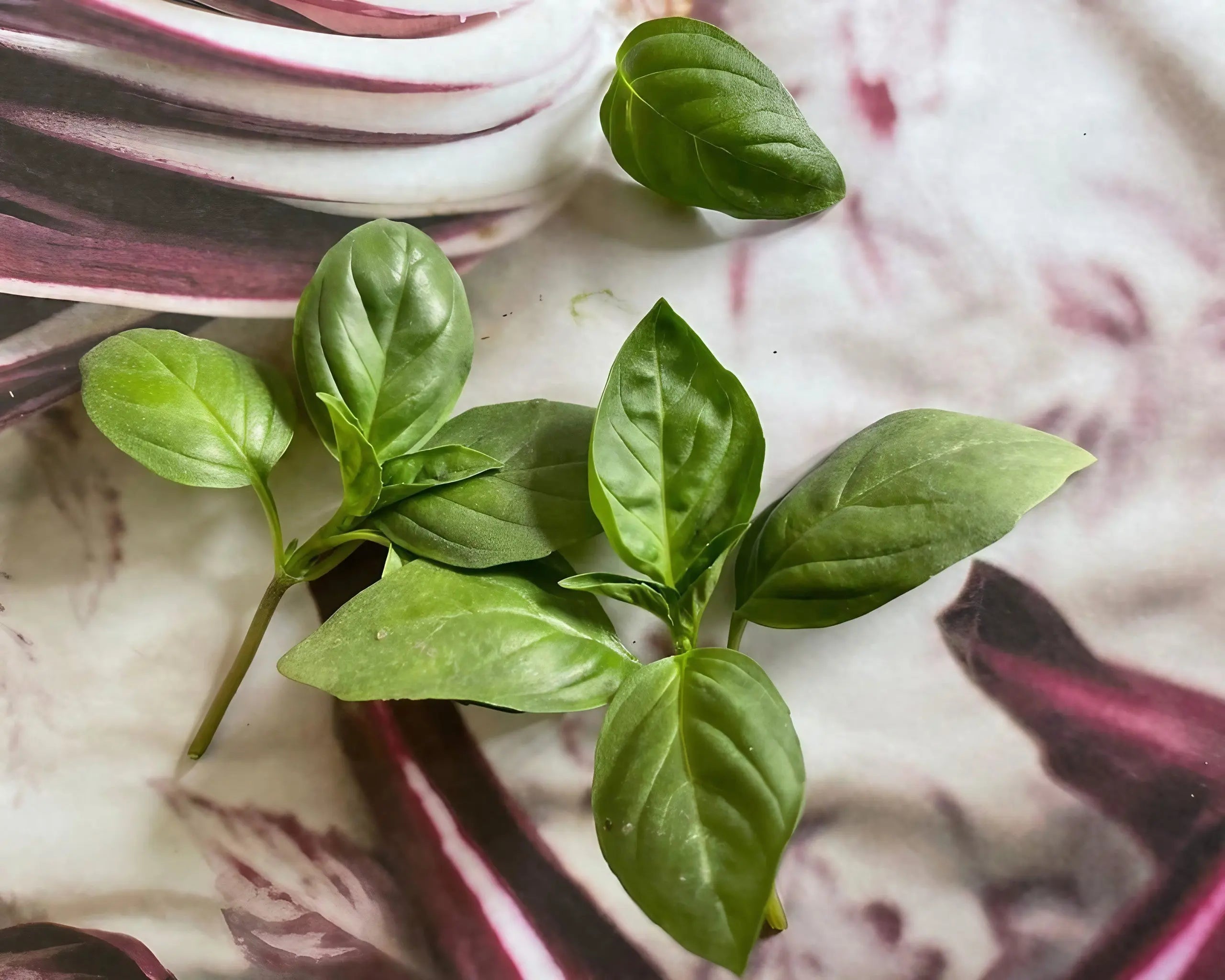
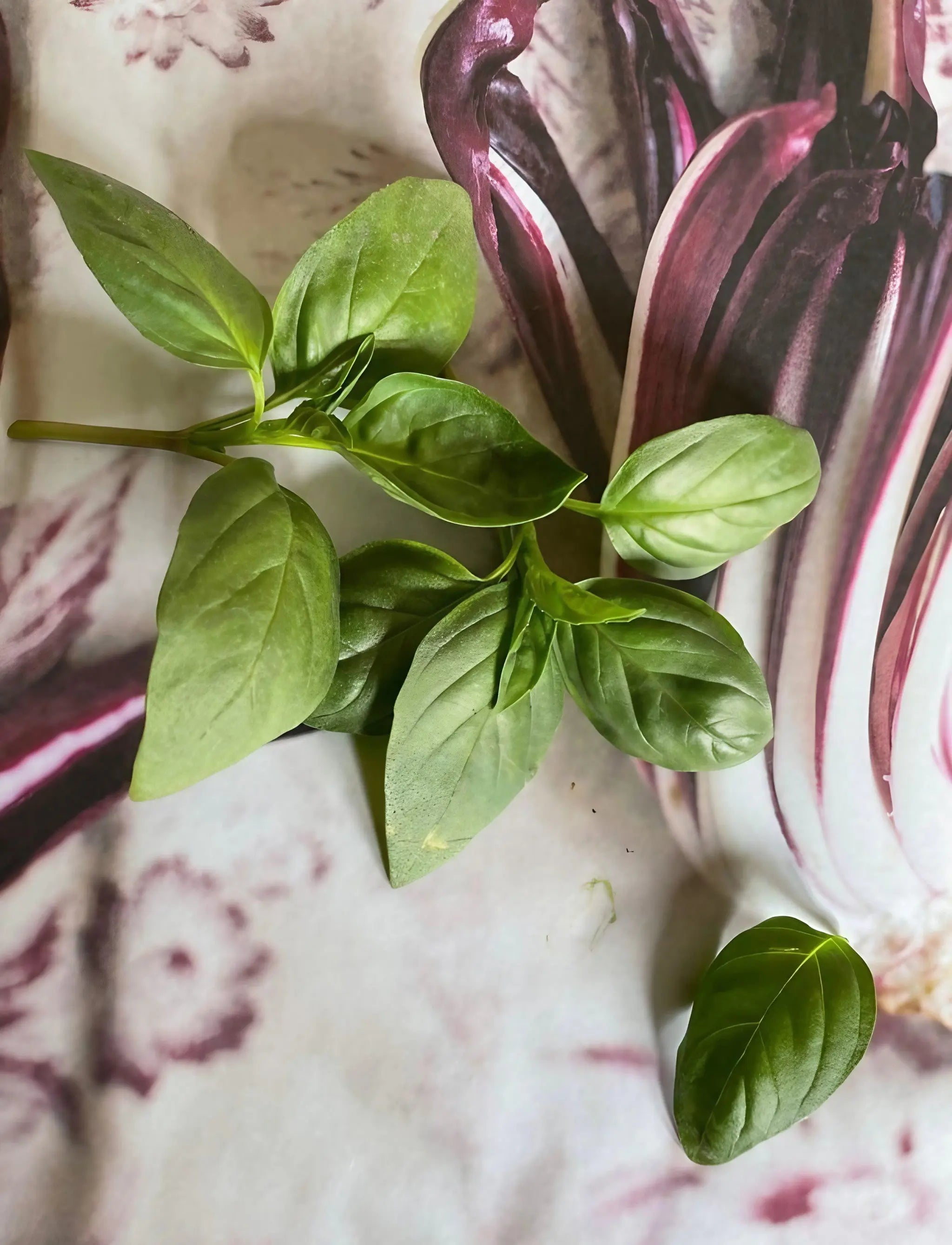
Thai Basil 'Siam Queen' Seeds
If you love Thai Green Curry or spicy stir-fries, standard Italian basil simply won't cut it—the flavour is all wrong and it turns bitter and black the moment it hits heat. You need 'Siam Queen'. This award-winning variety (All-America Selections 1997) offers an intensely aromatic flavour profile with bold notes of aniseed, liquorice, and clove that stand up beautifully to high-temperature cooking. Unlike Genovese basil (which must be added at the last second), Thai Basil can be stirred into bubbling curries at the start to infuse the coconut milk base with that authentic Southeast Asian complexity, then tossed in fresh at the end for a final aromatic punch!
But 'Siam Queen' isn't just about culinary excellence—it's an architectural beauty with genuine ornamental wow-factor! This improved cultivar grows into a sturdy, compact, bushy mound (50-60cm tall) with glossy olive-green leaves sprouting from dramatic purple-red stems. Late in the season, it produces absolutely spectacular dense spikes of deep lavender-purple flowers (8-12cm tall!) that rise above the foliage like regal crowns. The flower display is truly breathtaking—pollinators go absolutely wild for them! What makes 'Siam Queen' genuinely special is its slow-to-bolt nature: unlike most basils (where flowering ruins the flavour), 'Siam Queen' retains its delicious sweet-spicy anise flavour even when blooming, so you can enjoy BOTH the stunning ornamental display AND continue harvesting leaves throughout summer and into autumn. Spectacular in a pot on a sunny patio, productive enough for serious cooking, and beautiful enough to win horticultural awards!
Read More
🌿 Understanding the Plant
Thai Basil 'Siam Queen' is a Tender Annual (technically a tropical perennial in frost-free zones, but grown as an annual in temperate UK climate).
The Award-Winning Improvement:
'Siam Queen' isn't just any Thai Basil—it's a carefully selected and improved cultivar that won the prestigious All-America Selections (AAS) Award in 1997, recognising it as a breakthrough variety with superior performance compared to standard Thai basil. Here's what makes it special:
1. EXTRA-LARGE LEAVES: Nearly twice the size of standard Thai basil varieties (up to 10cm/4 inches long and 5cm/2 inches wide), making harvesting easier and yields dramatically higher. More leaf surface = more essential oils = more intense flavour!
2. LATE FLOWERING (Slow to Bolt): This is the game-changer! Standard basils bolt (flower) quickly in hot weather, and once they flower, the leaves become bitter and unpalatable. 'Siam Queen' has been bred for delayed flowering, meaning:
- Longer harvest window (weeks longer than standard varieties)
- Leaves stay sweet and aromatic even when flower buds appear
- Flavour DOESN'T deteriorate when flowering (unlike other basils!)
- You can enjoy BOTH ornamental flowers AND culinary harvests simultaneously
3. SPECTACULAR ORNAMENTAL VALUE: Dense, showy spikes of deep lavender-purple flowers (8-12cm long) rise dramatically above the foliage—genuinely stunning! The flower display rivals ornamental salvias for visual impact.
4. SUPERIOR VIGOUR & DISEASE RESISTANCE: Grows more vigorously than standard Thai basil, with stronger stems, bushier habit, and better resistance to common basil diseases like downy mildew.
5. INTENSE CLOVE-ANISE AROMA: Higher concentration of essential oils (particularly eugenol - the clove compound) gives 'Siam Queen' a more powerful, complex aroma than standard varieties.
This is HORAPA (Sweet Thai Basil):
Just like Thai Basil 'Large Leaf', 'Siam Queen' is the authentic Bai Horapa variety used in Southeast Asian cooking. It's one of THREE different basils used in Thai cuisine—and they're NOT interchangeable!
1. SWEET THAI BASIL (Horapa / Bai Horapa) - Ocimum basilicum var. thyrsiflora - THIS SEED:
- Cultivar: 'Siam Queen' - an improved selection with extra-large leaves and late flowering
- Leaves: Glossy, olive-green, large (up to 10cm), slightly serrated edges
- Stems: Purple-red, sturdy, square
- Flavour: Sweet anise/liquorice with STRONG clove notes
- Used in: Green curry, red curry, pho, spring rolls, Thai basil chicken, pad see ew
- Flowers: Dense spikes of deep lavender-purple (8-12cm tall)
- Thai name: Bai Horapa (โหระพา)
2. HOLY BASIL (Kaprao / Tulsi) - Ocimum tenuiflorum:
- Different species entirely!
- Dull green, hairy, heavily serrated leaves
- Peppery, clove-like, camphor flavour
- Used in Pad Kra Pao stir-fries and Indian Tulsi tea
3. LEMON BASIL (Maenglak) - Ocimum × citriodorum:
- Narrow, matte green leaves
- Lemony flavour with basil undertones
- Used in soups and seafood dishes
'Siam Queen' vs. 'Large Leaf' Thai Basil:
Both are excellent Sweet Thai Basil (Horapa) varieties, but they have different strengths:
'SIAM QUEEN' (This Variety):
- Best for: Ornamental value + culinary use combined
- Leaves: Extra-large (up to 10cm), glossy olive-green
- Growth: Compact, bushy (50-60cm tall)
- Flowering: LATE flowering (slow to bolt), spectacular dense purple spikes
- Flavour when flowering: RETAINED - stays delicious even while blooming!
- Ornamental impact: EXCEPTIONAL - grown as ornamental AND culinary
- Award status: All-America Selections Winner 1997
- Best feature: Can enjoy flowers AND harvest leaves simultaneously
'LARGE LEAF' (Alternative Variety):
- Best for: Maximum leaf production for cooking
- Leaves: Large (5-7cm), glossy green
- Growth: Very vigorous, productive (40-50cm tall)
- Flowering: Standard flowering speed
- Flavour when flowering: Good, but best before flowering
- Ornamental impact: Beautiful, but less dramatic than Siam Queen
- Best feature: Prolific leaf production, vigorous growth
CHOOSE SIAM QUEEN IF: You want a dual-purpose herb that looks spectacular in ornamental containers while providing culinary harvests; you appreciate extended harvest windows; you want to let some plants flower for pollinators without sacrificing flavour.
CHOOSE LARGE LEAF IF: You're growing primarily for maximum leaf yield in cooking; you want the most productive, vigorous plants; you'll be pinching off all flowers anyway.
The Distinctive Characteristics:
Like all Thai Basils, 'Siam Queen' differs dramatically from Italian basil:
- Leaf texture: Thicker, more robust, glossy olive-green (vs. soft matte green in Genovese)
- Leaf size: EXTRA-LARGE in 'Siam Queen' (up to 10cm long, 5cm wide!)
- Leaf shape: Narrow, lance-shaped with slightly serrated edges
- Stems: Purple-red to reddish-purple, square, very sturdy
- Flavour compounds: High in methyl chavicol (anise/liquorice) and eugenol (clove)
- Heat stability: Flavour holds beautifully under cooking (unlike Genovese)
- Flowers: Dense, dramatic spikes of deep lavender-purple (vs. small white flowers in Italian basil)
- Flower timing: LATE flowering in 'Siam Queen' (stays vegetative longer)
- Aroma: VERY strong, clove-like scent when leaves are crushed
Culinary Magic:
'Siam Queen' is genuinely different from Italian basil in the kitchen:
1. Cook It Early OR Late: Add leaves at the START of cooking to infuse curries and stir-fries, then add fresh leaves at serving for aromatic punch. Italian basil would turn to black mush if you tried this!
2. Flavour Under Heat: The anise-clove flavour compounds are heat-stable, so they actually develop and deepen when cooked rather than turning bitter.
3. "Vegetable" Quantities: In Southeast Asia, Thai Basil is used generously—handfuls, not pinches! Think of it more like a leafy herb vegetable than a mere garnish.
4. The Flowers Are Culinary Too: Those spectacular purple flower spikes? They're edible and delicious with an even more intense sweet-spicy flavour than the leaves! Use whole flower heads as garnish for curries, scatter individual florets over salads, or freeze them in ice cubes for cocktails.
The Visual Drama:
'Siam Queen' is genuinely ornamental—not just "pretty for a herb"!
- Compact, bushy mound (50-60cm tall, 40-50cm wide)
- Glossy olive-green leaves that catch and reflect light
- Dramatic purple-red stems creating striking colour contrast
- SPECTACULAR dense spikes of deep lavender-purple flowers (8-12cm tall!) rising above foliage
- Square stems (characteristic of mint family) with leaves arranged in opposite pairs
- Late-season bloom means the plant looks its best when other herbs are fading
- Flowers attract clouds of bees, butterflies, and hoverflies
Perfect for ornamental herb gardens, mixed borders, edible landscapes, or as a stunning focal point in large decorative pots!
🌱 Growing Guide
'Siam Queen' is genuinely easier to grow from seed than standard Thai basil—it was bred for vigorous growth and superior germination! It loves heat and thrives in UK summers and greenhouses when given warm, sunny conditions.
When to Sow:
Indoor Sowing (March to May): Sow indoors from early March through late May for outdoor planting. 'Siam Queen' germinates reliably and quickly when given warmth—one of the fastest-germinating basils!
Outdoor Sowing (Not Recommended in UK): Only possible in very warm microclimates during heatwave summers. Generally not successful.
Greenhouse/Polytunnel Sowing: Can be sown April-June directly into greenhouse beds once soil has warmed to 15°C+. This is ideal for 'Siam Queen' as it thrives in protected environments.
How to Sow:
Seeds need light to germinate! This is CRITICAL for success.
1. Fill small pots or module trays with sterile seed compost
2. Water thoroughly and let drain
3. Scatter seeds thinly on the surface (3-4 seeds per module)
4. Cover with the finest dusting of vermiculite (1-2mm maximum—seeds should still be visible through it)
5. Place in warm location (20-25°C)—heated propagator ideal
6. Keep compost consistently moist but not waterlogged
7. Germination: FAST! 3-7 days at optimal temperature (this is much quicker than standard Thai basil!)
8. Once seedlings emerge, provide very bright light and excellent air circulation
Seedling Care:
'Siam Queen' seedlings are notably vigorous compared to other basils:
- Damping-off prevention: Excellent air circulation essential, sterile compost, morning watering only
- Light requirements: Very bright light (south-facing windowsill or grow lights 12-14 hours daily)
- Temperature: Keep warm (15-20°C minimum at night, 20-25°C daytime)
- Thinning: Once seedlings have 2 true leaves, thin to one strong plant per module
- Feeding: Begin light feeding with diluted liquid fertilizer once first true leaves appear
- Early pinching: When seedlings reach 10-15cm and have 3 pairs of true leaves, pinch out the growing tip—this early pinching is KEY to 'Siam Queen's' compact, bushy habit!
The ESSENTIAL "Pinching" Technique:
This is absolutely CRITICAL for developing 'Siam Queen's' signature compact, bushy form! Without pinching, you'll get tall, leggy plants. With proper pinching, you'll get those gorgeous, mounded specimens covered in flowers!
First Pinch (EARLY!): When plants reach 10-15cm tall and have 3 pairs of true leaves, pinch out the very top growing tip—remove the top 2-3cm just above a pair of leaves. Do this EARLIER than you would with other basils!
Result: Within 7-10 days, two new growing tips emerge from the node below. You've just doubled your branches!
Second Pinch: When those two new growing tips reach 10-12cm, pinch them again. Now you have 4 growing tips!
Third Pinch: Repeat when new growth reaches 10cm. Now you have 8 growing tips!
Ongoing Maintenance: Continue pinching growing tips every 2-3 weeks until mid-summer. Each pinch creates more branches, more leaves, and ultimately MORE flower spikes!
When to STOP Pinching: Stop pinching in mid-July (for outdoor plants) or early August (for greenhouse plants) to allow the spectacular flower display to develop. Those dense purple flower spikes take 3-4 weeks to fully form from bud stage.
Planting Out (Outdoor Growing):
When to plant: ONLY after all frost risk has passed AND nighttime temperatures stay consistently above 10°C. In most of UK, this means late May to early June.
Hardening off: Gradually acclimatize plants over 10-14 days before planting out
Where to plant:
- Location: Hottest, sunniest spot in garden (south-facing wall ideal, 8-12 hours direct sun)
- Soil: Rich, fertile, well-drained soil. 'Siam Queen' appreciates nutrient-rich conditions
- Spacing: 25-30cm (10-12 inches) apart (they grow into substantial bushes!)
- Protection: Sheltered from strong wind (though stems are sturdier than standard Thai basil)
'Siam Queen' excels in greenhouses and polytunnels! The extra warmth and humidity promote vigorous growth and earlier, more abundant flowering.
Container Growing (HIGHLY Recommended!):
'Siam Queen' is SPECTACULAR in containers—arguably the best basil for ornamental pot displays!
Why containers showcase Siam Queen perfectly:
- Displays those dramatic purple flower spikes at eye level
- Can be positioned prominently on patios, porches, or by the kitchen door
- Easy to move to follow sun and maximize warmth
- Protection from unexpected cold snaps
- Creates stunning focal points in ornamental container gardens
- The purple stems and flowers look incredible in decorative pots
Container specifications:
- Minimum 30cm (12-inch) diameter for one plant; 45-50cm (18-20 inch) for 2-3 plants
- Use rich, nutrient-dense compost (loam-based John Innes No. 2 or enriched peat-free multipurpose)
- Excellent drainage essential (add 3-4cm gravel layer at bottom)
- Choose decorative pots that complement the purple stems and flowers!
- Glazed ceramic or terracotta both work well (terracotta provides better air circulation to roots)
Watering:
'Siam Queen' has slightly higher water needs than Genovese basil:
- Consistent moisture: Soil should stay evenly moist (not waterlogged, not bone-dry)
- More tolerant of moisture: Can handle slightly more water than Genovese without developing root issues
- ALWAYS water at base, never overhead! Wet foliage overnight = fungal diseases
- Timing: Water in morning only (never at night)
- Hot weather: May need daily watering, especially containers
- Humidity: Appreciates humidity (mist occasionally in very dry conditions, or group pots together)
Feeding:
'Siam Queen' benefits from regular feeding to support its vigorous growth and large leaves:
- Feed every 2 weeks during active growth (June-September)
- Use balanced liquid fertilizer (seaweed extract, fish emulsion, or general vegetable feed)
- Can tolerate slightly higher nitrogen levels to promote leafy growth (but don't overdo it!)
- When flower spikes begin forming, switch to tomato feed (higher potassium) for better flower development
- Yellowing leaves (despite adequate water) = needs more nitrogen
Harvesting:
When to start: Begin harvesting when plants are 20-25cm tall (usually 8-10 weeks from sowing)
How to harvest:
- Cut, don't tear: Use clean scissors or pruners to cut stems just above a leaf pair
- Harvest from the top: Always cut growing tips (this is simultaneous harvesting AND pinching!)
- Take 1/3 maximum: Never remove more than one-third of the plant at once
- Harvest regularly: Cut every 1-2 weeks to keep plants bushy and productive
- The BIG DECISION: Pinch off flower buds for maximum leaf production, OR allow flowers to develop for ornamental display (remember, 'Siam Queen' retains flavour when flowering!)
Best timing: Harvest in morning after dew dries but before heat of day (highest essential oil content)
Storage: Use fresh ideally (best flavour), or store stems in water like cut flowers (lasts 1 week), or freeze whole leaves in ice cube trays covered with water/oil
The Flowering Decision (Unique to 'Siam Queen'):
Unlike other basils where flowering ruins the plant, 'Siam Queen' gives you OPTIONS:
OPTION 1 - Maximum Leaf Production:
- Pinch out ALL flower buds as soon as they appear
- Continue harvesting leaves all summer
- Plants stay compact and bushy
- Maximum culinary harvest
OPTION 2 - Dual-Purpose (Recommended!):
- Allow 1-2 plants to flower fully for ornamental display
- Continue harvesting leaves from the SAME plants (flavour stays good!)
- Enjoy spectacular purple flower spikes AND culinary harvests
- Pollinators get massive nectar source
- Use the edible flowers in cooking too!
OPTION 3 - Full Ornamental Display:
- Stop pinching in mid-July
- Allow ALL flower spikes to develop
- Create stunning late-summer/autumn display
- Still harvest some leaves, just less prolifically
- Perfect for ornamental containers on patios
Pest & Disease Management:
'Siam Queen' has better disease resistance than standard Thai basil but can still face issues:
Common Pests:
- Aphids: Cluster on tender new growth and flower buds. Blast off with water spray or use companion planting
- Japanese beetles: Can defoliate plants. Hand-pick and drop in soapy water
- Slugs: Target young plants. Use copper tape, beer traps, or organic pellets
Common Diseases:
- Downy mildew: Grey fuzzy growth on leaf undersides. 'Siam Queen' is more resistant than standard varieties, but prevent with good air circulation and avoid overhead watering
- Fusarium wilt: Yellowing and wilting. No cure—remove and destroy affected plants
📏 Plant Specifications
| Common Name: | Thai Basil 'Siam Queen', Sweet Thai Basil, Bai Horapa, Anise Basil |
| Botanical Name: | Ocimum basilicum var. thyrsiflora 'Siam Queen' |
| Plant Type: | Tender Annual (tropical perennial in zones 10-11) |
| Height: | 50-60cm (20-24 inches) when properly pinched; can reach 75cm if allowed to flower naturally |
| Spread: | 40-50cm when regularly pinched to encourage bushiness |
| Leaf Size: | EXTRA-LARGE: 8-10cm (3-4 inches) long, 4-5cm (1.5-2 inches) wide (nearly twice the size of standard Thai basil!) |
| Leaf Colour: | Glossy olive-green (sometimes with subtle purple tinges on edges) |
| Stem Colour: | Purple-red to deep reddish-purple, square, very sturdy |
| Flavour Profile: | Intense sweet anise/liquorice with STRONG clove undertones and subtle spiciness |
| Flowers: | SPECTACULAR dense spikes of deep lavender-purple, 8-12cm long, highly ornamental (edible!) |
| Flowering Time: | LATE flowering (slow to bolt) - typically mid-summer to autumn (July-October) |
| Sunlight: | Full sun (minimum 8-12 hours daily for best growth and flowering) |
| Soil: | Rich, fertile, well-drained; pH 6.0-7.5 |
| Hardiness: | H1c (Very Tender - killed by frost; needs minimum 10°C to survive, 15°C to thrive) |
| Germination Time: | FAST! 3-7 days at 20-25°C (faster than standard Thai basil) |
| Germination Temperature: | Optimal 20-25°C (won't germinate reliably below 18°C) |
| Time to First Harvest: | 8-10 weeks from sowing (65-70 days to maturity) |
| Sowing Depth: | Surface sowing (barely cover with 1-2mm vermiculite - seeds need light!) |
| Spacing: | 25-30cm (10-12 inches) apart |
| Growth Habit: | Compact, bushy, upright mound (with proper pinching) |
| Disease Resistance: | IMPROVED resistance to downy mildew compared to standard Thai basil |
| Attracts: | Bees, butterflies, hoverflies (EXCEPTIONAL pollinator plant when flowering!) |
| Awards: | All-America Selections Winner 1997 |
| Best Uses: | Thai curries, pho, spring rolls, stir-fries, ornamental containers, edible landscapes, pollinator gardens |
| Seeds per Packet: | Approximately 100 seeds |
🎨 Perfect Garden Companions
'Siam Queen' thrives alongside other heat-loving plants, and its ornamental purple flowers make it perfect for creating stunning colour-coordinated container displays!
-
🌶️ Chillies (Thai Bird's Eye, 'Basket of Fire', Jalapeño) - The Spicy Power Couple
Thai Basil and chillies are THE classic culinary pairing—they're inseparable in Southeast Asian cooking AND they're perfect growing companions! Both are heat-loving tropicals that thrive in identical conditions: full sun (8-12 hours), warm temperatures (25-30°C optimal), rich well-drained soil, and consistent moisture. Culturally, they complement each other perfectly: both benefit from regular pinching to stay bushy and productive; both appreciate fortnightly liquid feeding; both can be grown in containers and brought indoors before frost. The visual combination is stunning—bright red or orange chillies against 'Siam Queen's' purple stems and lavender flowers! Plant chillies with 'Siam Queen' in large containers (minimum 45cm diameter): position one chilli plant in the centre with 2-3 'Siam Queen' plants around the edges. The chilli provides some light afternoon shade during extreme heat, while Thai Basil's aromatic oils may help confuse aphids and whitefly that target chillies. Indoor/greenhouse growers: create a complete "Thai Kitchen Garden" with chillies, 'Siam Queen', lemongrass, and coriander grouped together in matching decorative pots! -
🧡 Tagetes 'Burning Embers' - The Colour-Coordinated Pest Patrol
This pairing creates an absolutely STUNNING ornamental display while providing practical pest protection! Tagetes 'Burning Embers' features burnt-orange and burgundy flowers that perfectly complement 'Siam Queen's' purple stems and lavender flower spikes—it's a masterclass in colour coordination! Functionally, marigolds serve multiple purposes: (1) Their bright flowers attract hoverflies and ladybirds whose larvae devour aphids that might otherwise colonise Thai Basil's tender new growth. (2) Marigolds emit compounds from their roots that repel soil nematodes and other underground pests. (3) The combination of glossy olive-green basil + purple flowers + burnt-orange marigolds creates extraordinary visual impact—perfect for ornamental edible containers on patios or by front doors! (4) Both plants love full sun and warm conditions. (5) Tagetes blooms continuously all summer, providing constant pollinator attraction even before 'Siam Queen' flowers. Plant 3-5 'Burning Embers' marigolds around the edges of large pots (50cm diameter) containing 2-3 'Siam Queen' plants in the centre—they create a colourful, protective "living mulch" while the purple and orange colour scheme is genuinely spectacular! -
🌿 Coriander - The Fresh Herb Partnership
Thai Basil and coriander are essential partners in Southeast Asian cuisine—together they provide the complete fresh herb profile for Vietnamese, Thai, and Lao dishes! However, they have opposite temperature preferences: coriander prefers cooler conditions (15-20°C) and bolts quickly in heat, while 'Siam Queen' adores scorching sun (25-30°C) and thrives in conditions that would make coriander flower immediately! The solution? Strategic companion planting! Position coriander on the north or east side of 'Siam Queen' plants or containers, where the basil's foliage provides light afternoon shade. This keeps coriander several degrees cooler and significantly delays bolting. Alternatively, in greenhouses, plant coriander near the door (cooler spot) and 'Siam Queen' at the back (hottest position). Succession plant coriander every 3-4 weeks April-August for continuous harvests. Cultural tip: once coriander inevitably bolts, let it flower and set seed—those coriander seeds are essential for Thai curry pastes! Meanwhile, 'Siam Queen' keeps producing all summer and into autumn. -
🌾 Lemongrass - The Southeast Asian Ornamental Duo
For the ultimate ornamental edible display with authentic Southeast Asian flair, pair 'Siam Queen' with lemongrass! Both are tropical perennials (grown as annuals in UK), both essential to Thai cuisine, and the combination creates genuinely dramatic architectural interest! Lemongrass grows tall and grass-like (60-90cm) with elegant arching blades, while 'Siam Queen' stays compact and bushy (50-60cm) with those spectacular purple flower spikes rising above the foliage—the contrast in form, texture, and colour is stunning! Plant lemongrass at the back/center of large containers (minimum 50cm diameter) with 2-3 'Siam Queen' plants around the front and sides. Both love identical conditions: full sun (8-12 hours), heat (20-30°C), humidity, rich well-drained soil, and fortnightly feeding. Both can be brought indoors for winter (lemongrass in a cool conservatory, 'Siam Queen' on a sunny windowsill). Cultural requirements are perfectly matched, making them effortless companions. Add Thai chillies and coriander to create a complete "Thai Four Herbs" container garden that's both functional and museum-quality beautiful! Harvest lemongrass by cutting entire stems at soil level; harvest 'Siam Queen' by pinching growing tips regularly. -
🍅 Tomatoes - The Warm Greenhouse Trio
While not traditionally paired in Asian cuisine, tomatoes and 'Siam Queen' make excellent growing companions, particularly in greenhouses and polytunnels! Both are warm-season crops that thrive in protected environments with abundant warmth and consistent moisture. Growing 'Siam Queen' near tomatoes offers multiple benefits: (1) Thai Basil's strong anise-scented oils confuse whitefly and aphids—acting as a natural pest deterrent for both crops. (2) 'Siam Queen's' spectacular purple flower spikes attract beneficial insects including parasitic wasps and hoverflies whose larvae eat tomato pests. (3) Tomato plants provide some wind protection for Thai Basil (though 'Siam Queen' has sturdier stems than standard varieties). (4) In greenhouses, they create a mutually beneficial warm, humid microclimate. (5) The purple flowers against red tomatoes create stunning visual combinations! Plant 'Siam Queen' between tomato plants at 30cm spacing in greenhouse beds, or grow in pots placed amongst tomato grow bags. Both appreciate similar feeding schedules (balanced liquid fertilizer every 2 weeks, switching to tomato feed when flowering begins). Bonus culinary pairing: 'Siam Queen' is delicious with fresh tomatoes in fusion dishes combining Italian and Thai flavours!
💡 Ornamental Container Tip: Create a stunning "Purple & Orange Sunset" container by combining 'Siam Queen' (purple stems and lavender flowers) with Tagetes 'Burning Embers' (burnt-orange and burgundy flowers) and perhaps a trailing purple-leaved sweet potato vine around the edges. Position this container where you'll see it daily—on a patio, by the front door, or outside the kitchen window. It's genuinely beautiful enough to be purely ornamental, yet provides abundant culinary harvests all summer! Use a large decorative pot (minimum 50cm diameter), rich compost, and feed fortnightly with liquid fertilizer. The colour combination is spectacular!
📅 Sowing & Harvesting Calendar
| Activity | Jan | Feb | Mar | Apr | May | Jun | Jul | Aug | Sep | Oct | Nov | Dec |
|---|---|---|---|---|---|---|---|---|---|---|---|---|
| Sow Indoors | ✓ | ✓ | ✓ | |||||||||
| Plant Out | ✓ | ✓ | ||||||||||
| Harvest Leaves | ✓ | ✓ | ✓ | ✓ | ✓ | |||||||
| Flowering Period | 🌸 | 🌸 | 🌸 | 🌸 |
Note: The extended harvest period (June-October) includes the flowering months because 'Siam Queen' retains its flavour even when blooming—unique among basils!
⚠️ The 'Siam Queen' Advantage: Flavour During Flowering!
Unlike most basils (where flowering makes leaves bitter and inedible), 'Siam Queen' retains its delicious sweet-spicy anise flavour EVEN WHEN FLOWERING! This means you can enjoy BOTH spectacular ornamental purple flower spikes AND continue harvesting leaves for cooking—it's genuinely dual-purpose! Those dense lavender-purple flower spikes (8-12cm tall) are not only stunning but also 100% edible with an even more intense anise-clove flavour than the leaves. Use whole flower heads to garnish curries or salads, scatter individual florets over dishes, or freeze them in ice cubes for summer cocktails. 'Siam Queen' was specifically bred for this late-flowering, flavour-retaining trait—it's what won it the All-America Selections award!
🏆 All-America Selections Winner 1997
'Siam Queen' earned the prestigious All-America Selections (AAS) award for its exceptional combination of superior flavour, vigorous growth, late flowering, ornamental beauty, and disease resistance. This award recognises new varieties that demonstrate significant improvements over existing types through rigorous trials across North America. 'Siam Queen' outperformed all other Thai basil varieties for:
• Extra-large leaves (nearly twice the size)
• Delayed flowering (longer harvest window)
• Flavour retention when flowering
• Spectacular ornamental flower display
• Superior disease resistance
Nearly 30 years after winning, it remains the gold standard for Thai basil!
🐝 Pollinator Paradise!
Those spectacular dense spikes of deep lavender-purple flowers aren't just ornamental—they're exceptional pollinator magnets! Bees, butterflies, and hoverflies absolutely SWARM 'Siam Queen' when it's in full bloom. The long, tubular flowers are perfectly shaped for bee access and provide abundant nectar throughout late summer and autumn when many other flowers have faded. Consider growing some plants purely for ornamental/pollinator purposes (let them flower freely) while keeping others pinched back for maximum leaf production. You can have your flowers AND eat them too!
📖 Want more detailed growing advice?
View our Complete Growing Guides →
- Regular price
-
£1.95 - Regular price
-
- Sale price
-
£1.95
Couldn't load pickup availability


Basil Thai Siam Queen
- Regular price
-
£1.95 - Regular price
-
- Sale price
-
£1.95

