Chilli Open-pollinated

Bhutlah Red Chilli

One of the hottest chillies on earth - a brutal ghost pepper x Douglah superhot

£2.99approx. 10 seeds

A fearsome modern superhot - Bhut Jolokia crossed with 7 Pot Douglah to make something hotter than either parent. Said to rival the Carolina Reaper, with a complex fruity-earthy flavour beneath an overwhelming, instant heat. For experienced growers only.

Heat level 10/10
Extreme superhot
Scoville 1,500,000-2,000,000 SHU
Sowing months
JanFebMarAprMayJunJulAugSepOctNovDec
Harvest months
JanFebMarAprMayJunJulAugSepOctNovDec
Height
150-180cm
Spread
60-90cm
Spacing
60-70cm
Position
Full sun. Greenhouse essential in the UK. Frost-tender. Long season.
Soil
Rich, fertile, well-drained.

Handle with care — this is a superhot chilli

This variety is exceptionally hot. The capsaicin in superhot chillies can cause real discomfort and even burns to skin and eyes, so a few simple precautions make all the difference when handling the fresh or dried fruit:

  • Wear disposable gloves whenever you cut, deseed, or handle the fruit
  • Keep your hands well away from your eyes, nose, and face while working
  • Never touch contact lenses with hands that have handled the fruit
  • Work in a well-ventilated space — the fumes from cooking or drying can irritate the lungs and eyes
  • Wash hands, knives, and boards thoroughly with soapy water afterwards
  • Keep fresh and dried fruit well out of reach of children and pets

The plants themselves are perfectly safe to grow and handle — these precautions apply to the ripe fruit and its seeds.

About this variety

Capsicum chinense 'Bhutlah' (Red) One of the hottest chillies on earth — a brutal ghost-pepper × Douglah superhot

This is about as far up the heat scale as it is possible to go. The Bhutlah is a modern superhot of fearsome reputation, created by crossing two of the world's hottest chillies — the legendary Bhut Jolokia (ghost pepper) and the Trinidad 7 Pot Douglah — to produce something hotter than either parent. The red form is a true monster, widely said to rival the Carolina Reaper itself, with a heat that arrives almost instantly and lands with overwhelming, breathtaking force. This is not a chilli for the curious; it's a chilli for the dedicated, experienced superhot grower who knows exactly what they're taking on.

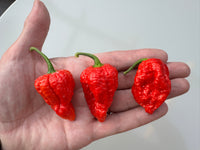
For all its ferocity, there is genuine flavour in there for those equipped to find it. The Bhutlah inherits the floral, fruity character of its ghost pepper parent and the deep, rich, Caribbean fruitiness of the Douglah, giving a complex, fruity-earthy flavour beneath the inferno — which is precisely why dedicated chilli-heads and hot-sauce makers prize it. The pods are large, gnarled, and heavily wrinkled, often with a pointed tail, ripening to a glossy deep red.

The plant matches the pods for vigour: a big, productive Capsicum chinense reaching 1.5m or more, capable of carrying a remarkable weight of fruit over a long season. Like all the superhots it's warmth-hungry and slow, needing the longest possible growing season, but for the experienced grower it's a hugely satisfying and genuinely impressive thing to bring to fruit — one of the ultimate badges of honour in any chilli collection.

A word of real respect is due here. This is among the hottest chillies on the planet, and it should be grown, handled, and used with genuine caution — please read the safety guidance shown at the top of this page before growing it.

A note on growing

Sow early — absolutely essential with an extreme superhot chinense. Sow indoors from January (or even late December if you can give the seedlings enough warmth and light) in a heated propagator at 28–30°C. Superhot seeds need genuine, constant warmth and are slow and erratic to germinate, often taking three to six weeks or more, so patience is everything — don't give up on a tray too soon.

Prick out into 9cm pots once the seedlings have two true leaves, and grow on at a minimum of 22°C with bright light. Pot on progressively to large final pots, keeping the plants warm through spring in a heated greenhouse or conservatory before moving to an unheated greenhouse or polytunnel from June. A long, warm season under cover is essential in the UK; this is emphatically not a chilli for an exposed outdoor bed.

Water consistently but never let the roots stand waterlogged, and feed weekly with a high-potash tomato food from the first flowers onwards. Pinch out the growing tip at around 25–30cm to build a strong, bushy, heavy-cropping plant, and support the branches as they become laden with fruit. Harvest from late summer through autumn once the pods are fully red, finishing the last of the crop indoors under a grow light if needed. Always wear gloves and eye protection when picking, handling, and processing the fruit, and take great care — full safety guidance is shown at the top of this page.

Where it shines

In the kitchen, the Bhutlah is strictly for the serious enthusiast and the experienced hot-sauce maker — and it should always be used in tiny, carefully measured amounts. Its fruity-earthy complexity makes it a favourite for intense extract-style hot sauces and for adding extreme heat with real depth of flavour. A mere fragment is enough to bring searing heat to a large pot, and the pods dry and grind into a ferocious powder to be used the merest pinch at a time, with great care. One plant produces far more heat than any household could reasonably use in a year.

In the garden, it's a genuine showpiece for the dedicated grower — a big, vigorous plant heavy with gnarled scarlet pods, and an unmistakable statement of chilli-growing credentials.

At a glance

  • Heat: extreme superhot, around 1,500,000–2,000,000 SHU — among the hottest on earth
  • Flavour: complex, fruity and earthy beneath an immediate, overwhelming heat
  • Parentage: Bhut Jolokia (ghost pepper) × 7 Pot Douglah
  • Plant: large, vigorous and very high-yielding, 1.5m+ — long-season, so sow early
  • Pods: large, gnarled and wrinkled, often pointed, ripening to deep red
  • Sow: January (or earlier), heated propagator at 28–30°C
  • Harvest: late summer to autumn, fully red
  • For experienced growers and cooks only — handle with real care

Plant alongside

Chillies do well with companions that draw in pollinators and help keep pests down. Plant alongside French Marigold 'Spanish Brocade' to deter aphids and whitefly, and Calendula 'Neon' to attract beneficial predators. Basil is a traditional greenhouse companion that enjoys the same warmth, and if you're assembling a collection of the world's hottest chillies, the Bhutlah sits among fierce company with our Bhut Jolokia, 7 Pot Infinity, 7 Pot Yellow, and Armageddon.